
The Story of Porters at the Shores of Kusamba Village
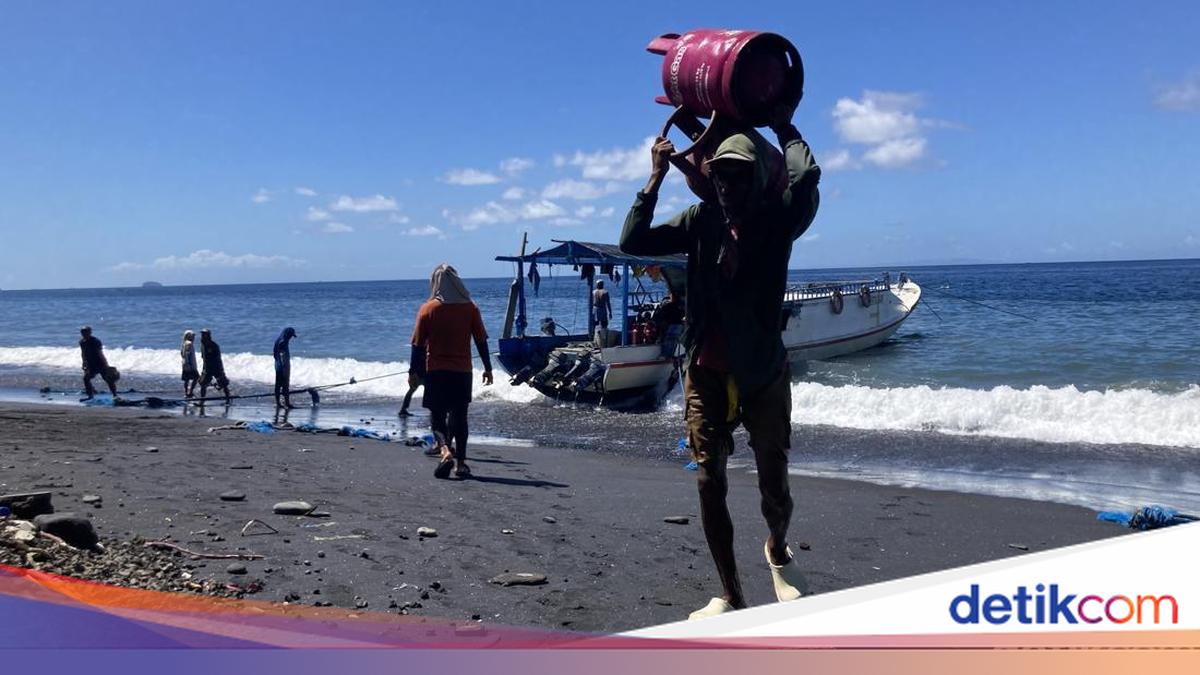
A cargo boat docks at the shore of Kusamba Village, Dawan Subdistrict, Klungkung, Bali. Dozens of bundles of timber, sacks of sand, gas cylinders, cement, glass, and various other goods destined for Nusa Penida Island are lined up along the beach.
Meanwhile, dozens of porters rush to load these goods onto the boat as soon as the anchor is dropped on the shore. One of the porters is Ardimas (42), a resident of Kusamba Village. Ardimas is the leader of the porter group at that coastal area.
“The term here is sekaa sorong sampan, meaning the group that pushes the sampan. In the past, when these goods were still transported by jukung boats, we had to push the sampan out to sea. Now we still push it, but not as far as pushing the jukung,” said Ardimas on Saturday (2/4/2026).
On clear weather days, the porters must toil under the scorching sun and occasionally battle the waves. They need to strengthen their shoulders to earn their wages each time a cargo boat docks at the shore.
Ardimas explained that the number of registered porters in the group is around 30 people. The porters are aged between 30 and 60 years. According to Ardimas, becoming a porter at that beach requires stronger shoulders than working on land, such as at markets or terminals.
“It’s not easy because when loading goods onto the boat, we are hit by waves. The weather is good right now. If not, it’s even harder. There have even been cases where boats got holed and sank,” he added.
Ardimas was reluctant to detail his income as a porter. He said the wages for loading goods are calculated on a piece-rate basis according to the type and quantity of goods to be transported. The amount depends on the volume of goods and the number of boats that arrive.
Goods such as timber, planks, tiles, bricks, gas cylinders, water gallons, and others are charged per unit. Meanwhile, sand and gravel are charged per cubic metre on a piece-rate payment system.
For example, if there are a hundred gas cylinders priced at Rp3,000 per cylinder, the boat owner will pay Rp300,000 for transporting a hundred gas cylinders.
The price is usually adjusted according to the level of difficulty and risk involved in transporting the goods. Services for transporting cement are priced at Rp5,000 per sack.
Ardimas then showed a scar on his hand. He recounted that the injury occurred while transporting a 2-square-metre sheet of glass.
“When we reached the edge of the beach, a big wave came. The glass in my hand shattered. My finger was nearly severed,” said Ardimas.
The daily income per person as a porter ranges from Rp250,000 to Rp300,000. According to Adi, this is earned under conditions of loading two to three boats. On the other hand, Ardimas and the porters in Kusamba Village cannot work if the weather is bad.
“Yesterday there was only one boat. Today is decent with two boats. If it’s one boat, we finish by 11 o’clock. If two boats, usually until 2 o’clock,” he explained.
The heaviness of the work as a beach porter means not many people can endure it. Ardimas revealed that some porters from markets or terminals who came to join mostly did not make it.
“During the busy season, we sometimes have to work until night. So we need extras. Once, 10 people came from a construction project. Only one lasted until receiving payment. Even then, he didn’t come back the next day,” said Ardimas.
Becoming a goods porter at the port requires many times more strength than transporting goods on land, such as at markets or terminals. The risk of goods falling while being loaded onto the boat is often borne by the porters.
“We must have a day off in a week. At least one day. Sometimes two days because of fatigue,” explained Ardimas.