
The Story of Moses Parting the Sea: What Scientific Research Reveals
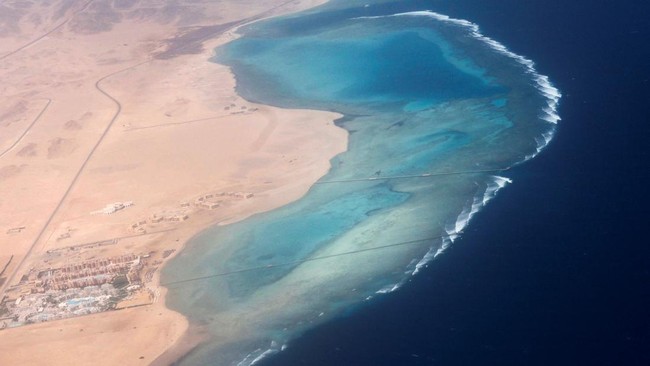
Jakarta, CNBC Indonesia - Several researchers are examining the scientific explanation behind the story of Moses parting the Red Sea as written in sacred texts. The study attempts to examine the event from a scientific perspective to understand how it could have happened.
Experts argue that there is a rational explanation for the event believed to have occurred 3,500 years ago. According to them, the event may have occurred due to certain natural factors without involving divine power.
The scientific explanation proposed by scientists is a combination of extreme weather and supporting geological conditions. These natural factors are considered to have made it possible for seawater to part at that time.
Computer modeling shows that strong winds of around 100 km/h from a certain direction could open a path as wide as 5 kilometers in shallow seas. Once the wind subsides, the water will return quickly like a tsunami, engulfing Pharaoh’s army in pursuit.
Carl Drews, an oceanographer from the National Center for Atmospheric Research, explained that this phenomenon is a combination of nature and timing.
According to the biblical story, after seven plagues in Egypt, Moses led the Israelites out towards the desert in search of the promised land.
However, they were trapped between Pharaoh’s pursuing army on one side and the vast Red Sea on the other.
After waiting overnight, Moses is said to have stretched out his hand until the sea parted, creating a dry path with walls of water on either side.
The event is believed to have occurred in the Gulf of Aqaba, one of the widest and deepest parts of the Red Sea.
This body of water is up to 25 km wide, has an average depth of 900 meters, and its deepest point is almost 1,850 meters.
Modern archaeological research shows a different location. If Moses did indeed cross part of the modern Red Sea, it is most likely that the event occurred in the Gulf of Suez.
This long and narrow body of water separates western Egypt from the Sinai Peninsula to the east. More importantly, the Gulf of Suez has an average depth of only 20-30 meters and a relatively flat bottom, making crossing more plausible.
As happened in 1789, Napoleon Bonaparte once led cavalry across part of the Gulf of Suez during low tide.
However, like Pharaoh’s army, Napoleon’s soldiers were almost swept away when a 3-meter high tide suddenly returned to fill the passage.
According to Dr. Bruce Parker, former chief scientist at the National Oceanic and Atmospheric Administration, Moses may have used his knowledge of tides to escape.
“Moses once lived in the desert around that area, he knew where caravans crossed during low tide. He also understood the night sky and ancient methods for predicting tides, based on the position of the moon and its full phase,” Parker said in an article in the Wall Street Journal.
Meanwhile, Pharaoh’s army, who were accustomed to the Nile River which does not have tides, did not know this danger - until they were finally trapped when the tide returned quickly.
For some scientists, the mention of strong winds is key to understanding how Moses crossed the Red Sea.
Professor Nathan Paldor, an oceanography expert from Hebrew University of Jerusalem, explained that when strong winds blow south from the head of the gulf for about a day, the water is pushed out to sea, so that what was previously submerged becomes exposed.
Professor Paldor’s calculations show that winds of 65-70 km/h from the northwest can open a path for the Israelites.
If such winds blew overnight, they could push the water back up to 1.6 km, lower the sea level by about 3 meters, and allow people to cross on an underwater ridge.
Although the scientific explanation sounds plausible, Drews stressed that as a Christian, he still believes that the story is full of miracles.
“For me personally, as a Lutheran, I have always believed that faith and science can go hand in hand. It is only right for a scientist to examine the natural aspects of this story,” he said.
Source: jawawa.id (https://jawawa.id/newsitem/the-story-of-moses-parting-the-sea-what-scientific-research-reveals-1780695790)
Originally published by CNBC Indonesia (https://www.cnbcindonesia.com/tech/20260517113700-37-735315/peristiwa-nabi-musa-membelah-laut-ini-hasil-kajian-menurut-sains), translated from Indonesian