
The Story of Jumaria, an Indonesian Hajj Icon: The Tears of a Farm Labourer at the Kaaba
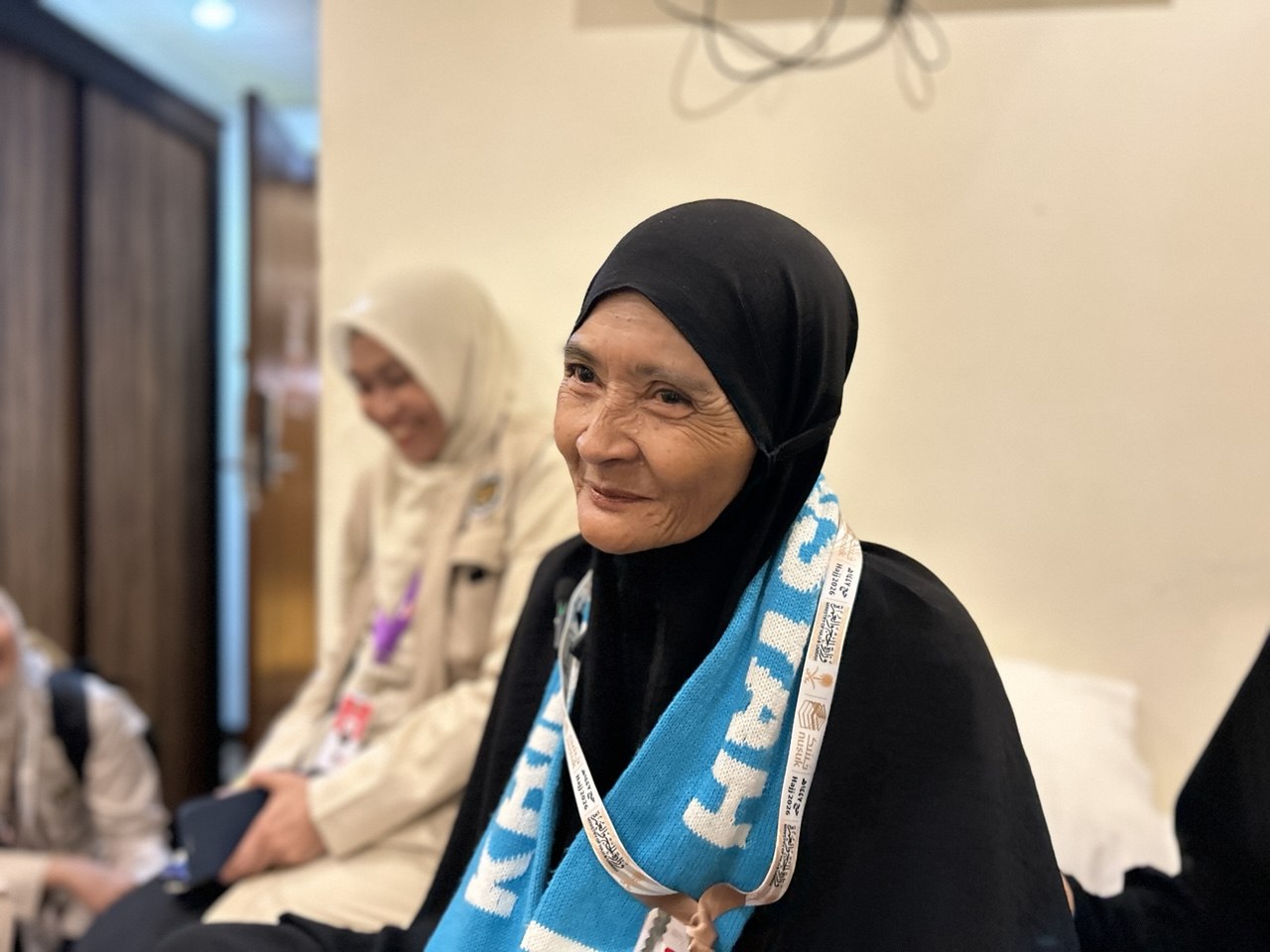
From a simple house in the remote Maros Regency, South Sulawesi, the name Jumaria is now echoing in the Holy Land as an inspiring icon for the 2026 Hajj season. This elderly woman has successfully crossed the boundaries of impossibility, saving for 20 years from her wages as a farm labourer in a bucket, until her face of determination now adorns international Hajj promotional screens in Saudi Arabia.
Jumaria has become the face of Indonesian pilgrims in Saudi Arabia. She went viral after the Saudi Arabian Immigration Authorities uploaded her story of performing Hajj on the @makkahroute social media channel. “I am happy to be able to see the Kaaba,” she whispered to the Hajj Media Centre team in the Jarwal area of Makkah, where she is staying. Her tears flowed again as she recalled that beautiful moment.
The hope she had held for decades to set foot in the Baitullah has finally been realised. The woman, whose age is somewhat uncertain but estimated to be in her 70s, has lived alone for decades. Daily, she makes a living tending to her own rice fields and the gardens of her neighbours. Jumaria’s activities begin at dawn; after the Subuh prayer, she feeds her chickens, cleans her house, and eats breakfast prepared from her own produce. Afterwards, she heads to the garden to tend to a neighbour’s cassava crops for modest wages.
Her steps then lead her to the rice fields located about 50 metres from her house to weed the paddy plants. She performs this strenuous labour independently every day. “I plant it myself, tend to it myself, harvest it myself. Previously I used a sickle, but now I am assisted by machinery,” she continued.
Despite living alone, Jumaria is acutely aware that the Creator always accompanies her steps. This belief strengthened her resolve to visit the House of God with all the means she possessed. Since two decades ago, she realised this resolve by starting to set aside money. “I collected the money little by little,” she said. “I kept it under the bed, in a bucket.”
After her savings in the bucket reached 25 million Rupiah in 2011, she decided to register for the Hajj, accompanied by her nephew. Her inability to read or write and her lack of formal schooling were not obstacles. After registering, she worked even harder to save the remaining costs for her departure. “If I earned 110,000 Rupiah, I would save 50,000,” said Jumaria while wiping tears with her headscarf.
Once her name was officially announced as one of the 2026 pilgrims, her spirit intensified. She consistently attended over 80 Hajj training sessions (manasik) with the Hajj and Umrah Guidance Group (KBIHU). The 15-kilometre distance from her home to the training location was never an excuse for her absence. Her discipline in sitting in the front row during briefings made her well-known to almost all KBIHU members.
Jumaria’s profile of perseverance eventually reached the Ministry of Hajj and Umrah. “The consideration was due to her daily life. She lives alone, solitary, and from a remote area, which is inspiring,” explained the Chairperson of the UPG 14 group, Sitti Hawaisyah.
Two days before her departure to the Hajj Dormitory, on 28 April, a documentation team visited her simple home. It took only four hours to record the series of events in Jumaria’s life. This short audiovisual recording was later transformed into an official documentary used as part of international promotional media by Saudi authorities to welcome the 2026 Hajj season.
Three days later, for the first time in her life, Jumaria experienced flying on an aeroplane to Madinah, the city where the tomb of the Prophet Muhammad (PBUH) is located. “At first I was nervous, wondering how I could fly, but eventually, I got used to it,” she said.
In Madinah, this elderly woman’s stamina was even more evident. She was able to remain in the Prophet’s Mosque from the Asr call to prayer until the completion of the Isha prayer. “I have also been to the Raudhah,” said Jumaria. As she does not possess a smartphone, her movement to the ‘Garden of Paradise’ was coordinated within her group.
She demonstrated this physical resilience again upon arriving in Makkah on Saturday (9/5). Jumaria immediately completed the obligatory and sunnah Umrah. Throughout the physically demanding religious processes, she did not complain of any illness. Now, Jumaria is preparing for the peak of the Hajj pilgrimage, the Wukuf at Arafat. In the expanse of the desert, she will kneel in surrender, bringing all the longings and prayers she has voiced from her small house for decades.