
The Story of Indonesia's 'Poorest Minister' Who Worked in a 'Wet Field'
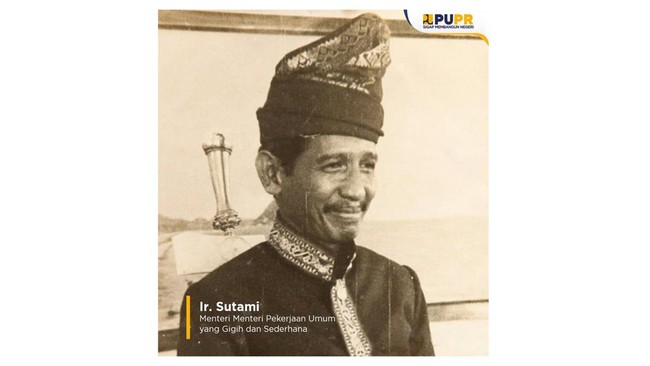
Behind the glamour of ministerial posts associated with state facilities, there was an official who chose to live far from luxury. He was Sutami, the Minister of Public Works and Public Housing (PUPR) during the New Order era, known as Indonesia’s ‘Poorest Minister’.
Sutami served for 14 years, from 1964 to 1978, spanning eight cabinet periods. Although he held control over a series of mega-projects, he consistently refused excessive state facilities. His reasoning was simple: he felt it was inappropriate for an official to live in luxury while many people still lived in misery.
Sutami’s expert staff member, Hendropranoto, in a testimony titled ‘Sutami: The Figure of Indonesia’s Development Man’ (1991), recounted that one such attitude was reflected in his habit of walking when visiting a region, particularly rural and remote areas.
He was willing to walk for kilometres because he did not want to inconvenience others. Moreover, walking was also chosen because it was more efficient and easier when inspecting various infrastructure projects.
By doing this, Sutami could ascertain the implementation of projects under his purview. Additionally, if there were problems, they could be resolved quickly.
For him, infrastructure development in rural and remote areas was more beneficial for ordinary people, rather than being focused on industrial and business interests.
In Tempo’s reporting on 22 November 1980, Sutami’s words and daily life were also steeped in humility. As an intellectual and professional in his field, the man born on 19 October 1928 was known to be simple and very close to the people.
Although he worked in a ‘wet field’, Sutami did not take state money at all. In fact, he did not even own a private home. He only acquired a house after stepping down as minister on 29 March 1978 due to illness. Even then, the house purchase was made through monthly instalments.
On this basis, he was nicknamed by many as the ‘Poorest Minister’. He did not mind the nickname.
After retiring, Sutami lived far from luxury. The house he was still paying off in instalments once had its electricity cut off because Sutami could not pay the bill. Then, when he was ill, Sutami was reluctant to go to hospital because he feared he could not pay the hospital bill.
It is known that Sutami suffered from chronic liver disease. The liver disease was attributed to a lack of nutritious food during his lifetime and exhaustion from frequently travelling on foot.
This tragic news was eventually heard by President Soeharto, who immediately asked Sutami to seek treatment without having to pay. However, Sutami ultimately lost his battle with the disease. On 13 November 1980, he passed away.
Although he is gone, Sutami’s works, which were far from sensational during his tenure, have been widely felt by the public to this day. A series of mega-projects built under his leadership include the Jagorawi toll road, Semanggi Bridge, Ampera Bridge, and others.