
The Smoke We Inherit
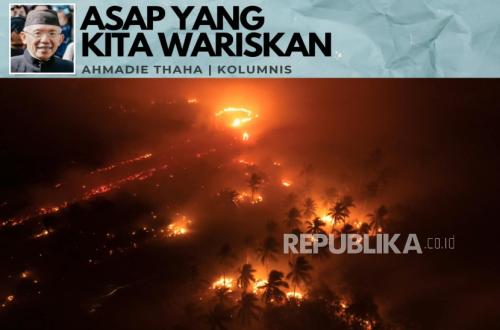
Sometimes disasters arrive with sirens. Sometimes they arrive silently, making us forget that we are even breathing. Forest and land fires (Karhutla) belong to the second type.
Fire is visible in the distance, but the true enemy enters through the nose, throat, lungs, bedrooms, classrooms, and eventually, hospitals.
A report from The Guardian on 21 September 2026 describes the increasingly serious situation of forest and land fires in Sumatra and Kalimantan. By the end of August, the Nusantara Atlas recorded approximately 895,657 hectares of land burned in Indonesia.
This figure is 34 per cent higher than the same period in 2019, partly due to El Niño. However, the total burned area does not fully capture the extent of the suffering. We can see the fire from a helicopter, but we inhale the smoke while eating our meals.
As of 9 September, the Ministry of Health recorded 113,336 cases of acute respiratory infections across 63 regencies/cities in seven affected provinces. On 1 September, the number was 50,891 cases. In just nine days, the figure more than doubled. Notably, 26,545 of these cases occurred in children aged 0–5 years.
This is the part often missing from fire statistics. We are busy counting hectares, while humans are counting breaths.
Forest fire smoke is not merely a haze that makes city photos look dramatic. It carries fine particulates and various pollutants that can disrupt the respiratory system. Therefore, when schools are closed, hospitals are filled with patients, children wear masks in classrooms, and parents keep doors and windows shut all day, we are actually witnessing a public health crisis, not just a forestry issue.
In Sampit, Central Kalimantan, air quality even reached an index of 1,142 on 10 September according to IQAir monitoring. For context, an index of 0–50 is categorised as healthy, while anything above 300 is considered dangerous.
If 1,142 feels like a number from another planet, that is precisely the problem. We have become too accustomed to small numbers in our daily lives that such high pollution levels sound like a mere telephone number. Yet, what is being measured is not a bank balance, but air quality.
Even more concerning is that some fires occur in peatlands. Drained peatlands can burn not only on the surface but also underground. Fire can move silently, resurfacing elsewhere and producing smoke for extended periods.
David Gaveau from Nusantara Atlas refers to such fires as a legacy of decades of forest degradation and peat drainage. Therefore, we must stop viewing every forest fire as an isolated incident. It is not simply about ‘a hotspot today’. There is a long history behind it: land clearing, peat drainage, changes in forest cover, concession management, burning practices, weak supervision, and then the arrival of the dry season.
El Niño plays a significant role in this narrative. This year, the conditions are described as ‘super El Niño’, which prolongs and intensifies the drought. On 7 September, the BMKG (Meteorology, Climatology, and Geophysical Agency) warned that September remains a critical phase for forest fires due to dry conditions, the influence of El Niño, and a high number of hotspots.
However, El Niño does not bring matches. This is the sentence we should remember. Weather can provide the fuel for the fire, but humans often provide the spark. Mark Parrington from Copernicus stated that El Niño strengthens fires that are already common during this season. Gaveau put it more sharply: El Niño is the enabler, while the ‘match’ is human.
Thus, blaming El Niño alone is akin to blaming the wind for a house fire. The wind may make the fire grow, but we must still ask: who struck the match, who left the petrol exposed, and who has spent years building a house on a pile of straw?
The impact does not stop at Indonesia’s administrative borders. Smoke moves with the wind, becoming transboundary haze. Malaysia, Singapore, Brunei, and even parts of the Philippines feel the impact. In Kuching, air quality repeatedly reached unhealthy to dangerous categories. This means smoke knows no passport; it does not ask if someone is Indonesian, Malaysian, or Singaporean before entering their lungs.
This is where forest fires transform into an issue of environmental diplomacy. Neighbouring countries may send aid, such as Malaysia and Japan offering or sending aerial firefighting capabilities. However, international cooperation must not become an annual habit: Indonesia burns, neighbours cough, and everyone meets only after the smoke has thickened.
The government has indeed taken action. The police are handling arson cases, and the government has deployed aircraft, helicopters, drones, and military personnel, while international assistance continues to arrive.