
The Sixth Challenge to the Regional Election Threshold
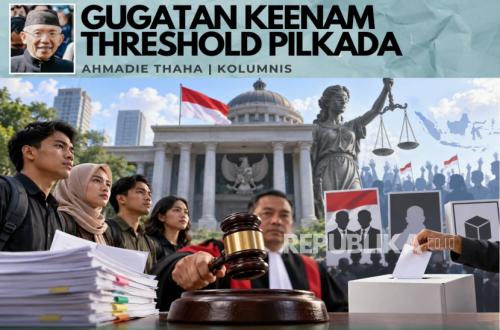
By Ahmadie Thaha, Columnist
JAKARTA — This is perhaps a scene that could only emerge from a democracy that habitually argues with itself. A clause of a law is created to regulate who may stand as a candidate for regional head. That clause is then challenged again and again.
First, the Constitutional Court amended it. After it was amended, the clause was challenged once more, and the Court rejected the petition. Most recently, the same clause returned to the Constitutional Court building, brought by four citizens with legal backgrounds.
If democracy were imagined as a house, Article 40 paragraph (1) of the Regional Election Law is like a doorway that is never finished being debated. There is endless discussion over who may enter, how many people are allowed through, and whether the gatekeeper has the right to impose too many requirements.
Last week, the Constitutional Court registered Case Number 331/PUU-XXIV/2026. The four petitioners — Muhamad Riziq Maulana, Halim Rahmansah, Restu Putri Nilakandi, and Kanda Nilam Mustika — are asking that the nomination threshold for regional heads via political parties be abolished. The case is now in the preliminary examination stage.
Tracing the cases that have made Article 40 paragraph (1) of the Regional Election Law their principal object, this Petition 331 is the sixth wave since 2019. The starting point was Case 50/PUU-XVII/2019, which was ultimately withdrawn by the petitioner.
It was followed by Case 51/PUU-XVII/2019, which the Court declared inadmissible on grounds of legal standing. That means the Court never got to examine the substance of the threshold itself.
The most important turning point came in Case 60/PUU-XXII/2024, filed by the Labour Party and the Gelora Party. The Court granted part of the petition, lowering the nomination threshold based on the percentage of valid votes and the permanent voter list — ranging between 6.5 and 10 per cent.
This ruling opened the way for political parties without seats in regional legislatures to nominate candidate pairs. The door to candidacy grew wider. However, the scrutiny did not stop there. Case 120/PUU-XXII/2024 was filed before eventually being withdrawn.
Subsequently, in Case 90/PUU-XXIII/2025, eight students asked that the threshold be abolished entirely. The Court rejected the petition on 13 November 2025, affirming that minimum support requirements do not contravene popular sovereignty.
Now, in Case 331/PUU-XXIV/2026, the arguments presented have shifted to empirical grounds. The petitioners point to the reality of the 2024 regional elections, in which 235 regions (around 43.1 per cent) were contested by only one or two candidate pairs.
Indeed, the number of regions with a single candidate fell only slightly, from 41 to 37 regions — even though the threshold had already been cut by Ruling 60/2024. The petitioners argue that this threshold is the source of the problem and must be abolished.
Herein lies a fundamental paradox. The Constitutional Court did lower the barrier, yet the competition field remained largely empty. The trouble is that slashing the nomination percentage requirement did not automatically prompt political parties to field their own cadres in greater numbers.