
The Sewing Machine That Stitched the Red and White Flag, Still Preserved at Fatmawati's House in Bengkulu
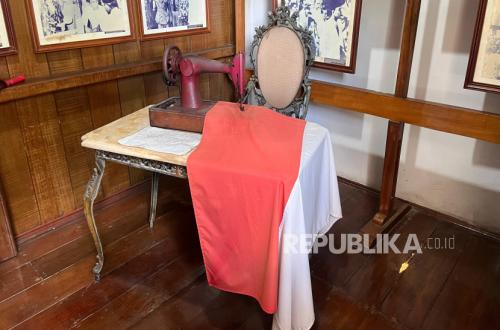
An old red sewing machine is neatly stored in one of the rooms of Rumah Fatmawati on Jalan Fatmawati, Bengkulu City. The historic sewing machine is the most valuable collection in the museum, which was once the birthplace of the first First Lady of the Republic of Indonesia. It is not merely an antique object. From this simple tool, Fatmawati stitched the red and white fabric that became the Sacred Red and White Flag, which flew during the Proclamation of Indonesian Independence on 17 August 1945. Despite being decades old, the sewing machine remains well-preserved. Its presence is a major attraction for visitors tracing Fatmawati’s struggle and the nation’s history.
Marwan Amanadin, Fatmawati’s younger cousin and the manager of Rumah Fatmawati, confirmed that the sewing machine on display is the original one used by Fatmawati to sew the Heritage Flag. “The flag was actually sewn on this machine in Jakarta. But because this place was turned into a museum, it was brought here. It is the original machine, the genuine one,” Marwan said. Fatmawati’s sewing skills, learned during her teenage years, became a vital part of the nation’s history when she was entrusted to sew the Sacred Red and White Flag. According to Marwan, the sewing machine was moved from Jakarta to Bengkulu after Fatmawati’s birthplace was designated a museum in the 1990s, so the public could see the historic relic linked to the independence struggle firsthand.
Besides the sewing machine, the renovated house museum holds several other historic collections. Photographs chronicling Fatmawati’s life are displayed throughout the rooms. Visitors can also view many photos of Fatmawati with Bung Karno and original clothing she once wore. The family’s bed frame has also been retained as part of the museum collection. “As for the bed, only the frame is original; the mattress is no longer the original one,” he noted. Marwan explained that Fatmawati was born in the house in 1923 and lived there until marrying Bung Karno in 1943. After the marriage, Fatmawati followed Bung Karno to Jakarta, and the house was later occupied by other family members before finally becoming a museum. “Fatmawati was born in this house in 1923. Then in the 90s, the house was renovated into a museum like this,” he said. He also revealed that the local government renovated the house in the 1990s, transforming it into a historical museum while preserving the building’s original form so the public could see traces of Fatmawati’s early life. “The building’s wood uses red meranti. Everything is still original, just renovated,” he added.
Marwan also recounted how Fatmawati first met Bung Karno when the Dutch colonial government exiled the Proclamator to Bengkulu in 1938. At that time, Bung Karno lived with Inggit Garnasih during his exile. Although far from the centre of the national movement, Bung Karno remained active in teaching, organising, and interacting with the local community. Through these activities, the relationship between Bung Karno and Fatmawati grew closer until they married in 1943. “Their meeting began when Bung Karno was in exile in Bengkulu. From that introduction, a relationship grew that eventually led them to marriage,” he said. The story of their meeting is an important part of Bengkulu’s history, as the household journey of Bung Karno and Fatmawati began in this city. Besides being known as the companion of Indonesia’s first president, Fatmawati is also remembered as a humble figure close to the people. Marwan said Fatmawati never kept her distance from residents, even after becoming a national figure. “Fatmawati was a good person and not arrogant. She was very down-to-earth and easy to get along with anyone,” he said.
Sofyan Setyo Darmawan, a member of Commission A of the Yogyakarta Special Region Legislative Council (DPRD DIY) who visited Rumah Fatmawati, assessed that historical relics like the sewing machine are important for introducing the founders’ struggle to the younger generation. “Alhamdulillah, I think we are getting to know the history of our nation’s struggle better. The figure of Mrs Fatmawati, who from her teenage years was an activist with high social awareness and a concern for independence,” Sofyan said. He noted that Fatmawati’s life story is an inspiration, showing that a spirit of struggle and care for the nation can grow from a young age. He hopes that through the various collections and stories preserved in the museum, visitors can trace Fatmawati’s journey, from her youth in Bengkulu and her meeting with Bung Karno to her contribution to the historic birth of the Indonesian nation.
Source: jawawa.id (https://jawawa.id/newsitem/the-sewing-machine-that-stitched-the-red-and-white-flag-still-preserved-at-fatmawatis-house-in-bengkulu-1781599943)
Originally published by Republika (https://rejogja.republika.co.id/berita/tgpr4k291/melihat-mesin-jahit-bendera-merah-putih-yang-masih-tersimpan-di-rumah-fatmawati-bengkulu), translated from Indonesian