
The Secret of China's Man-Made Forests: Greening 66 Percent Faster
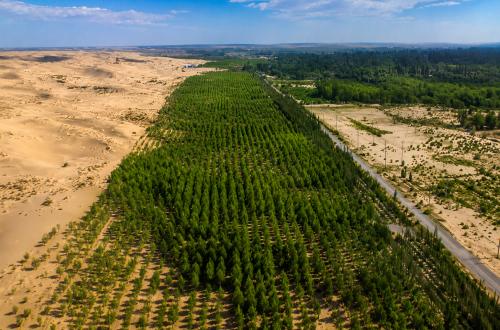
A recent study has found that China’s massive afforestation programme has resulted in planted forests increasing their leaf area 65.8 percent faster than natural forests, highlighting Beijing’s ability to accelerate vegetation cover through species selection, intensive management, and forestry technology. The research, led by Yuhang Luo from Peking University’s Shenzhen Graduate School and published in Geophysical Research Letters, used satellite data, machine learning modelling, and environmental condition matching to compare planted and naturally regenerated forests.
However, the headline figure requires careful interpretation. The 65.8 percent increase refers specifically to the leaf area index (LAI), a measure of canopy density and photosynthetic capacity, and does not mean that stem volume or carbon stocks are growing at the same rate. When the researchers adjusted for tree age and growing conditions, the growth advantage of planted forests shrank dramatically to approximately 4.6 percent. This indicates that the large initial difference is primarily because China’s planted forests are, on average, much younger than natural ones, and young trees naturally accumulate leaf area faster than mature stands.
The findings correct the narrative that planted forests are inherently more ecologically productive. While LAI is an important indicator, it does not capture the full carbon stored in trunks, roots, dead wood, and soil. Planted forests achieve faster early growth because humans control nearly every aspect of their establishment, selecting fast-growing species like eucalyptus and poplar, managing spacing, applying fertiliser, and controlling pests and competing vegetation. This reduces competition for light, water, and nutrients, allowing the trees to respond more rapidly to rising atmospheric carbon dioxide levels.
Yet this advantage is not permanent. The study found that the enhanced growth response of planted forests to carbon dioxide peaks when the trees are around 30 to 40 years old, after which the benefit declines markedly. In contrast, natural forests grow more slowly but develop more complex structures, including diverse species, microorganisms, root systems, and soil layers, making them more stable for long-term carbon storage and biodiversity support. A separate 2025 study in Communications Earth & Environment found that, at comparable ages, naturally regenerated young forests in China actually have a higher rate of above-ground carbon accumulation than young plantations, and projected that plantation carbon stocks could fall below those of natural forests by 2060.
Source: jawawa.id (https://jawawa.id/newsitem/the-secret-of-chinas-man-made-forests-greening-66-percent-faster-1785289966)
Originally published by Republika (https://news.republika.co.id/berita/tiws2b451/rahasia-hutan-buatan-china-menghijau-66-persen-lebih-cepat), translated from Indonesian