
The Secret Behind Türkiye’s Altay Tank Engine: Blocked by Germany, Rescued by South Korea
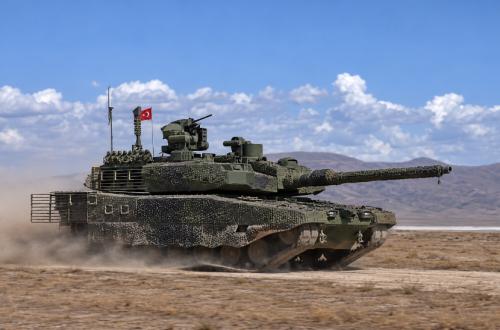
JAKARTA — Competition between Türkiye and South Korea in armoured combat vehicle technology has entered a new phase after Poland received more K2 Black Panther tanks in October 2026. While South Korea is expanding its exports of combat vehicles to Europe, Türkiye is accelerating production of its Altay tank, whose engine and transmission are made in South Korea.
The revelation highlights the close technological links between two modern main battle tanks developed by different countries. Although the Altay was developed as a symbol of Türkiye’s defence-industrial independence, the powertrain in its early production vehicles still relies on the South Korean-made DV27K diesel engine and EST15K transmission.
The latest development came on 28 October 2026, when Poland’s Armaments Agency explained the operational status of its K2 Black Panther fleet. The agency rejected suggestions that dozens of tanks had suffered serious damage, saying only a few vehicles were undergoing repairs and routine maintenance.
According to Defence24, fewer than five per cent of Poland’s fleet of more than 200 K2s were undergoing maintenance and repairs. The statement also highlighted the South Korean tank’s operational progress in Europe, following the announcement of an additional delivery on 20 October 2026.
Meanwhile, Altay manufacturer BMC is targeting cumulative deliveries of 14 tanks to the Turkish Army by the end of 2026. The target is part of a 250-vehicle production contract that continues to face challenges in developing a domestically produced powertrain.
The comparison between the two tanks is notable because their technological ties extend beyond the use of an engine. South Korea’s Hyundai Rotem has provided engineering support to Türkiye’s defence industry since the early stages of the Altay’s development.
The Altay uses a South Korean engine
The Turkish-built Altay uses a 1,500-horsepower DV27K diesel engine. The engine is made by South Korea’s HD Hyundai Infracore and was developed to power heavy armoured combat vehicles.
The DV27K has a 12-cylinder configuration, twin turbochargers and a cooling system designed for heavy military vehicles. Its power is delivered through the EST15K automatic transmission, made by South Korean defence company SNT Dynamics.
The engine and transmission together are known as a powerpack. This is one of a tank’s most important components, determining its power output, manoeuvrability and mobility, as well as its ability to operate across different terrain.
A Janes report on Altay testing in 2026 confirmed that the initial Altay T1 production vehicles use a South Korean powerpack. The configuration pairs the DV27K engine with the EST15K transmission after plans to use German components could not proceed.
The use of South Korean components does not mean that all Altay technology comes from South Korea. Türkiye has developed a number of domestic systems, including fire-control equipment, electronics, vehicle protection and weapons integration.
However, engines and transmissions are among the most complex components to develop for a modern main battle tank. Reliance on foreign suppliers for both systems remains a major challenge in Türkiye’s drive for defence-industrial self-sufficiency.
Technology cooperation began in 2008
The Altay’s links with the K2 Black Panther date back nearly two decades. In 2008, Turkish company Otokar entered into a partnership with Hyundai Rotem to obtain technical and engineering support for the development of Türkiye’s national tank.
Under the arrangement, Otokar was responsible for the vehicle’s design, prototyping, testing and qualification. Hyundai Rotem provided technical assistance in several areas, as well as support with certain components sourced from South Korean industry.
The Altay’s development also involved Turkish defence companies, including Aselsan, which worked on electronics and fire-control systems. Roketsan contributed to the development of armour protection, while MKE was involved in producing the main gun system.
The partnership helped Türkiye establish a technological foundation for building a modern main battle tank. However, the Altay should not be viewed as a vehicle whose components are all identical to those of the K2: the two tanks were developed with different configurations, dimensions and operational requirements.
The Altay is designed for a crew of four, while the K2 Black Panther uses three personnel thanks to its automatic ammunition-loading system. This difference affects the crew compartment’s design, the vehicle’s weight and its operating requirements.
The Altay programme continued with prototype testing over several years. After completing the qualification stages, the Turkish government signed a mass-production contract with BMC in November 2018.
The contract covers the procurement of 250 tanks for the Turkish Armed Forces. However, production encountered major obstacles when supplies of the engines and transmissions originally planned for the programme could not go ahead.
Source: jawawa.id (https://jawawa.id/newsitem/the-secret-behind-turkiyes-altay-tank-engine-blocked-by-germany-rescued-by-south-korea-1793947875)
Originally published by Republika (https://news.republika.co.id/berita/to29t5451/rahasia-mesin-tank-altay-turki-diblokir-jerman-diselamatkan-korea-selatan), translated from Indonesian