
The Sashes That Must Be Earned
The measure of Cak and Ning 2026’s success will not be how long the public remembers their coronation night, but how much benefit people feel from their work.
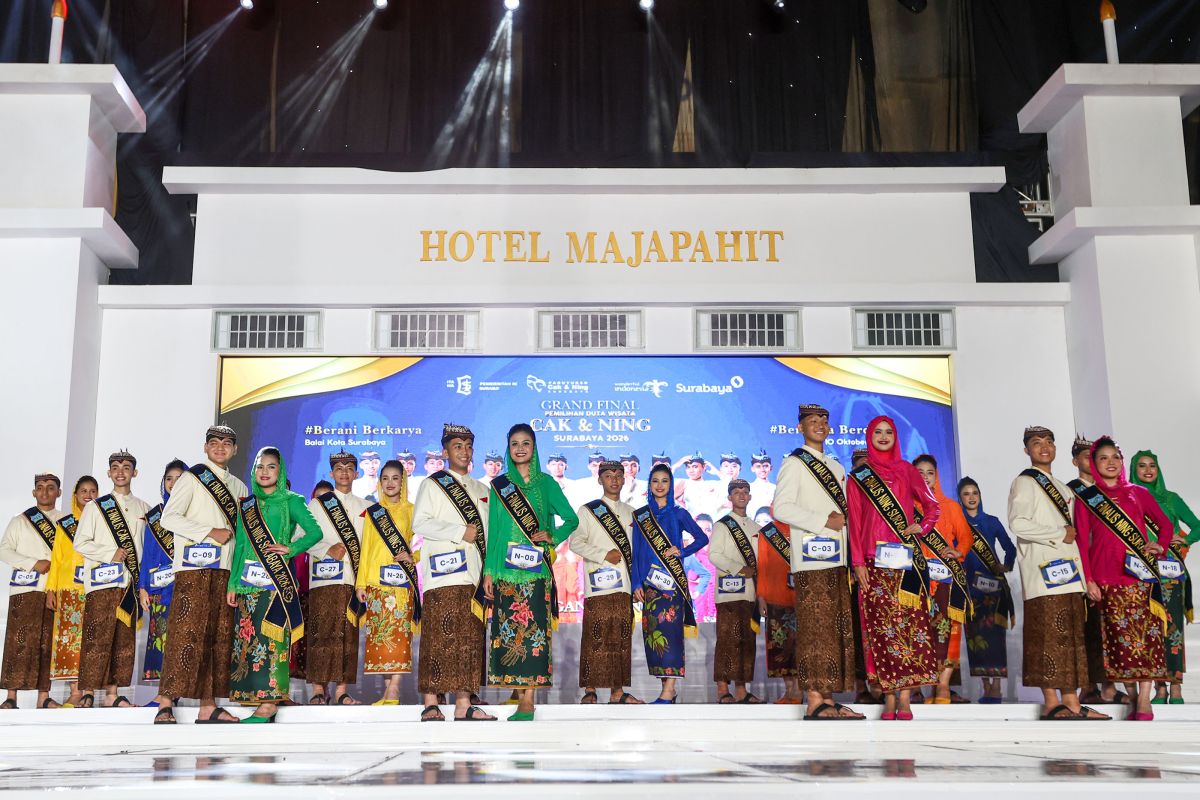
Surabaya (ANTARA) – The grand final of Cak and Ning Surabaya 2026 at Surabaya City Hall on Saturday (10 October) was more than a stage for deciding who was most deserving of wearing a tourism ambassador’s sash.
Before the judges, the finalists presented something more important than their appearance: ideas about the city’s future. These ranged from preserving cultural heritage and tourist destinations to digitalisation, waste management, tackling stunting and strengthening the value of mutual cooperation.
Fifteen finalists put forward their ideas in a competition themed Adhigana Manggala, which promotes the spirit of daring to create and becoming stronger together. Cak Aldo from Tegalsari district and Ning Rara from Gubeng district were selected as Cak and Ning Surabaya 2026.
They now have a responsibility to show that the title of tourism ambassador can serve as a gateway to making a broader contribution to society.
The range of ideas highlights Surabaya’s young people’s potential to engage with public issues. The challenge is to ensure that ideas presented on stage do not remain impressive answers for the judges, but develop into programmes that address residents’ needs.
This is where the relevance of Cak and Ning extends beyond tourism. The event can be a space for developing young people’s leadership, particularly as Indonesia prepares its human resources for Golden Indonesia 2045.
Success cannot be measured solely by the quality of the event or the winners’ popularity, but by the changes they bring about after the spotlights have faded.
Indonesia has a substantial demographic asset for building future leadership.
According to a publication by Statistics Indonesia (BPS), the number of Indonesians aged 16–30 was estimated at 66.83 million in 2025. This large population is an opportunity, but it does not automatically give Indonesia an edge in global competition.
The National Development Planning Agency (Bappenas) identifies improving the quality of young people as an important factor in achieving the Golden Indonesia 2045 vision. Education, health and productivity need to advance together so that young people can drive development rather than simply constitute a productive-age group in population statistics.
Leadership, however, does not develop through formal education or public-speaking skills alone. It also takes shape through experience in solving problems, working with people who hold different views, understanding the needs of vulnerable groups and being accountable for decisions.
Data from the Youth Development Index (IPP), published by the Ministry of Youth and Sports, show that the index rose from 48.67 in 2015 to 58.33 in 2024. Although this exceeded the 2020–2024 National Medium-Term Development Plan (RPJMN) target of 57.67, its average increase over the decade was no more than one point a year.
The Youth Development Index (IPP), published by the Ministry of Youth and Sports, shows that the index rose from 62.88 in 2024 to 65.78 in 2025, exceeding the national target of 65.16. However, participation and leadership remain among the main challenges in youth development.
The Ministry of Youth and Sports also includes participation and leadership as one of the domains used to assess youth development.
These figures are a reminder that developing the younger generation is a long-term undertaking. Individual achievements deserve recognition, but improving the quality of young people more broadly requires access to education, training, decent work, opportunities to join organisations and space to influence decision-making.
In this context, Cak and Ning Surabaya occupy an interesting position. They can connect young people’s knowledge with the needs of the community. They also have the opportunity to introduce Surabaya’s history, culture and economic potential through communication that resonates with their peers.