
The Riyal Has Not Weakened in 40 Years: What Is the Secret to Saudi Arabia Taming the Dollar?
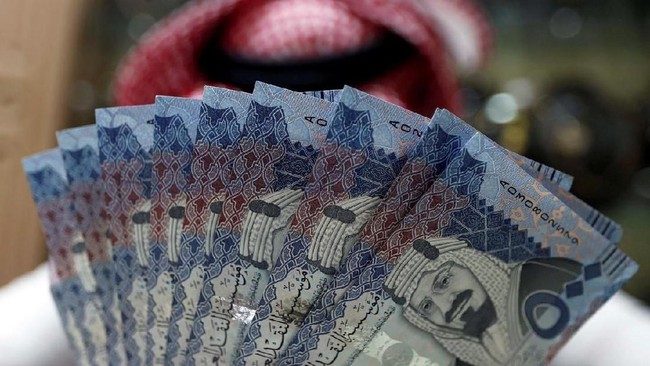
The Saudi riyal has become one of the world’s most stable currencies against the US dollar. While many global currencies fluctuate against the greenback, the riyal has remained almost unchanged for nearly four decades. According to Refinitiv data, from 1987 through to projections for 2026, the exchange rate of the Saudi riyal has moved very stably around the level of 3.75 riyals per US dollar. During this period, the riyal has only fluctuated within a range of 3.68 to 3.79 per US dollar. Looking at annual closing positions, the movement is even narrower, with the closing rate staying between 3.74 and 3.75 per US dollar.
This condition differs significantly from many other nations, particularly developing countries, where currencies often weaken or strengthen sharply due to global sentiment, foreign capital flows, inflation, interest rates, and trade balances. This stability is not accidental; the role of the Saudi Arabian Monetary Agency (SAMA), the kingdom’s central bank, is the key differentiator. Citing the Bank for International Settlements (BIS), Saudi Arabia employs a fixed exchange rate system against the US dollar. Under this system, the riyal is not allowed to float freely according to market forces; instead, its value is actively maintained by Saudi monetary authorities.
The policy of pegging the riyal to the US dollar has served as an anchor for currency stability since the mid-1980s. Since June 1986, the riyal has been pegged at approximately 3.75 per US dollar. The mechanism is straightforward: Saudi Arabia earns its foreign exchange revenue primarily from oil exports. These revenues enter in US dollars and are managed through the financial system by SAMA. SAMA then credits the government’s accounts in riyals. This position allows SAMA to play a major role in meeting foreign exchange needs for both the public and private sectors. When domestic banks require dollars for trade transactions or import payments, SAMA can sell dollars to them in exchange for riyals, thereby maintaining the domestic dollar supply. If demand for dollars increases, SAMA has the capacity to intervene and ensure the exchange rate remains near the peg.
According to BIS records, SAMA’s last direct intervention in the foreign exchange market occurred in 1998, specifically in the forward market to combat speculation. While speculation occurred in the early 1990s during periods of low oil prices and declining reserves, Saudi Arabia did not abandon its fixed rate system. In 2007-2008, the situation reversed as speculation arose that the riyal might be revalued due to strong fiscal balances and a weakening US dollar; however, SAMA reaffirmed its commitment to the peg without needing actual market intervention.
The primary reason for pegging the riyal to the dollar is Saudi Arabia’s oil-dependent economic structure. Most global oil transactions are conducted in US dollars, meaning fluctuations in the riyal do not significantly impact the competitiveness of Saudi oil exports. Unlike manufacturing exporters, a weaker currency does not automatically make Saudi oil more competitive, as prices are set globally in dollars. A fixed rate also provides budgetary certainty; oil revenues arrive in dollars while government spending is conducted in riyals. Furthermore, a stable rate helps maintain the price of imports, which is vital as Saudi Arabia relies heavily on imports for consumer goods and capital needs.
However, this system carries consequences. Because the riyal is pegged to the dollar, Saudi Arabia’s interest rate direction must largely follow the US Federal Reserve. If the Fed raises rates, SAMA must typically adjust accordingly to prevent pressure on the riyal. The strength of this system is underpinned by massive foreign exchange reserves. The BIS notes that Saudi currency issuance is supported by the principle of 100% currency backing by foreign exchange reserves, ensuring that the money in circulation does not exceed the held foreign assets. Ultimately, the system relies on credibility; the market must believe that the central bank has both the ability and the will to maintain the exchange rate, a trust SAMA maintains through consistent governance and discretionary, stability-focused interventions.