
The 'Red Light' of Shrinking Rice Fields
When discussing the Academic Paper for the Draft Law on the Protection of Sustainable Food Agricultural Land around 19 years ago, a heated discussion arose regarding the term “Eternal Rice Fields”.
The spirit was that rice field land must be safeguarded, maintained and preserved so that it continues to serve as a “factory” for the staple food of most of the population.
The discussion became increasingly focused, and several participants suggested that the title of the law to be drafted should be the Eternal Rice Fields Law. Suggestions and proposals in a discussion are, of course, not prohibited.
It is perfectly acceptable for a participant to express their heartfelt views, including concerns about the ever-shrinking area of rice fields in our country as a result of rampant land conversion.
The conversion of productive agricultural land to non-agricultural uses in agricultural production centres should be controlled more effectively.
Do not allow land grabbers to deplete the existence of rice fields at will merely to satisfy personal or group ambitions. Save the existing rice fields. The task of keeping rice fields sustainable is not an exaggeration. It is the moral responsibility of the current generation not to burden the lives of future generations.
Such was the discussion that underpinned the importance of promptly issuing a law-level regulation on the protection of sustainable food agricultural land.
From that emerged Law No. 41 of 2009. Now, more than 17 years have passed since this law was issued. Government regulations, regional regulations, governor regulations, regent regulations and mayor regulations are now scattered across the archipelago.
The critical question is whether the presence of this plethora of regulations has been able to control agricultural land conversion or not. The existing regulations seem powerless in the face of the land grabbers themselves.
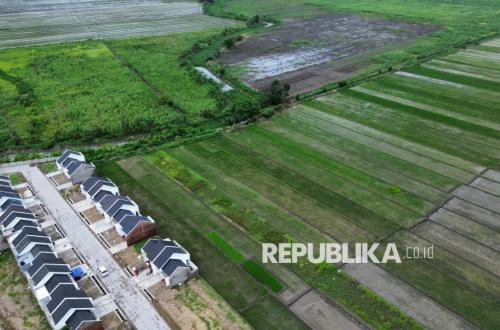
They casually convert rice fields into housing and residential areas as the population requires places to live. Others turn them into industrial estates. Countless more have been transformed into toll roads.
In fact, not a little agricultural land has been converted into international airports and seaports as well as high-speed railway infrastructure. All of this is happening rapidly and is visible before our eyes.
Even more heartbreaking is that the land conversion process is also accompanied by a transfer of ownership of farmers’ rice fields to non-farmers.
The government’s efforts to create new rice fields still appear to face various obstacles. Field reports indicate that many rice field creation programmes have failed due to haphazard planning.
Even more absurd, there are rice field creation sites where the irrigation is damaged.
Imagine the condition when the dry season arrives. They seem to think that creating rice fields is the same as making bandros cakes. This is the kind of thing that requires our collective scrutiny.
The effort to protect farmers’ rice fields from uncontrolled land conversion has actually been addressed through regulation. However, what is the point of a regulation if it cannot be implemented effectively?
Experience has shown that many regulations are drafted, but when implemented they often clash with existing regulations, thereby creating new problems in society.
Development, which has been an ideal since Indonesia’s independence, is fundamentally a choice. It is this development that is expected to bring our nation to achieve its independence aspirations.
Development is not merely about creating basic physical infrastructure; it must also be able to safeguard and maintain vital resources for the sustainability of people’s lives.
The rice fields we possess are a legacy from our ancestors that must be preserved. Our predecessors bequeathed rice fields as a source of life and livelihood for the community.
Rice fields serve as factories for staple food that keep human life connected. That is why this precious inheritance must not fail to be passed on to future generations.
Looking ahead, the problems we face are not limited to land conversion and ownership transfer. There is another more serious matter to address: the declining interest of rural youth in becoming farmers.
Farmer regeneration requires serious and intelligent handling. What will become of an agrarian nation that aspires to become the world’s food barn by 2045 if it develops without farmers?
Farmer regeneration cannot be answered merely by the presence of millennial farmers. More importantly, how do we produce farmers who are willing to cultivate and work the rice fields in rural areas themselves?
This is important to note, because not many millennial farmers are willing to work on the upstream or production side. Most prefer to work on the downstream side, which in the rice agribusiness has a fairly high economic added value.
Another matter that requires honesty in answering is whether, in the minds of today’s youth, being a millennial farmer is a profession or merely a stepping stone while waiting for an opportunity to pursue a more promising career.
The concern is that the millennial farmers currently being recruited are only filling idle time before they obtain their dream jobs. It is even more worrying if the programme is packaged as a project rather than as a movement.
A project is bound by a timeframe. Programmes and activities will run as long as the project is ongoing. Once the project ends, the programmes and activities usually end as well.
Will the millennial farmer programme fall into such a trap? If not, what assurance can be given to the public that the millennial farmer programme will be the saviour ensuring a smooth and responsible farmer generation transition?
Land conversion and farmer regeneration are serious problems that will disrupt the sustainability of agricultural development. The loss of rice fields and the depletion of farmers are the ultimate outcome of all these concerns. We remain optimistic that this will not happen. Agriculture will continue, despite the many challenges and obstacles ahead.