
The Problem of Welfare and Regeneration of Lecturers
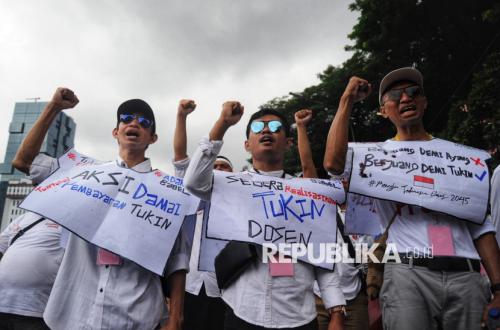
Dosen is actually an honourable, proud, and (should be) prosperous profession. But for now, becoming a lecturer is apparently not an attractive choice for university graduates. #JanganJadiDosen is a hashtag that recently went viral on social media platform X, formerly Twitter, which has become a medium for academics to vent about the reality of the welfare of the lecturer profession in Indonesia, which is often disproportionate to their heavy workload.
At various well-known universities in Indonesia, a prospective doctor or doctor accepted as a lecturer will certainly only receive a basic salary of Rp 2.345 million per month. This salary is only enough to meet daily food needs – and that too only a simple one. A lecturer who does not have a side job cannot hope to save money, buy a two-wheeled motor vehicle, let alone buy a house to live in.
With the average lecturer salary in Indonesia only around Rp 3.36 million per month, below the lowest regional minimum wage, it is understandable if the interest of university graduates to become lecturers is declining. If this condition is left unchecked without any guarantee of welfare for lecturers, the threat of a lecturer regeneration crisis will certainly loom over the world of higher education in Indonesia. One can imagine, who would be interested in becoming a lecturer if their salary is barely enough or even insufficient. Lecturers may now be the last choice for graduates with a Master’s degree – especially a doctorate.
Ironic
Becoming a lecturer is not an easy thing. But ironically, the welfare of lecturers is still a big question mark. Someone who has struggled to study and pursue knowledge even abroad, when they return, their salary is no different from that of a factory worker. In fact, not a few lecturers have salaries below the regional minimum wage. For this reason, it is understandable if many graduates are now reluctant to become lecturers. They prefer other jobs that offer higher income.
A preliminary survey conducted by young people who are members of “Melbourne Bergerak” in the period 17-20 May 2026 found a worrying fact. The survey, which involved Indonesian student respondents at the Master’s and Doctoral levels in Australia, showed that the majority of scholars studying abroad said they were not interested in becoming lecturers in Indonesia because the salary was very low. They are well aware that not much can be expected from the salary of a lecturer who only teaches.
Instead of being able to teach calmly because of an adequate salary, a study found that the average basic salary of lecturers in Indonesia is still around Rp 3.36 million per month. What is more worrying, the survey shows that until mid-2026, there are still more than 40 percent of lecturers – especially in Private Universities – who receive an income below Rp 3 million per month. This figure is even below the standard Regional Minimum Wage in many major cities in Indonesia. Truly ironic.
It is impossible for a lecturer’s family to live only relying on the salary they earn from the university where they work. In the mass media, it was reported that a number of lecturers were forced to moonlight as online drivers or ojol to meet their family’s needs. A lecturer who already has one or two children certainly cannot survive if they only rely on their teaching salary. It is fortunate if a lecturer can get a research project from the local government, the Directorate General of Higher Education, or from other donors. But lecturers like this can be counted on one hand.
Apart from minimal salaries, lecturers in their daily work life generally also bear additional administrative duties. When their study programme is accredited, the lecturer concerned must be willing to work overtime. The overtime pay compensation received is usually no more than one million rupiah, with the workload of compiling forms that takes days. This is done for the sake of loyalty to the university where they work.
In the work carried out each semester, lecturers are required to always publish scientific papers in reputable international journals, manage functional positions, and fulfil Lecturer Workload obligations. Even in the 2026 Lecturer Certification process, lecturers must struggle with various strict portfolio forms and performance documents for the three pillars of higher education. This workload is often not proportional to the income received. For now, it is impossible for a lecturer with less than five years of service to meet daily living needs if they already have a family and children.
Regeneration of Lecturers
The Minister of Education, Culture, Research, and Technology Regulation Number 44 of 2024 concerning the Profession, Career, and Income of Lecturers actually guarantees the welfare of lecturers with a decent wage standard. This regulation stipulates that a lecturer’s salary must not be below the district/city minimum wage, must be above the UMK. In addition, lecturers are also entitled to a number of allowances attached to their income. However, this Permendikbudristek is apparently only a paper tiger.
The fate of lecturers who live hand-to-mouth, even in deprivation, is not a figment of the imagination. The best graduates of universities now think realistically. They prefer to work in the private sector or in companies that offer higher salaries than becoming lecturers. Admittedly or not, low lecturer salaries have triggered the most dangerous domino effect: the death of the younger generation’s interest in pursuing a career in academia.
For Master’s and Doctoral graduates with high competence, becoming a lecturer is a counterproductive investment. They have to spend years and considerable costs to earn the highest degree, but the income they receive is far from commensurate.