
The Presidential Bugging Scandal and the Future of the National Police
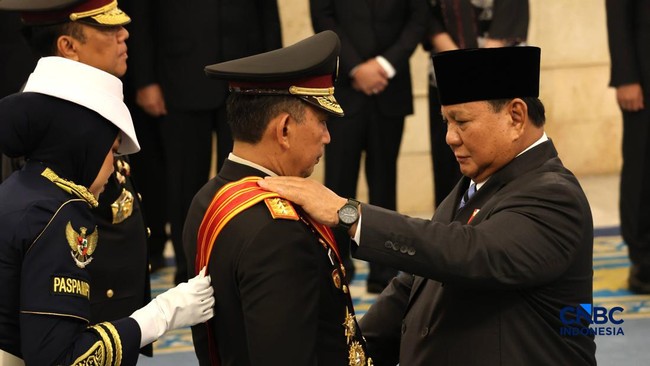
The public was taken by surprise. On 3 November 2026, the National Police’s Criminal Investigation Department (Bareskrim) announced that General Listyo Sigit Prabowo, a former National Police chief who had served for more than five years, was a suspect in a case involving alleged unlawful interception, illegal access and the deletion of electronic data.
The alleged surveillance targeted not only the President but also a number of officials, party leaders, media outlets, analysts and civil society activists. The motive for the illegal interception remains unclear. However, State Secretary Prasetyo Hadi said the surveillance of the President of the Republic of Indonesia amounted to an act of subversion and could endanger the country’s interests and security.
There has been much speculation in the media, from analysts as well as online commentators. But the issue needs to be examined through the lens of political economy and power relations. It is difficult to believe that a former National Police chief and a number of other senior officers would intercept the President, public officials and civil society figures without a purpose or motive.
Moreover, the incident did not occur in a vacuum or emerge from nowhere. It must be understood as part of the active influence of history, particularly the role of the National Police in past political arrangements.
Police Gangs and the Shadow of Powerful Figures
To analyse the motives behind the alleged interception by the former National Police chief and several senior officers, including of communications belonging to President Prabowo and civil society figures, the political context in which it arose cannot be ignored. It is widely known that Listyo Sigit’s rapid career advancement is often cited as a key example in discussions of fast-track promotions for police officers, linked to his service in Solo.
A strategic encounter took place when Commissioner Listyo Sigit was chief of the Surakarta City Police while Joko Widodo was mayor of Solo. After Jokowi was elected Indonesia’s seventh president, Listyo Sigit was brought to the centre of government to serve as presidential aide. His career advanced rapidly compared with his peers from the 1991 Police Academy cohort. He successively held key posts: Banten police chief in 2016, head of the National Police’s Professional and Security Division (Propam) in 2018, and chief of the Criminal Investigation Department in 2019.
In Ruling Indonesia: Jokowi’s Presidency in an Age of Democratic Crisis and Great Power Competition, particularly the chapter “Controlling the Guns and Sheriffs”, Marcus Mietzner describes how Jokowi, as a president without a military background or roots in the traditional political elite, faced challenges in controlling the Indonesian National Armed Forces (TNI), the National Police and other security agencies.
Early in his administration, Jokowi encountered several difficulties, including the controversy over Budi Gunawan’s appointment as National Police chief. During his second term, however, control over the security and law-enforcement institutions became increasingly institutionalised.
Mietzner says the rapid promotion of officers who had served in Solo, worked as presidential aides or served in the Presidential Security Force (Paspampres) eventually became a recurring alternative pathway. This gave rise to the term “Solo Gang” within the TNI and National Police, where service in Solo repeatedly featured in officers’ promotions.
This pattern has ensnared the police institution in the phenomenon of police gangs or cliques: informal networks built through personal closeness, shared experience, patronage and access to positions. The “Solo Gang” in the police is not merely an institutional subculture; it involves informal norms that support political power and patronage networks.
The problem goes beyond the mere existence of police gangs. It also involves informal power constraints: a situation in which a leader who has left office retains the capacity to restrict the decisions and actions of the incumbent through informal mechanisms.
In this context, a police gang can serve as an instrument of informal power constraints, preserving the political influence of a former leader and limiting the authority of their successor.
This is what Junyan Jiang, Tianyang Xi and Haojun Xie describe as “In the Shadows of Great Men”: former leaders do not become merely symbolic figures after leaving power. They seek to build alternative centres of power that constrain a new administration through political networks and personnel who remain inside state institutions.
Former leaders leave people with political or personal ties to them in strategic positions. These loyalists are expected to maintain their influence after a change of leadership, enabling former leaders to affect strategic decisions without holding official office.
Such networks can limit a new leader’s ability to replace officials, reshape the balance of power or consolidate the government. A new leader may have formal authority but does not necessarily enjoy full political freedom to exercise it.
This is where the distinction between formal authority and effective political control arises. It is also where the case of alleged interception by the former National Police chief and several senior officers becomes relevant. From this perspective, the alleged unlawful surveillance is not simply a matter of factionalism within the police; it points to informal power exercised after a presidency.
In Kompromat: A Theory of Blackmail as a System of Governance, James P. Choy argues that surveillance is not merely an activity to gather information. It can alter power relations by giving the person conducting it greater capacity to influence, direct or control the target’s behaviour.
In the case of the alleged surveillance of the President by Listyo Sigit, interception could have been used to learn about the President’s plans and strategic communications, identify conflicts within his circle of power, and gather information that could be used to pressure the President or those close to him.
Ultimately, this could make the President dependent on whoever controlled the information. In this framework, power need not be dismantled through a coup. The President remains in office, but freedom to make decisions can be curtailed because another party holds sensitive information.
From Barry Buzan’s perspective, this could create a securitisation paradox: intercepting presidential communications without legal procedures may itself threaten the country’s political security. The President’s communications contain not only personal information but may also include strategic material relating to defence, diplomacy, intelligence and government decision-making.
Unauthorised access to such information could compromise state secrecy and the independence of executive decision-making. More broadly, when state security instruments are used by internal actors outside their mandate and legitimate accountability mechanisms, the issue touches on national sovereignty. The state faces a problem when officials established to protect national security may themselves become a source of security vulnerability.
A Formidable Task for the New National Police Chief
The first issue that National Police Chief General Suyudi Ario Seto must address in investigating the alleged illegal interception is the accusation that the inquiry is a weaponisation of the law against the old power base within the police. The investigation has been framed as part of a “political war” between the Solo and Hambalang camps.
The new police chief must therefore demonstrate that the investigation is independent, objective and open to scrutiny. One step would be for the National Police to allow external oversight, particularly by relevant institutions.
The National Police Commission (Kompolnas) could help ensure the investigation’s independence, professionalism and accountability; the National Cyber and Crypto Agency (BSSN) could conduct a technical and security audit of the LIMS system; the Ombudsman of the Republic of Indonesia could investigate maladministration and the governance of interception powers; and the National Commission on Human Rights (Komnas HAM) could follow up on alleged violations of privacy and human rights affecting those targeted by the illegal surveillance.
In other words, the National Police must demonstrate accountability. The investigation into the alleged illegal surveillance should be an opportunity to restore what Guillermo O’Donnell calls horizontal accountability: an inquiry into the misuse of interception powers that shows state accountability mechanisms working in practice.
Treating every investigation of an official or public figure with political standing as a political attack risks weakening democratic accountability itself. The accountability of senior officers for alleged abuses of power must not be overridden by the political sensitivity of a case.
State powers are granted to protect the public interest and individual rights. They must not be used beyond their mandate. Surveillance technology, police powers and state resources do not belong to individual officials. If there is reason to believe these tools were used without proper authority, the state is obliged to investigate and demand accountability.
Investigating alleged abuses of power can help return state authority to its original purpose: serving the public interest. The inquiry into the alleged illegal surveillance should therefore be a first step towards freeing the National Police from the shadow of powerful figures, allowing it to develop into a healthy, meritocratic and impersonal institution.
But the problem is not that simple. Research by Jacqui Baker, an academic at Murdoch University, argues that the 1998 reform movement and the democratisation process, marked by the separation of the National Police from the TNI, did not automatically sever ties between the state, security forces and the illegal economy. The expansion of police authority in domestic security and law enforcement instead opened access to new sources of rent.
Baker describes a change in patronage mechanisms as military dominance in domestic security declined and the National Police emerged as an increasingly powerful actor. She identifies a link between the expansion of police authority after Reformasi and access to an off-budget economy previously controlled by the military during the New Order era.
Baker defines the off-budget economy as hidden money, gifts and material resources that illegally fund the police institution or its personnel. These resources fall outside the formal state budget and can take various forms of informal income.
In her chapter “Cukongism: The Gift Economy of Tionghoa Patronage”, Baker uses ethnographic research to show that relations between police officers and tycoon businesspeople can influence postings, appointments to strategic roles and access to education at the police academy. In other words, patronage ties between officers and tycoons play an important role in officers’ career development.
This means strategic posts may be awarded not solely on the basis of competence and organisational needs, but because they carry economic value and patronage networks. Baker further notes that an officer’s ability to generate resources for their unit can become an informal measure of operational success.
An officer who can provide income for their unit may attract the attention of superiors. That ability can become an asset in securing transfers and future promotion opportunities. Baker cites an interview with an officer who said that generating income for a unit could serve as a kind of promotion test.
This is where tycoons’ investment in officers’ careers becomes a shadow parallel hierarchy that operates beyond the police’s formal chain of command. The problem of cukongism cannot be solved merely by strengthening Propam or creating a new task force.
The problem is that, since Reformasi, the National Police has grown into an institution with extensive powers, yet no body has sufficient capacity to oversee it. As a result, police accountability depends heavily on the political balance and preferences of those in power, rather than on a stable oversight system.
Source: jawawa.id (https://jawawa.id/newsitem/the-presidential-bugging-scandal-and-the-future-of-the-national-police-1794156641)
Originally published by CNBC Indonesia (https://www.cnbcindonesia.com/opini/20261108223017-14-783332/tragedi-penyadapan-presiden-dan-masa-depan-polri), translated from Indonesian