
The Philosophy Shelf of Natsir
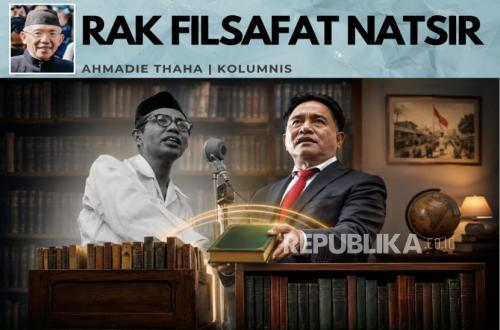
There is a quiet task in a library that often escapes attention. It is not buying new books, nor beautifying the building. The task is simply moving a book from one shelf to another. It seems trivial. Yet, from that moment on, the same book will be read in a completely different way.
Imagine if Plato’s works were moved from the philosophy shelf to the literature shelf. Or if Adam Smith’s writings were stored on the economic history shelf without ever being placed on the moral philosophy shelf. The book does not change. Its sentences remain the same. But the way people view it changes entirely. It loses its intellectual home.
Perhaps that is the task Yusril Ihza Mahendra has just completed at the University of Indonesia. Many media outlets reported that the Coordinating Minister for Law, Human Rights, Immigration, and Corrections successfully earned a doctorate in philosophy with a dissertation on the relationship between Islam and the state in the thought of Mohammad Natsir.
That is true. Yusril has now obtained his second doctoral degree with cum laude honours. But, in my view, that does not touch the core of his entire intellectual project. What he is actually doing is not merely rereading Natsir. He is moving Natsir from the politics shelf to the philosophy shelf—to a place that, until now, has been the least visited by Indonesian readers.
For decades, Mohammad Natsir has almost always been introduced as a Masyumi Party figure, a Prime Minister, a modernist ulama, a statesman, or an Islamic political leader. All these titles are correct. However, precisely because they have been repeated so often, we forget to ask: was Natsir merely a politician who was clever at thinking, or was he actually a political philosopher who happened to enter the world of politics?
This question became the centre of gravity for Yusril’s dissertation. Finally, in the concluding section of his presentation in the open session, he delivered something far more important than the announcement of his graduation in the large hall filled with hundreds of important invited guests.
After elaborating on the ontological, epistemological, and axiological structure of Natsir’s thought, Yusril concluded that the time has come for Natsir to no longer be viewed merely as a political thinker or an Islamic political figure, but rather to be placed as a philosopher who formulated his own system of political thought. The sentence might sound simple. Yet, in the academic world, it represents a monumental proposal.
A political philosopher is not measured by the number of speeches, the track record of success, or the high offices once held. He is recognised because he succeeded in building a complete framework of thought concerning humanity, the state, power, sources of legitimacy, and the ultimate purpose of political life and the state. In the Western tradition, we know Plato, Aristotle, Hobbes, Locke, Rousseau, Montesquieu, Kant, and John Rawls. In the Islamic tradition, there are Al-Farabi, Ibn Tufayl, Al-Ghazali, Ibn Rushd, Al-Mawardi, Ibn Khaldun, and even Muhammad Iqbal. Natsir’s name has almost never been mentioned in the same conversation until now.
Yusril has brought Natsir into that dialogue. Therefore, his dissertation is neither a biography nor a defence of a figure. He treats Natsir as an academic would treat Plato or Al-Farabi. Yusril dissects the structure of his thinking, seeks its ontological foundation, traces its epistemology, and then formulates the axiology of the state he built. In other words, he is demonstrating that behind Natsir’s political speeches, there actually lies a hidden system of political philosophy that has not been read in its entirety for decades.
Why has this work only been done now? Perhaps precisely because the one doing it is Yusril. There is a long relationship between him and Natsir. Since his youth, he was often called the ‘Young Natsir’. The nickname was not born without reason. Both grew up in the Masyumi tradition, both mastered law, both were skilled debaters, both were writers, and both viewed politics as a vehicle for fighting for values, not merely seizing power.
But time has passed. The ‘Young Natsir’ is now seventy years old. He has become a doctor of law. He has become a professor. He once led a political party. He has served as a minister multiple times. He is one of the most influential constitutional law experts in Indonesia. He has hundreds of students and alumni. If the measure of life is position and title, Yusril has long been complete with himself.