
The Philippines Emerges as Asia’s Renewable Energy Story
The Philippines Emerges as Asia’s Renewable Energy Story
Skyrocketing fossil fuel prices drive transition
By: Tita C. Valderama
For years, Asia’s renewable energy transition has been defined by familiar players. China dominates clean-energy manufacturing, India has become a solar powerhouse, and countries such as Vietnam and Indonesia have pursued ambitious energy-transition plans.
Now the Philippines, which relies almost entirely on imported crude oil and refined petroleum – recently exacerbated by skyrocketing fuel prices driven by the Gulf War – is emerging as one of the region’s fastest-growing renewable energy markets. To combat the economic strain, the government recently declared a state of national energy emergency.
Recent data from global energy think tank Ember shows the Philippines has overtaken Pakistan as China’s second-largest export market for solar panels, next to the Netherlands, a key import hub for much of northwest Europe. More than 4,000 megawatts (MW) of Chinese solar panels entered the country during the first four months of 2026 alone, including over 3,000 MW in March and April.
In an analysis released in late May, Ember noted that China has also begun exporting solar cells – the basic building blocks of solar panels – to the Philippines, with imports reaching US$292 million (about P18 billion) from October 2025 to March 2026, up sharply from almost zero in previous periods, based on the latest China trade data cited.
At the same time, the government is pushing one of Asia’s most ambitious offshore wind programs, attracting billions of dollars in prospective investments from international developers.
The surge reflects a combination of economic necessity, energy security concerns, policy reforms, and rapidly declining renewable energy costs.
High power prices drive solar demand
The Philippines has long struggled with some of the highest electricity prices in Southeast Asia. Residential consumers pay roughly ₱12 to ₱15 (US$0.20 – US$0.24) per kilowatt-hour, while businesses face electricity costs that are among the highest in the region. Rising generation charges and dependence on imported fuels have further increased pressure on households and industries. As a result, solar power has become an increasingly attractive investment.
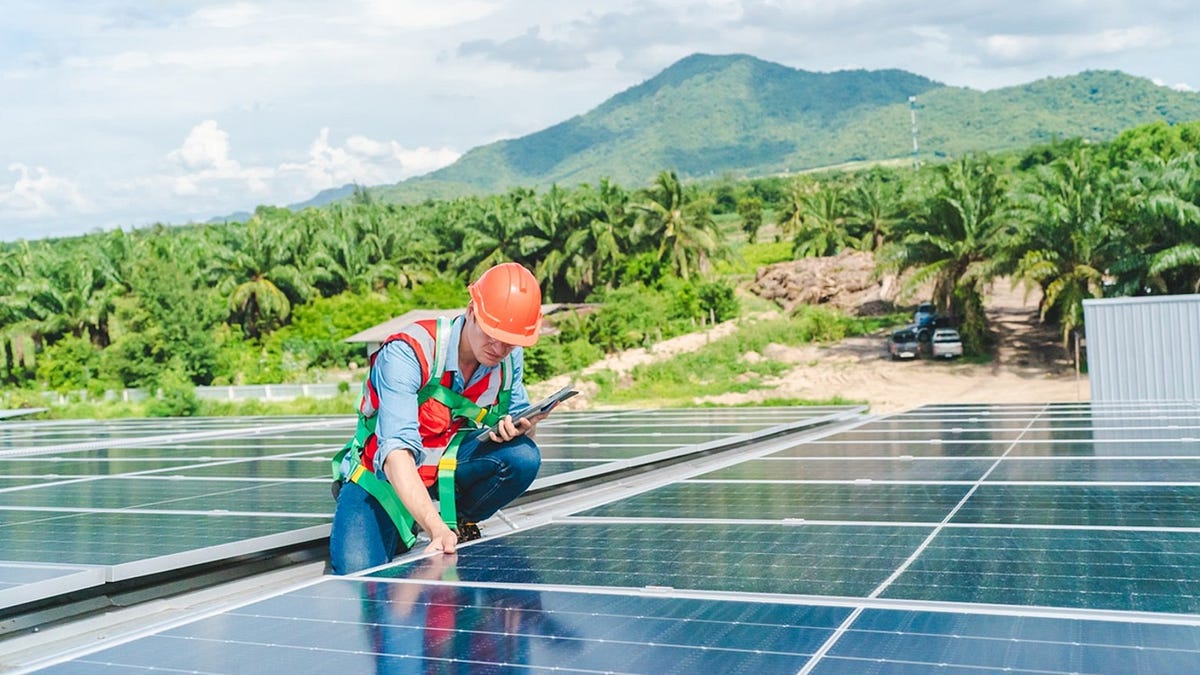
Payback periods for rooftop solar systems have fallen sharply. Commercial establishments can recover their investments in just over two years, while industrial users typically achieve payback within three years, down from about four years previously. The economics are compelling for factories, shopping malls, office buildings, warehouses, schools, and hospitals seeking to reduce operating costs. Under the government’s net metering program, consumers with solar panels can even export excess electricity to the grid in exchange for credits on their power bills.
“The economics of rooftop solar are more attractive than ever, and its rapid rise is inevitable,” Ember chief analyst Dave Jones said in a recent assessment.
Citing the United Nations’ commodity trade statistics database, the Ember report found that solar panel imports into the Philippines grew to $483 million in 2025 from the previous year’s $365 million. Notably, 98 percent of last year’s imports came from China.
“The government has an opportunity to carve its own path on rooftop solar, to bring the Philippines out of fossil dependency, and onto a path of cheap, abundant electricity,” Jones said.
Beyond lower electricity bills, solar power also reduces dependence on imported coal and natural gas, which still account for much of the country’s electricity generation. For policymakers, renewable energy is increasingly viewed not only as a climate solution but also as a means of strengthening energy security.
Economic growth fuels demand
The renewable energy expansion is occurring against the backdrop of robust economic growth, with the Philippines one of Southeast Asia’s fastest-growing economies, supported by a young population, rapid urbanization, and expanding industrial activity. Rising incomes and business investments continue to push electricity demand higher.
Historically, much of that demand would have been met through new coal-fired power plants. Today, government policy is steering investment toward renewable energy instead. Recent reforms have relaxed foreign ownership restrictions on renewable energy projects, introduced competitive auctions, and streamlined permitting processes. These measures have encouraged domestic and foreign investors to commit billions of pesos to new projects. Major developers, including subsidiaries of ACEN, Aboitiz Power, and Meralco PowerGen, are expanding utility-scale solar projects across Luzon, Visayas, and Mindanao.
Offshore wind offers bigger opportunity
While solar installations are expanding rapidly, offshore wind could prove even more transformative, with extensive coastline and favorable wind conditions creating some of Asia’s most attractive energy prospects. Government agencies have awarded dozens of offshore wind service contracts covering projects that could eventually generate tens of gigawatts of capacity.
Among the most closely watched proposals are developments in Northern Luzon, Mindoro, and the Guimaras Strait, where international companies are studying multi-billion-dollar investments. European, Middle Eastern, and Asian firms have formed partnerships with Philippine companies to develop these projects, reflecting growing confidence in the country’s renewable energy prospects.
Growing opposition
The renewable energy boom, however, is not without challenges. Several large-scale solar and wind projects have encountered opposition from environmental groups, local communities, church organizations, and indigenous peoples concerned about ecological and social impacts.
In Quezon Province, renewable energy developments near environmentally sensitive areas around Mount Banahaw have raised concerns among conservation advocates over pot