
The people's power over 'leyeh-leyeh'
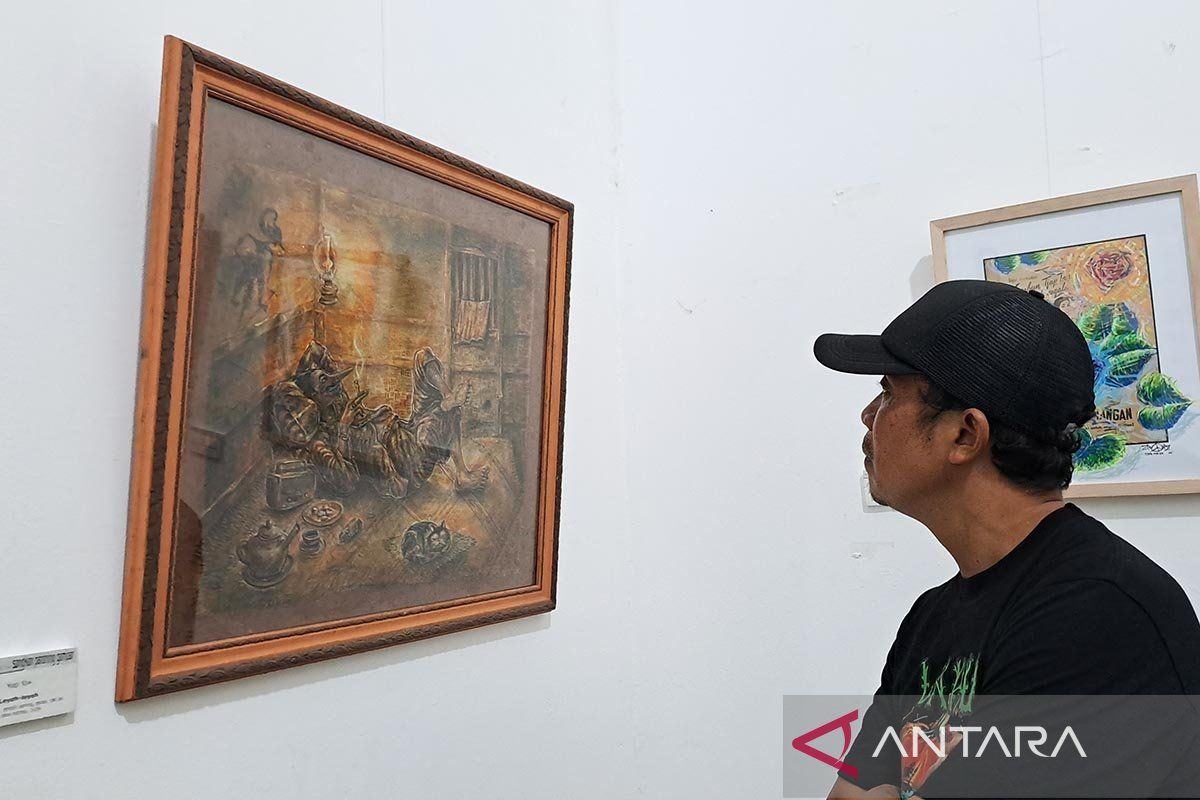
Magelang - Painter from the Borobudur Temple area in Magelang Regency, Central Java, Yogi Setiawan (52), allows viewers of his work ‘Leyeh-Leyeh’ to interpret the painting as being about a ruler’s success in leading the people towards affluence, prosperity, and a peaceful life.
The artwork on 45x54 centimetre paper, created this year, uses a combination of coloured pencils, pen, and watercolour. It depicts a figure resembling Petruk from the world of Javanese shadow puppetry, relaxing while lying down on a mat woven from mendong grass. In the corner of the wall, a lit oil lamp reinforces the impression of a night-time atmosphere in the room where the figure resides.
Petruk’s head is supported by a folded pillow leaning against a woven bamboo wall. Behind him, a window with wooden trellises and a fabric curtain, seemingly made from a folded sarong, is visible. His left hand is depicted propping up the fold of the pillow while supporting his head in a relaxed pose.
His right hand is raised, holding a cigarette between his index and middle fingers. His little finger is adorned with an agate ring, while his wrist is circled by a bracelet with an akar bahar motif. His left leg is bent sideways and rests on his right knee. The position of the leg pulled back lifts the right knee, forming a silhouette resembling an inverted ‘V’.
Petruk’s face, who in the shadow puppet world is a commoner figure, is painted smiling with eyes that appear joyful while relaxing, accompanied by a transistor radio, a teapot and cup on a saucer, and snacks. There is also a painting of a sweet-faced cat sleeping in its bed, a small mendong mat, with the punakawan.
Precisely on the bamboo wall above the reclining Petruk, a wayang puppet is tucked, whose figure the painter did not name. However, the figure appears to be one of the wayang characters from the knightly Pandawa family. The proportion of the knight in the painting is far smaller than that of the punakawan.
Puppeteer from the Lima Gunung Community of Magelang Regency, Sih Agung Prasetyo, confirmed the wayang figure is Werkudara, or Bima, or Bratasena, while the reclining figure is Petruk.
In Javanese culture, the Pandawa family is simply considered a capable and charismatic leader in governing the state, ensuring a strong government and a prosperous and affluent populace, in contrast to the antagonistic Kurawa faction in the wayang stories of the Mahabharata.
The painting ‘Leyeh-Leyeh’, which interprets luxury from the perspective of the common people through the simplicity of daily life, is one of 45 drawing works exhibited by seven artists from Magelang and its surroundings at Loka Budaya Kota Magelang from 30 May to 6 June 2026.
The artists adopted the major theme for the exhibition ‘Sangkan Paraning Gambar’, a title that sounds grand while simultaneously inviting interpretation. The name appears to be a playful twist on the Javanese philosophical concept, ‘Sangkan Paraning Dumadi’, which discusses the origin and purpose of human life. In this understanding, life is viewed as a journey to fulfil virtue before ultimately returning to the Creator.
The curatorial writer for the exhibition in the city square area of Magelang is the President of Indonesia Raya Menggambar, Edo Pop. Meanwhile, the exhibition was opened by the Head of the Education and Culture Office of Magelang City, Nurwiyono Slamet Nugroho, representing the Mayor of Magelang, Damar Prasetyono.
On that occasion, Nurwiyono briefly paused in the third exhibition room to observe the painting ‘Leyeh-Leyeh’ displayed on the wall of Loka Budaya Kota Magelang. He was accompanied directly by the painter, Yogi Setiawan, who recounted a visitor who interpreted the work from a political perspective.
Upon hearing the explanation, Nurwiyono merely smiled while continuing to observe ‘Leyeh-Leyeh’. As a bureaucrat, he gave no specific comment, choosing to enjoy the work like any other visitor free to interpret its meaning.
However, when giving a speech to open the joint exhibition, he stated that paintings play an important role in providing inspiration to the public. Including in the context of education and the importance of art in shaping children’s character, drawing artworks provide inspiration to students.
According to writer Edo Pop, Yogi’s painting is considered to use a fluid and humorous visual approach to present humour that is not merely a work to entertain, but rather the painter’s way of reading reality critically and reflectively.
Indeed, the people’s power to relax is exercised because they are relieving fatigue after carrying out activities to meet their living needs. The ‘leyeh-leyeh’ in Yogi’s work seemingly does not intend to convey a message about being unmotivated or lazy. On the contrary, it depicts a people’s activity after they have worked and the people undertaking spiritual reflection on what they have done, thereby achieving an awareness of the meaning of affluence, prosperity, and peace.
The work is an appearance of a silent journey, which Edo Pop describes as precisely in that silence the drawing finds its depth. This is certainly different from idleness caused by being unmotivated. A person does not do any activity in response to a situation or to fulfil needs. It is like waiting for a durian to fall; even that could be unfortunate if the durian falls on their body, causing injury. As a humorous yet satirical work, Yogi seemingly presents the relationship between the knight Bima and the commoner figure Petruk in the painting.