
The Pawn That Moves Backwards
In chess, the pawn is the smallest piece. Its movement is limited, and it cannot move backwards. It can only advance one square at a time, except on its first move, when it may advance two squares.
I have enjoyed chess since I was a child. My father often played, and often lost to my younger sibling. That was how I learnt how each piece moves. A pawn cannot leap like a knight, travel far like a rook or slide diagonally like a bishop.
But do not underestimate a pawn. If it reaches the last rank in its opponent’s territory, it can be promoted to a more powerful piece, even a queen.
Indonesian politics, much like a chessboard, has witnessed this kind of promotion. The son of a president began his political career as a mayor and then suddenly vaulted into the vice-presidency.
His name is Gibran Rakabuming Raka. Now, after around two years in the republic’s second-highest office, he is reportedly stepping down. It has been a swift and controversial journey.
Reports of his resignation have emerged as political pressure on Gibran has intensified. Controversies over the requirements for his candidacy and his education documents continue to attract scrutiny.
Court rulings concerning those documents, first at the Constitutional Court and then at the Supreme Court, have undermined the legitimacy of his vice-presidential candidacy. This is compounded by the fact that the rulings apply retroactively.
Moreover, 120 MPs from eight parliamentary factions have backed a proposal to exercise the right to express an opinion, which could pave the way for impeachment proceedings.
Budi Arie Setiadi has confirmed that Gibran resigned by submitting a letter to Prabowo at Halim Perdanakusuma Air Base. However, MPR Speaker Ahmad Muzani says he has not seen the letter.
It is as if two processes are racing one another: one through parliament, the other through resignation. Gibran has chosen to step down rather than be impeached, presumably based on his own political calculations.
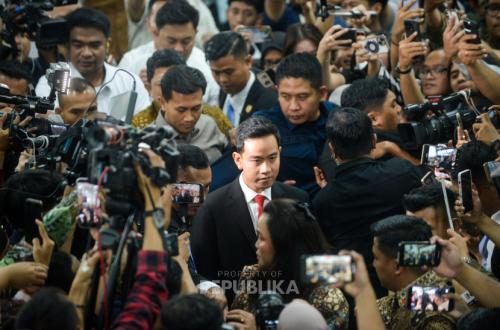
He is not a wooden pawn. He is a self-aware one. It is true that he can appear bewildered. He is tall, with short, unassuming hair. In front of the camera, he often has a blank expression, occasionally offering a faint smile.
His eyes sometimes seem to search for direction when he faces questions from journalists. His voice tends to be deep, with a flat intonation and brief answers. His appearance reminds people of his father, Jokowi.
Of course, someone’s face, gaze and voice cannot be used to measure their intelligence. But when someone holds the office of vice-president, the public is entitled to assess their preparedness, experience and leadership maturity.
That question is all the more pertinent because Gibran’s path to the Presidential Palace was far quicker than that of most politicians.
The way was opened by his father’s power. Jokowi was still president when Gibran was given the opportunity to run for vice-president.
The age requirement that had initially been an obstacle changed after the Constitutional Court issued Decision No. 90/PUU-XXI/2023.
The court’s chief justice at the time, Anwar Usman, was Gibran’s uncle. The ruling triggered major controversy and led to ethical sanctions against Anwar Usman.
This was where the opening moves in Gibran’s political game took place. He was given a route unavailable to most people.
But he did not move alone. Behind him stood a family with considerable political influence, Jokowi’s supporters, parties weighing electoral advantage, and interest groups looking for opportunities in the shift in power.
Jokowi had interests both as a father and as a president preparing his family’s political future. The ambitions and support of Gibran’s mother, Iriana, were also part of the family dynamics surrounding her son’s political journey.
Meanwhile, Prabowo needed political support that could broaden his chances of victory. Party elites and financiers had their own calculations, too. Each entered the game with interests that did not always align.
Gibran ultimately received an extraordinary promotion. From mayor, he became a vice-presidential candidate, then won the election alongside Prabowo.