
The Paradox of Indonesia's Stock Market: Strong Profits, Yet the Index Plunges
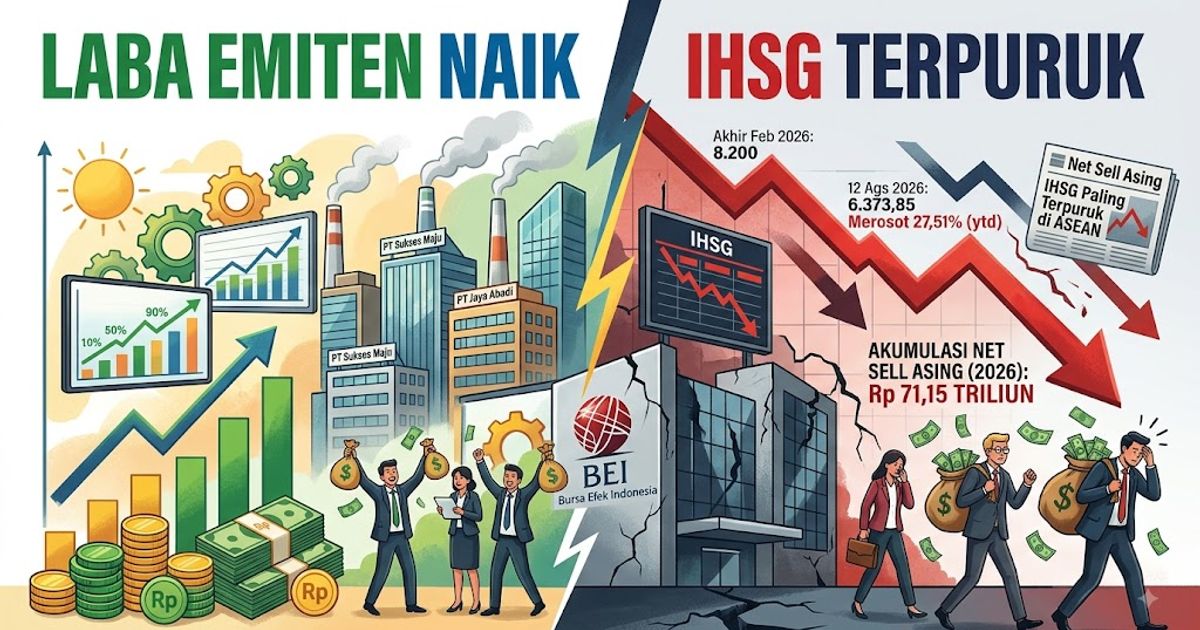
A paradox is unfolding in the Indonesian stock market. The fundamental economy is quite strong, with corporate profits in the first quarter of 2026 rising by 32%. However, the stock market is under severe pressure. Approximately 74% of listed companies booked a profit, yet the Jakarta Composite Index (IHSG) on the Indonesia Stock Exchange (BEI) has slumped more than 27% since the start of the year. Indonesia’s economy grew by 5.29% year-on-year in the second quarter of 2026, one of the highest rates in ASEAN, but the performance of the Indonesian stock index has been the worst in the region.
The next paradox is visible in stock valuations. Share prices have fallen sharply and are historically cheaper, yet foreign investors continue to exit. Accumulated net foreign selling has exceeded Rp 70 trillion throughout the year. At the same time, domestic institutional investors such as pension funds and insurance companies have not been a sufficient counterbalancing force because most of their funds remain placed in fixed-income instruments, particularly Government Securities (SBN) and Bank Indonesia Rupiah Securities (SRBI).
In fact, the potential of domestic institutional funds is enormous. If directed prudently into quality stocks, these long-term funds could serve as an anchor when foreign investors sell. However, various investment restrictions and risk management considerations mean that the allocation space for institutional funds in equities remains relatively limited. This is where one of the structural problems of the Indonesian capital market emerges: when foreign investors exit, there is not yet a sufficiently large domestic institutional force available to absorb the selling pressure.
This market condition contrasts sharply with the fundamental performance of listed companies. In the first quarter of 2026, the aggregate profit of issuers on the Indonesia Stock Exchange grew by almost 32% compared to the same period the previous year. The net profit of companies included in the LQ45 index also increased by approximately 14%. According to IDX data, around 74% of listed companies still recorded a net profit. Among the LQ45 constituents, the largest profit growth came from basic materials sector issuers. These figures show that the pressure on the Indonesian stock market is not caused by a wholesale collapse of corporate fundamentals.
It is precisely here that a very clear divergence between issuer fundamentals and share prices is visible. When aggregate corporate profits are still growing by almost 32% and LQ45 company profits are up around 14%, share prices are falling deeply. This confirms that the movement of the IHSG is not solely determined by corporate earnings. Investor sentiment, capital flows, liquidity, valuations, exchange rate stability, economic policy, fiscal conditions, and perceptions of economic and geopolitical risk have a very large influence.
The magnitude of corporate profits can be seen in the performance of the major banks. PT Bank Rakyat Indonesia (Persero) Tbk (BBRI) posted a net profit of approximately Rp 15.5 trillion. PT Bank Mandiri (Persero) Tbk (BMRI) recorded a profit of around Rp 15.4 trillion, while PT Bank Central Asia Tbk (BBCA) achieved a profit of approximately Rp 14.6 trillion. This performance confirms that the financial sector remains one of the backbones of national corporate profitability. Credit growth, interest income, fee-based income, and relatively well-maintained asset quality have enabled the large banks to continue generating very large profits.
However, the paradox appears once again. The pressure on the Indonesian stock market throughout 2026 is also reflected in the performance of large-cap banking stocks. Based on IDX Daily Statistics as of 12 August 2026, shares of PT Bank Central Asia Tbk (BBCA) had corrected by 21.36% year-to-date. PT Bank Rakyat Indonesia (Persero) Tbk (BBRI) fell by 14.48%, while PT Bank Mandiri (Persero) Tbk (BMRI) weakened by 19.02% year-to-date. This decline is striking because it occurred while the three major banks were still generating very large profits. Thus, the pressure on the share prices of the large banks is not fully aligned with the companies’ fundamental performance.
This situation simultaneously illustrates one of the paradoxes of the Indonesian stock market in 2026. When companies are still generating large profits, their share prices are actually experiencing double-digit corrections. Because BBCA, BBRI, and BMRI have large market capitalisations and significant weight in the formation of the IHSG, the pressure on these three stocks has contributed significantly to the overall weakening of the index.
The divergence between profits and share prices also shows that investors do not solely assess companies based on current financial performance. Foreign capital flows, liquidity, rupiah movements, interest rates, economic expectations, and risk perceptions also determine the valuation the market is willing to give. Therefore, even though banking fundamentals remain strong, share prices can continue to be under pressure as long as investor confidence and fund flows have not fully returned to the Indonesian stock market. Because these three are stocks with large market capitalisations and weight in the IHSG, the decline in their share prices has a very large impact on the index. The weakening of a few blue-chip stocks can drag the IHSG down much deeper than the decline of hundreds of small-cap stocks.
The next paradox is seen in the relationship between economic growth and the stock market. The Indonesian economy grew by 5.29% year-on-year in the second quarter of 2026. This growth is still considered quite high compared to many countries in the region. Theoretically, healthy economic growth should provide an environment that supports increased corporate revenues and profits.
Source: jawawa.id (https://jawawa.id/newsitem/the-paradox-of-indonesias-stock-market-strong-profits-yet-the-index-plunges-1786582217)
Originally published by investortrust.id (https://investortrust.id/indepth/112685/paradoks-bursa-saham-indonesia-laba-emiten-naik-ihsg-terpuruk), translated from Indonesian