
The MSCI Threat: Why We Need a Megawati-Era ‘Sense of Crisis’
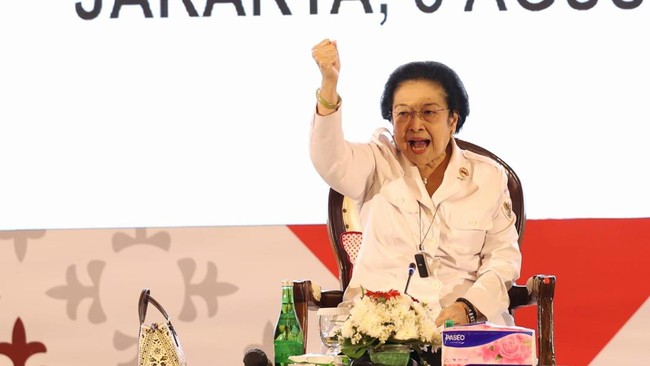
The Bali bombings on 12 October 2002 triggered panic in the stock market. The Jakarta Composite Index (JCI) fell by 10.36 per cent, from 376.46 to 337.47 points, on the day of the terrorist attack.
That same day, President Megawati Soekarnoputri, accompanied by Coordinating Minister for Political and Security Affairs Susilo Bambang Yudhoyono and Coordinating Minister for People’s Welfare Jusuf Kalla, held a press conference at the State Palace in Jakarta. Megawati condemned all acts of terrorism and said she would travel to Bali immediately with the commander of the Indonesian National Armed Forces (TNI), the National Police chief and the foreign minister.
Megawati arrived in Bali the following day, 13 October 2002, and went straight to visit blast victims at Sanglah General Hospital in Denpasar. The attacks left 202 people dead and 324 injured. She then travelled to the bombing site.
There, Megawati inspected the damage and sought assurances that security forces were working hard to investigate the attacks and arrest those responsible. In her instructions, she stated that the government would issue an anti-terrorism regulation in lieu of law (Perppu). The market responded positively: the JCI rose by 4.4 per cent to 357.37 points on the day she arrived in Bali.
MSCI’s assessment
The assessment by global financial index provider Morgan Stanley Capital International (MSCI), which proposed changing Indonesia’s stock-market classification from emerging market to standalone market, has triggered market panic.
The JCI’s plunge of 11.57 per cent on 16 October 2026 should serve as a moment for the government and relevant authorities to make reforms and restore investor confidence.
Reform is crucial, particularly in areas now under scrutiny, including transparency, governance and market integrity. The deadline is tight: a final decision on the proposed change in classification is scheduled no later than 30 June 2027.
The most prominent concern is law enforcement, which is seen as inconsistent and lacking a lasting impact. Global investors are also concerned about opaque share-ownership data amid indications of coordinated trading practices, such as share-price manipulation that distorts fair price formation in the market.
These concerns have intensified amid the high concentration of ownership in major listed companies, which distorts the proportion of shares genuinely available for free public trading (free float). If the issue is not addressed seriously and promptly, the consequences will go beyond an MSCI downgrade and could trigger a further outflow of foreign capital from Indonesia’s stock market.
That could also undermine the rupiah’s stability and damage the credibility of Indonesia’s financial markets. In the worst long-term scenario, a standalone-market classification could isolate the Indonesia Stock Exchange (IDX) from global institutional capital flows benchmarked against major indices.
The government’s corrective measures must be concrete, firm and transparent. A comprehensive overhaul is needed, including tighter scrutiny of beneficial ownership data, rigorous audits of price manipulation and stronger law enforcement, to restore market confidence.
Combating market panic
Economic management under President Megawati took a technocratic approach focused on macroeconomic stability, fiscal tightening through budget discipline, banking-sector recovery and strengthening national economic self-reliance after the 1998 monetary crisis.
To support this approach, Megawati appointed several experienced senior economists to her cabinet, including Dorodjatun Kuntjoro-Jakti as Coordinating Minister for Economic Affairs, Boediono as finance minister and Kwik Kian Gie as head of the National Development Planning Agency (Bappenas). Her government’s economic policies were considered measured, rational and pragmatic in efforts to restore the confidence of global markets.
Megawati placed her full trust in her economic team. Cabinet meetings were held every Thursday. At these meetings, she gave direction and ministers set out the policies they intended to pursue.
If a proposal could be justified, Megawati consulted the minister of law and human rights, Yusril Ihza Mahendra, to ensure it did not violate the Constitution. If it was constitutional, the relevant economic minister would implement it, while Megawati consistently made clear that she was prepared, as president, to sign off on and take full responsibility for the policy.
The combination of trusted technocratic ministers and consistent political leadership under Megawati helped strike a balance. Other strategic steps, such as repaying foreign debt to reduce the debt-to-GDP ratio from 77 per cent in 2001 to 57 per cent in 2004, significantly boosted market confidence, with the JCI rising by 78 per cent.
The market, which had been shaken, recovered on the back of clear policy direction, a commitment to structural reform and legal certainty. Moreover, despite the economy’s difficulties after the 1998 crisis, Indonesia managed to increase tax revenue to 12.3 per cent.
The experience of governance under Megawati offers valuable lessons in confronting the potential market panic following MSCI’s announcement. When financial markets are shaken by uncertainty, the government’s response must not be merely defensive or rhetorical.
Markets need concrete technocratic policies based on transparency, legal certainty and the resolve to carry out reforms with discipline. A leader’s sense of crisis is essential at this moment to provide reassurance and certainty to investors.
The same logic could be applied by today’s capital-market authorities in responding to the threat of MSCI downgrading Indonesian shares. Enforcing the law against market manipulation and improving free-float data are no longer merely matters of regulatory administration; they are crucial to safeguarding national economic stability.
The government, the Financial Services Authority (OJK) and the Indonesia Stock Exchange must not be reactive, let alone dismiss MSCI’s deadline for improvements. If the courage to pursue technocratic reform shown under Megawati can be replicated today, Indonesia could not only avoid a standalone-market classification but also reaffirm its position as a leading destination for global portfolio investment.
Source: jawawa.id (https://jawawa.id/newsitem/the-msci-threat-why-we-need-a-megawati-era-sense-of-crisis-1792756277)
Originally published by CNBC Indonesia (https://www.cnbcindonesia.com/opini/20261023170635-14-779006/ancaman-msci-mengapa-kita-perlu-sense-of-crisis-era-megawati), translated from Indonesian