
The Mixed Verdict of the Constitutional Court
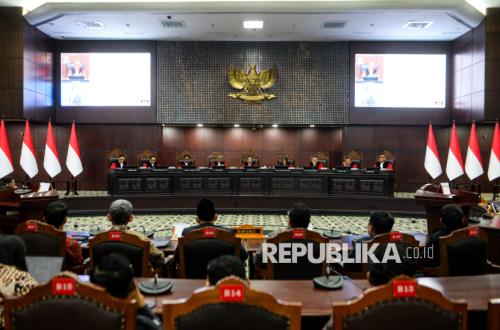
Pakpok. Or one by one. Perhaps that is the most appropriate East Javanese term to describe the Constitutional Court’s ruling on Tuesday night, 6 October 2026. After a marathon session lasting more than two weeks, the Court finally delivered its verdict.
However, the sound of the gavel felt like two distinct strikes: the petitioners’ application was declared inadmissible, yet the certificate of educational equivalence used by Gibran Rakabuming Raka to meet the requirements for his 2024 election candidacy remains substantively problematic.
The nine Constitutional Court judges stated that the application for Case Number 01/PHPU.PRES-XXIV/2026, filed by Denny Indrayana and several colleagues, could not be accepted. Their reasoning: the petitioners were not presidential or vice-presidential candidates.
In disputes regarding presidential election results, the Court’s procedural law grants legal standing specifically to candidate pairs. Consequently, the Court granted the exception raised by the respondent—in this case, the KPU (General Elections Commission)—which had objected to the legal standing of the petitioners.
Yet, there is an issue that makes this ruling more complex than a simple “inadmissible” verdict. In examining the evidence and trial facts, the Constitutional Court judges also stated they found no convincing evidence regarding Gibrandum Rakabuming Raka’s educational diploma.
The Court acknowledged it found no factual evidence that Gibran possesses a diploma, certificate, or degree from abroad that could serve as a basis for equivalence to a minimum of high school education, as required by the Election Law.
The Court noted that the documents attached to support the equivalence letter consisted only of a certificate of attendance, academic records, and an explanation of grades. The Court has yet to obtain any single piece of evidence of a high school-level diploma or graduation certificate in his name.
According to the information considered by the Court, the documents obtained merely demonstrate Gibran’s attendance and learning process, rather than providing proof that an individual has completed that level of education.
This is where the “pakpok” (the ambiguity) lies. The Constitutional Court did not disqualify Gibran. However, the Court also did not state that the disputed educational evidence had been proven valid. Instead, the Court stated that it found no convincing evidence regarding Gibran’s diploma.