
The Million-Dollar Minister of Religious Affairs
Imagine a country with a special official in charge of religious affairs. His position is at the very top, with tens of thousands of officials and employees under him paid with taxpayers’ money. His task is not merely managing bureaucracy, but managing the sacred worship of millions of people.
Then, after months of investigation since 1 September 2025, a team of prosecutors in court read out a shocking indictment. They charged the official with preparing one million US dollars to influence a state institution that was investigating his policies. The whole world watched live on YouTube.
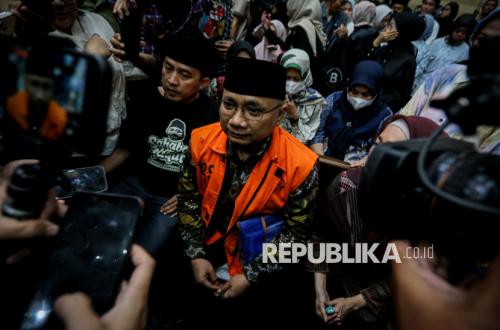
The official’s name is Yaqut Cholil Qoumas, former Minister of Religious Affairs of the Republic of Indonesia. On Tuesday, 11 August 2026, KPK prosecutors indicted Yaqut, wearing the yellow uniform of KPK detainee number 129, at the Jakarta Corruption Court. It was his first hearing on charges of corruption in the sacred hajj pilgrimage.
Prosecutors said Yaqut instructed his inner circle to prepare USD 1 million through a special staff member to influence the outcome of the House of Representatives’ Special Committee on the Hajj Inquiry. Yaqut’s side denies the charges. As the legal process has only just begun, it is the judge who will determine the truth.
However, this case is worth examining from both legal and religious perspectives. Religion does not only teach prayer, fasting, almsgiving and pilgrimage. It also governs matters of money, trust and justice. Religion strictly forbids buying decisions with wealth and forbids officials from taking what is not rightfully theirs.
Prosecutors explained that the case began with the distribution of 20,000 additional hajj quotas. Yaqut divided the quota into two parts: 50 percent for regular hajj and 50 percent for special hajj. Yet Law Number 8 of 2019 stipulates that the special hajj quota is only 8 percent.
The figures 50 and 8 are not merely mathematical calculations. For prospective pilgrims, these numbers represent queue positions and the course of their fate. People save for decades to go on hajj. Some sell their rice fields, set aside shopping money, and wait until old age. Then, when their turn for hajj arrives, the official strikes their name from the list.
For the people, when an official manipulates the hajj quota, he is manipulating the hopes of human lives. The House of Representatives’ Special Committee on Hajj in 2024 found alleged violations and called for a more transparent quota system. The Supreme Audit Agency also conducted an examination, finding a state loss of Rp622 billion from the case.
The figure of Rp622 billion is substantial. It would be enough to feed the poor, build dozens of Islamic boarding schools, or fund hospitals. Yet in this case, the loss arose from hajj pilgrimage affairs. It is as if someone sold umbrellas to people caught in the rain, then used the money to buy an umbrella for himself.
Prosecutors charged Yaqut with using two special staff members to influence the House special committee, while certain hajj travel operators exploited the situation through quota trading practices. If these charges are proven in court, we are not looking at an ordinary administrative error. We are looking at a betrayal of trust.
The Qur’an has long given a stern warning: “Do not consume one another’s wealth unjustly, and do not bribe officials to seize the rights of others” (QS Al-Baqarah: 188). This verse mentions money and power together. The Qur’an understands that humans are often defeated by the temptation of money and position.
Money can buy influence, while position can open the door to wrongdoing. When the two combine without fear of God, the law collapses. The Prophet also strongly condemned both the giver and receiver of bribes. Money itself is not a forbidden object. It becomes a problem when people use it to distort the truth.
State law assesses guilt based on evidence on paper. But religion reminds us of a Supreme Court that needs no false witnesses or fabricated documents. That is why Islam views public office as a burden of trust, not a luxury (QS An-Nisa: 58).
Source: jawawa.id (https://jawawa.id/newsitem/the-million-dollar-minister-of-religious-affairs-1786895603)
Originally published by Republika (https://analisis.republika.co.id/berita/tjnhiq415/menteri-agama-sejuta-dolar), translated from Indonesian