
The Mediterranean Sea, Nine Indonesian Nationals, and the Credibility Test of International Law
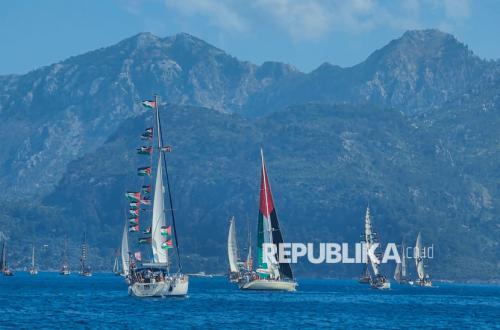
The modern world continues to talk about a rules-based international order, the supremacy of international law, the protection of human rights, and the importance of global stability. Yet in practice, the world often presents a harsher reality: international law is tested precisely when confronted with geopolitical interests and the logic of military power.
The case of alleged detention of nine Indonesian citizens (WNI) by the Israeli armed forces in the Mediterranean Sea area cannot be viewed as merely a routine security incident. The issue has dimensions far broader because it touches on the legitimacy of the use of force, respect for freedom of navigation, protection of civilians, and the international community’s consistency in upholding global law without double standards.
What is at stake is not only the safety of the nine Indonesians, but also the credibility of the international legal system itself. The world is watching whether global law is still truly respected as an instrument of shared justice, or whether it gradually yields to the geopolitical interests of states with dominant military power.
Therefore, this matter must be read objectively, critically, strategically, and based on international law, not merely through political emotion or ephemeral sentiment.
The high seas cannot be controlled unilaterally
From the perspective of international law, particularly the United Nations Convention on the Law of the Sea (UNCLOS) 1982, the maritime domain has clearly defined jurisdictional boundaries.
A state has full sovereignty only over its territorial sea up to 12 nautical miles from its coastline. Beyond that lies the Exclusive Economic Zone (EEZ), where a state has certain economic rights but not full authority over the passage of foreign vessels.
Meanwhile beyond that area lies the principle of freedom of navigation, i.e., the fundamental principle of international maritime law ensuring that the high seas cannot be monopolised by a single country.
This principle has underpinned the stability of world trade and maritime security for decades.
Hence the location of the interception is crucial. If actions against the vessel carrying Indonesians occurred outside Israel’s territorial waters, the issue would no longer be merely a security operation but could fall into the realm of a violation of international law.
And when freedom of navigation is unilaterally interfered with, what is threatened is not only one ship or one country, but the stability of the global maritime system as a whole.
The right to self-defence is not unlimited
Israel may use national security and the right to self-defence as the basis for its military actions.
In international law, the right to self-defence is recognised under Article 51 of the UN Charter. However, it must be emphasised that this right is not a limitless justification for unilateral military action outside a state’s jurisdiction.
International law continues to require a real threat, proportionate actions, and an urgent need truly unavoidable. In other words, not every civilian vessel can automatically be categorised as a threat to national security.
If elements of terrorism, arms smuggling, or a direct military threat are not found, the use of force against a civilian vessel would pose serious problems within the framework of international law and human rights.
In the modern era, the legitimacy of military operations is no longer measured solely by tactical success on the ground, but also by legality, proportionality, and moral legitimacy in the eyes of the international community. History shows that military operations that lose moral legitimacy often become long-term diplomatic burdens.
The Dangers of Using Force Extraterritorially
The most sensitive issue in this case actually lies in the extraterritorial use of force.
UN Charter Article 2(4) strictly prohibits the use of force against another party without a legitimate basis in international law.
Therefore, if an operation is conducted on the high seas without a clear international mandate, without a real threat that can be proven, and without a strong legal basis, such actions could be viewed as violations of freedom of navigation, unlawful detention, and even violations of the fundamental principles of modern international law.
That is why every military operation against civilian ships in the Mediterranean has drawn serious attention from the international community. The world understands that once such practices are allowed to continue, the line between security operations and abuse of force will become increasingly blurred.
The Shadow of Mavi Marmara and the Global Confidence Crisis
The world has not forgotten the 2010 Mavi Marmara incident when Israeli forces stormed a humanitarian aid flotilla in the Mediterranean Sea, causing casualties and widespread international condemnation.
That event became an important precedent that military operations against civilian ships can evolve into a protracted global diplomatic crisis.
Today the world is confronted again with the same question: are international laws being applied consistently to all countries? Or does international law appear stringent against some states but flexible when faced with the geopolitical interests of powerful states?
These questions gradually give rise to a crisis of confidence in the modern global order. And as the international community begins to lose faith in the consistency of international law.