
The meaning behind sports competitions for grassroots economic drivers
The efforts of many countries to compete to host sporting events seem not solely to pursue prestige, but rather the multiplier effect from the economic side that is sought. A small example is when a final sports match takes place, attention is not solely focused on the score, strategy, and who ultimately lifts the trophy. Alongside that, there is often another story unfolding on the sidelines of the arena, not recorded in the match statistics, but one that touches the most fundamental aspects of human life. Stories about people working quietly for their families or hopes that are not born from a team’s victory, but from goods that are sold out. Stories about struggles that do not last for two halves of a match, but for many years.
There is one moment, for example, the 2026 Pro Futsal League (PFL) Final at the Yogyakarta State University Sports Hall, which became a complete picture of how a match can drive the economic pulse of a region. Amidst approximately 5,400 spectators who filled the arena and enjoyed the match, there were ultra-micro entrepreneurs who also felt the benefits of the crowd. They did not wear team uniforms, did not stand in the middle of the court, and were not the centre of attention. However, their presence held a meaning that was no less important.
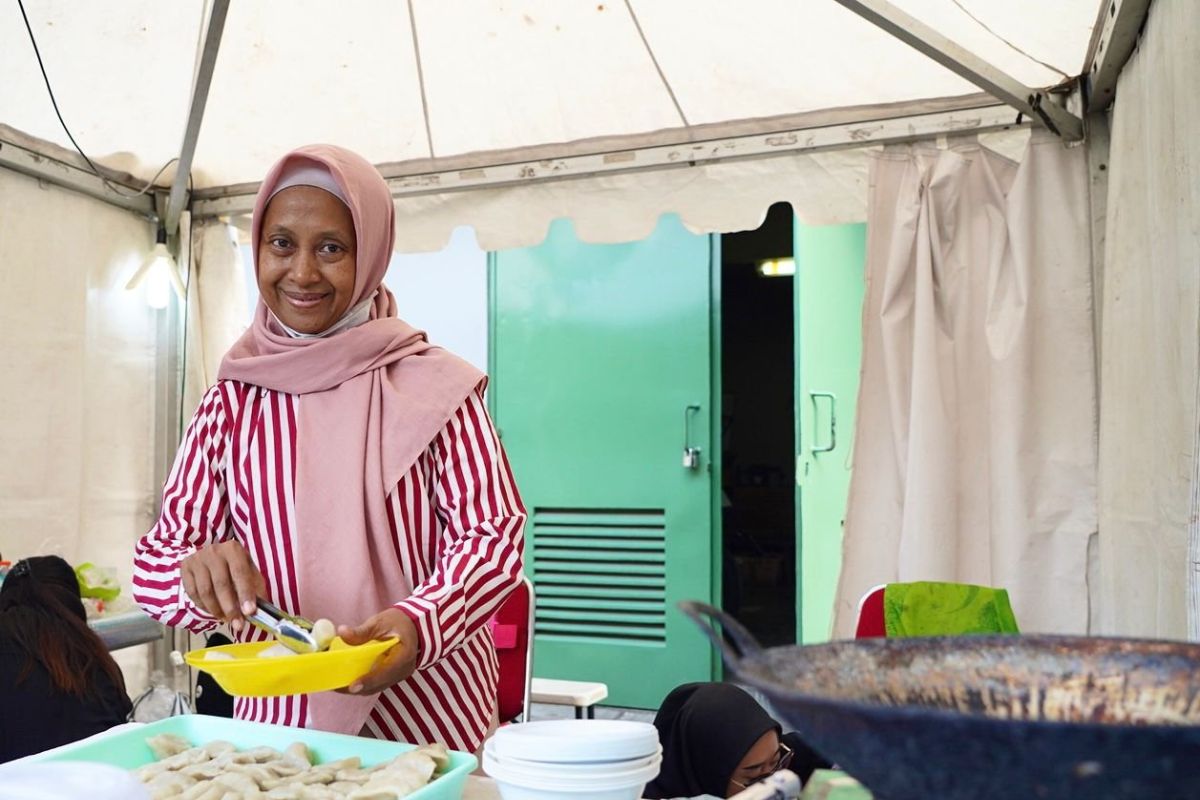
Iin Sutiyani, a snack seller in Yogyakarta, has spent 18 years making and selling pempek, a Palembang specialty inherited from a family recipe. What she does may seem simple. There is no large signboard, no branch network, and no bustling promotion on social media. There is only diligence repeated every day for nearly two decades. For some people, pempek may just be food. But for Iin, pempek is the reason the kitchen stove keeps burning. Pempek is the children’s school fees. Pempek is the family’s daily needs. Pempek is also the support when life tests their resilience. When her husband’s health deteriorated due to illness, that small business became the family’s mainstay. Not everyone can understand the weight of that position. There are bills to be paid, household needs that never stop, and worries that come in turns. Yet, like millions of other Indonesian women, Iin chose to keep moving forward. She did not have the luxury to give up. Every morning still had to begin. The dough still had to be made. The goods still had to be sold. In many Indonesian families, struggles like this take place every day, largely unknown to others. There are no cameras recording, let alone applause accompanying. Yet, it is precisely from these small struggles that the true economic resilience of society is built.
Driving the economy
The opportunity to sell at the 2026 PFL Final was very meaningful for ultra-micro entrepreneurs like Iin. Amidst thousands of spectators who came to watch the match, her pempek sold out quickly. In one day, her sales increased many times over compared to an ordinary day. For some, that additional income might seem ordinary. However, for a family that relies on a small business as its main source of livelihood, the extra income can mean many things. It can help meet the family’s needs. It can be used for her husband’s treatment, and also provide a slightly more comfortable breathing space amidst the various responsibilities that must be borne. The most palpable thing from that story is not the sales figure, but the sense of gratitude that accompanied it.