
The Lotus Flower: A Symbol of Purity and the Story of a Plant
Floating on the water, round and brownish in form, this flower typically blooms at night and spreads a fragrant aroma. For followers of Hinduism and Buddhism, the flower represents beauty, purity, and the purification of the soul.
In Buddhist teachings, important figures such as Siddhartha Gautama and the Goddess Kwan Im are often associated with this flower. The beauty of the lotus seems untouchable by just anyone or any other living creature, because the entire plant is covered in sharp thorns that keep the flower protected.
This aquatic plant, with its roots beneath the water and its leaves and flowers on the surface, is one of several ornamental plants that can beautify a pond in the garden. When in bloom, its fragrance fills the pond area, and the beauty of its colours soothes those who gaze upon it. It is no surprise that the plant is synonymous with beauty and purity.
In some places, the plant is used to flavour dishes, traditional cakes, and health-giving drinks. Beyond its beauty and fragrance, it indeed offers a variety of other benefits.
Parts of the plant can be used as medicine to treat bleeding, fever, liver and heart problems, as well as stubborn coughs. Chemically, the plant contains compounds with potential to reduce swelling, control blood sugar, kill bacteria and cancer cells, and protect the heart.
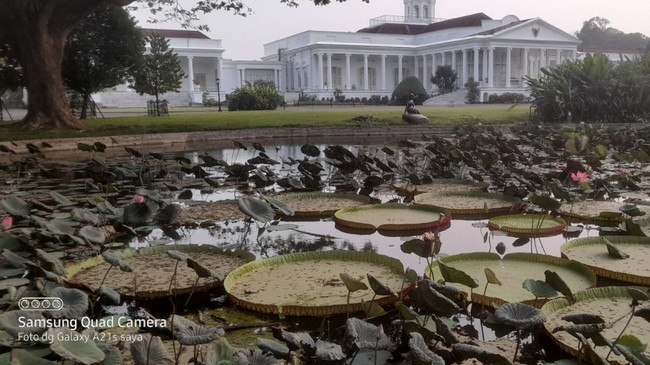
Although not native to Indonesia, the plant grows well here. In garden ponds across the country, it adorns and enhances the landscape, especially when flowering. At the Bogor Botanical Gardens, as the epicentre of cultivated plant distribution, the lotus and the giant water lily can be found in the lake, their beautiful flowers charming and attracting many visitors.
A Closer Look at the Giant Water Lily
The plant’s leaves are firm and strong, round in shape like a winnowing tray, with a diameter of roughly 1.50 metres, yellowish-green in colour, somewhat smooth, with edges that turn upwards about 5–10 centimetres.
Along the leaf’s rim are two notches positioned opposite one another, as if dividing the leaf into two equal parts. The underside of the leaf is surrounded by long, sharp thorns; if they prick the hand, it feels itchy and hot.
Its seeds are greenish-brown, with a hard shell roughly the size of a peanut. A single fruit contains 24–30 seeds, each wrapped in a thin, fairly tough, white casing.
The flesh of the seed is white, somewhat soft and starchy, containing starch, oil and protein, and is used as food by some indigenous African peoples. Indians consider the seed a forbidden object (a taboo) and call it “water corn”.
Its stem root resembles a tuber and stands upright in the mud beneath the water. These roots are reinforced by numerous supporting roots shaped like sponges, emerging from the bases of the leaves in bundles of 10 to 30, sometimes up to 40. Over time, these supporting roots rot away and are replaced by new ones as the leaves grow.
The plate-shaped flower of Victoria regia has a particular distinction: it blooms at night. When the flower opens, a powerful fragrance is released, attracting beetles to alight upon it.
The beetles land on the flower and enter it; once inside, they feed on the inner wall containing mucilage. So absorbed are the beetles in feeding that, as the flower gradually closes, they are unaware and become trapped inside as if prisoners.
On the following night, the flower opens a second time, though its colour is no longer the original but a somewhat dull purplish hue, and parts of its ornamental structures have wilted, the fragrance much diminished. As soon as the flower reopens, the beetles inside fly out. Unbeknownst to them, their bodies are now covered in pollen.
As we know, a beetle does not alight on just one flower, but moves from one bloom to another. So it is with these beetles. They will land on other, fresh Victoria regia flowers, and with their bodies laden with pollen, they unknowingly transfer it to each new flower they visit.
With the movements of their wings, the pollen falls away, some of it landing on the stigmas. Thus pollination of the Victoria regia flower is achieved, carried out by beetles.
Cultivating the plant is fairly easy. Its seeds are scattered in a shallow basin filled with clay and placed in a pan of water, around January or February, at a temperature of about 30°C. Soil is placed at the bottom of the basin to a depth of about 15 centimetres; deeper basins require up to 30 centimetres of soil.
Before sowing, the hard outer shell of the seed is filed down first to speed up germination. Germination takes a long time, roughly six months, sometimes longer.
During its growth, the plant requires plenty of light and must therefore be placed in open spaces where it receives direct sunlight. It also requires plenty of humus to grow.
If humus is unavailable, compost may be used, consisting of one-third cow manure, one-third crushed leaves, and soil as needed. To prevent the compost from being washed away by water currents, partitions should be built around the plant.
Once all these steps are complete, one need only wait for the flower to bloom in full splendour, its beauty there to be enjoyed and its fragrance breathed in at night. Beyond that, we also have a store of traditional medicine.
A Brief History of the Giant Water Lily’s Journey
The Bogor Botanical Gardens’ specimen is known scientifically as Victoria regia Lindl., synonymous with Victoria amazonica (Poepp.) Klotzsch, commonly called the “giant water lily”, an aquatic plant belonging to the family Nymphaeaceae.
This plant bears the largest flowers of any member of the family, milky-white, fragrant, and blooming at night. Pollination is carried out by a species of beetle that enters the flower as if becoming a prisoner. Propagation is possible only by seed, and germination takes six to eight months, sometimes longer.
How did this plant come to Indonesia? Plants, too, have their own history and story. According to various sources, the plant was first recorded in Bolivia by Haenke in 1801. Bonpland encountered it near Corrientes, Argentina, in 1809, and in 1825 he sent seeds and other information to Marbel, Paris.
In 1836, Robert H. Schomburgk discovered the plant in the Berbice River in British Guiana, collecting herbarium material and illustrations. From this discovery, Lindley named the plant Victoria regia in 1837, with the description published in 1838 and later revised in 1847 to Victoria amazonica.
The naming was a tribute to Queen Victoria of England. Schomburgk transferred the plant from lakes in the interior and from coves to Georgetown, British Guiana, but it soon died.
In 1846, Bridges obtained seeds in Bolivia and sent them to England packed in damp clay. Of 25 seeds at Kew Gardens, three germinated, but failed to survive the winter.
In 1848 he sent dried seeds and rhizomes to England. The rhizomes rotted and the seeds failed to germinate. An expedition from Georgetown in 1849 succeeded in bringing back 35 living plants, but all soon died. Rodie and Luckie, young doctors from England, sent several seeds from the Demerara River to Kew Gardens.
The seeds were placed in bottles filled with clean water. The first shipment arrived on 28 February 1849, and on 8 November 1849 the plant flowered at Chatsworth. From this plant, Victoria regia was distributed to gardens across Europe, Asia and America, including Indonesia. The Bogor Botanical Gardens received seeds of Victoria regia from the Amsterdam Botanical Garden in the Netherlands in 1860.
So behind the beauty of the flowers we admire lies a long history of scientific endeavour. The botanists involved never tired of trying, conducting research, trials, and continuous efforts in the face of obstacles.
Those efforts involved numerous researchers, research institutions, and even diplomacy across nations. The plant teaches us about the importance of science and its many experiments, the sincerity of sustained effort, and strong self-protection.
In such ways, our best selves can bloom fully, not merely beautifying the landscape but spreading a fragrant aroma. And no less importantly, the plant holds many other benefits within it.
Source: jawawa.id (https://jawawa.id/newsitem/the-lotus-flower-a-symbol-of-purity-and-the-story-of-a-plant-1788857876)
Originally published by CNBC Indonesia (https://www.cnbcindonesia.com/opini/20260908132336-14-766157/bunga-teratai-simbol-kesucian-dan-cerita-tumbuhan), translated from Indonesian