
The Londo Ireng Survey
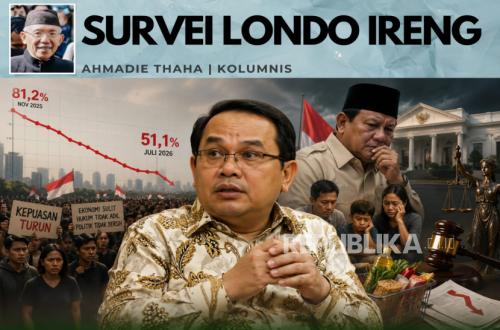
There are jobs that require one to keep a distance from the object being measured. A referee may love football, but should not kick the ball during a match. An auditor may have views about a company being examined, but it becomes problematic if they criticise it publicly in front of the company’s office. The same applies to political survey institutions. Their task is to measure public opinion about the government and political figures. Therefore, when the owner actively calls for the downfall of a figure being measured, people are right to ask: can the survey results still be fully trusted?
This is the issue facing Saiful Mujani, a problem more interesting than the criminal case trailing him. The founder of Saiful Mujani Research and Consulting (SMRC) holds a doctorate in political science from Ohio State University and is an academic and public opinion researcher. Consequently, his political statements carry more weight than the chatter of an influencer. In April 2026, Saiful became controversial after speaking about public consolidation to ‘bring down’ President Prabowo Subianto. He clarified that he meant political engagement, not insurrection, as part of democratic freedom and participation. He later even spoke of people power as an alternative, judging the formal impeachment route to be too difficult.
Saiful’s right to speak must certainly be protected. Criticising the president does not constitute insurrection merely because the tone is harsh. A democratic state should not be allergic to criticism. However, the issue is not just about permission. There is another question: is it proper for a figure so identified with a public opinion polling institution to also appear as a partisan in the very contest he is measuring, regardless of the reason? This is a matter of credibility, not criminality.
Amid these questions, Saiful’s company, SMRC, released a survey on satisfaction with Prabowo. The survey, conducted from 5 to 19 July with 749 respondents, stated that the figure stood at only 51.1 percent, a drop of 30.1 points in nine months. In November 2025, public satisfaction with Prabowo was still at 81.2 percent. According to the latest survey, 49.4 percent of respondents assessed the economic situation as bad or very bad, while only 15.7 percent considered it good or very good. This is a devastating numerical blow, but it carries the irony of a pollster who had already been shouting that the patient was sick.
The SMRC survey may well be completely accurate. If one wishes to criticise it, it must be answered with a counter-survey. Methodology must be judged by methodology, not by who owns the company. If the sample is correct, the questions are not leading, the weighting is appropriate, and the data processing is professional, then a dislike for Saiful cannot magically turn 51.1 into 81.2. Statistics do not recognise hurt feelings.
However, research also requires independence that must not only exist but must be ‘seen to exist’. This is the perceived conflict of interest. It does not mean Saiful manipulated the survey. The problem is that the public has reason to ask. Moreover, the company’s name is ‘Saiful Mujani Research and Consulting’. The founder’s name is emblazoned on it. The general public finds it difficult to surgically separate Saiful as a citizen from SMRC as a research institution. Organisationally, their tasks may differ, but the public sees Saiful as the owner. Therefore, the further Saiful enters the political arena, the higher the institutional firewall SMRC needs. Methodologies and questionnaires must be open, survey funding transparent, and the founder’s political activities strictly separated from research management. This is necessary so that people do not easily accuse him of cheating.