
The Legend of Si Pitung: Did the Betawi Folk Hero Die from a Golden Bullet?
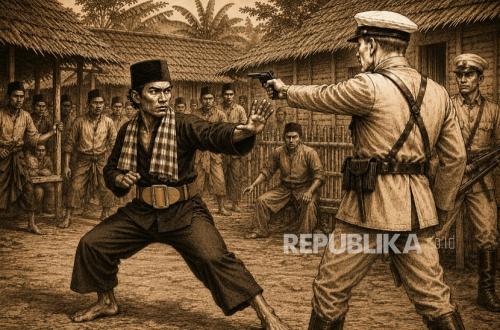
In October 1893, the people of Betawi in the kampungs were in mourning. Word spread from mouth to mouth that Si Pitung, or Bang Pitung, had died after being shot in an unequal fight with the Dutch East Indies Company. For the Betawi people, Si Pitung’s death was a profound loss, as he defended the common folk who suffered oppression during the Dutch colonial era. Conversely, the colonial government depicted him as a criminal, a troublemaker, and a robber.
This champion from Rawa Belong, West Jakarta, had become a major nuisance for the colonial administration in Batavia, including the governor-general. Because he posed a significant threat to security and order, the Dutch East Indies government employed various strategies to capture him, dead or alive. Pitung was designated the most wanted criminal in Betawi.
The Dutch had reason to be anxious. In his actions to defend the poor, Pitung stood on the front lines. At the time, the Dutch imposed forced labour on the natives, including ‘turun tikus’, a practice where people were mobilised to exterminate rats in the rice fields, alongside dozens of other forced labour schemes. Heavy land taxes, or ‘blasting’, imposed by landlords also burdened the farmers.
According to folklore, Pitung, who had been a target for years, was killed after being shot with a golden bullet by a Dutch schout (a police chief equivalent) named van Hinne during a raid. His hiding place was revealed by a traitor. He was shot with a golden bullet because he was believed to be invulnerable to ordinary ammunition. The colonisers were so fearful of Pitung that the location of his grave was kept secret, lest the silat master and idol of the common people become a shrine.
Based on the folklore still alive in Betawi society, Pitung studied the Koran at a small prayer house, or langgar, in Rawa Belong from a young age. He was, in the Betawi idiom, an obedient child and bright-minded, quickly grasping the religious teachings from his ustadz to the point of being able to recite the Koran. Alongside religious studies, he also learned silat martial arts from Haji Naipin, who was a tarekat teacher and a master of martial arts.
One day, as a teenager of about 16 or 17, his father sent him to sell goats at Tanah Abang Market in Central Jakarta. He took five goats by cart from his home in Rawa Belong. After selling the livestock and preparing to return home, Pitung was robbed by several market thugs. From that moment on, he did not dare to go home. He slept in the prayer house and sometimes at his teacher Haji Naipin’s residence, vowing not to return until he could recover the money from the goat sale. He felt deeply guilty towards his parents. With this determination, he further deepened his knowledge of martial arts and mysticism. His martial arts style was called the Syahbandar school. Pitung then undertook a 40-day fast as a form of meditation, followed by a wandering journey to test his skills, deliberately travelling to dangerous places where he would inevitably face bandits.
Source: jawawa.id (https://jawawa.id/newsitem/the-legend-of-si-pitung-did-the-betawi-folk-hero-die-from-a-golden-bullet-1786002810)
Originally published by Republika (https://news.republika.co.id/berita/tjc6ob282/benarkah-si-pitung-tewas-karena-ditembak-peluru-emas), translated from Indonesian