
The KM 50 Case: From the FPI Ban to the Killing of Its Members
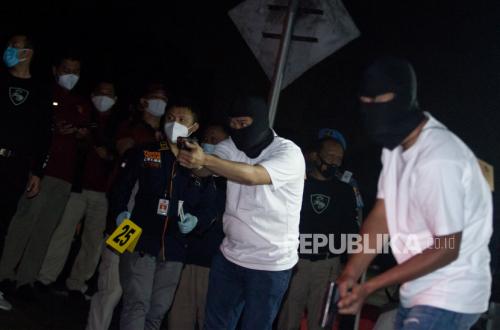
JAKARTA – Coordinating Minister for Political and Security Affairs Dudung Abdurachman has voiced support for reopening scrutiny of the alleged gross human rights violation involving the killing of six Islamic Defenders Front (FPI) members in 2020. What happened at the time, and what was the background?
The shooting of six FPI members at KM 50 on the Jakarta–Cikampek toll road on 7 December 2020 cannot be separated from the political and legal circumstances in Indonesia. The following timeline is based on reporting by Republika and distinguishes between events, the accounts given by the parties, and developments in the legal process.
Before the KM 50 incident, FPI was facing questions over its legal status. Its Registered Certificate (SKT) expired on 20 June 2019. The government under President Joko Widodo said that FPI, led by Rizieq Shihab (HRS), no longer had legal status as a mass organisation after the certificate expired on 21 June 2019 and was not renewed.
Around three weeks after the shooting, on 30 December 2020, the government formally banned FPI activities through a joint decree signed by six ministers and agency heads. The announcement was made by then Coordinating Minister for Political, Legal and Security Affairs Mahfud MD.
The government said FPI no longer had legal standing, either as a mass organisation or as an ordinary organisation. It also prohibited the use of FPI symbols and attributes and ordered all its activities to cease.
The government’s adversarial stance towards FPI at the time had earlier led HRS to seek refuge in Saudi Arabia. The Covid-19 pandemic repeatedly delayed his return. He eventually came back to Indonesia in November 2020.
His arrival, which was greeted by thousands of supporters, led to several legal issues relating to crowds and health protocols. Police then began tailing Rizieq’s convoy. Idham Azis was the National Police chief at the time.
The events begin
The incident began as HRS’s convoy travelled from The Nature Mutiara Sentul housing complex in Bogor to a destination in Karawang regency, West Java. From the night of 6 December into the early hours of 7 December 2020, police followed the convoy.
According to the National Human Rights Commission’s (Komnas HAM) investigation, officers from the Jakarta Metropolitan Police followed the group from the time it left the housing complex. HRS’s convoy comprised nine vehicles, with several police cars following it along the way.
Komnas HAM said the convoy initially travelled normally. But after leaving the Karawang Timur toll gate, seven of HRS’s vehicles moved ahead, while two escort vehicles fell behind.
The two vehicles were a silver Toyota Avanza, described as an escort car, and a Chevrolet Spin used by FPI’s Special Task Force. They later encountered the vehicles following them.
According to FPI’s account, as collected by Komnas HAM, the surveillance vehicles made several manoeuvres to enter the convoy. Police, meanwhile, said they were following it to establish HRS’s whereabouts.
The chase and exchange of gunfire
After leaving the Karawang Timur toll road, the FPI escort vehicles and police engaged in a series of manoeuvres, including tailing, edging in, sideswiping and chasing one another.
In Komnas HAM’s reconstruction, the incident escalated into mutual attacks and an exchange of gunfire. It took place around Jalan Internasional Karawang Barat, reportedly as far as KM 49, before ending at KM 50 on the Jakarta–Cikampek toll road.
At KM 50, two members of FPI’s Special Task Force were found dead inside a vehicle. Four others were still alive.
Komnas HAM said the first two victims were Faiz Ahmad Sukur and Andi Oktiawan. They died during the series of clashes before the other four victims came under police control.
During its investigation, Komnas HAM also received information about alleged removal of CCTV footage by officers, the cleaning of blood from the scene, and requests for residents to delete recordings or allow their mobile phones to be checked.
Komnas HAM recorded that police seized several pieces of evidence, including two homemade revolvers, a samurai sword, a sword, a sickle and a pointed wooden baton.
Source: jawawa.id (https://jawawa.id/newsitem/the-km-50-case-from-the-fpi-ban-to-the-killing-of-its-members-1795575119)
Originally published by Republika (https://analisis.republika.co.id/berita/tp1cj9393/rekam-kasus-km-50-pembubaran-fpi-sampai-pembunuhan-laskar), translated from Indonesian