
The Key to Reviving the Sharia Economy and Finance Lies in the Regions
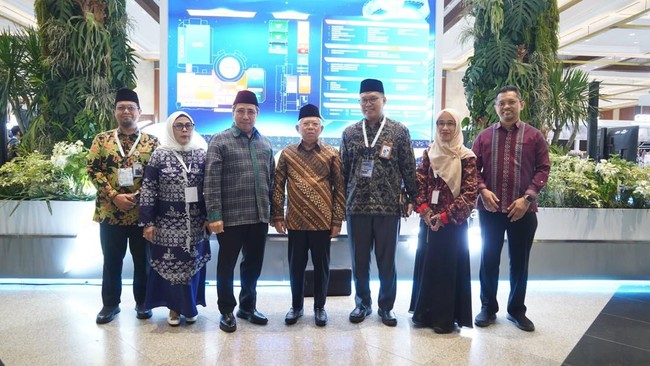
From the podium of the Plenary Hall at the Jakarta International Convention Center in Jakarta on Thursday, 15 October 2026, two messages were delivered that should be considered together. The first was a wake-up call: in the 2026 State of the Global Islamic Economy (SGIE) report, Indonesia had slipped from the top three to fourth place globally.
The second initially sounded like routine institutional advice, but contained the key to a recovery: Regional Sharia Economy and Finance Committees (KDEKS) must not depend on who holds office. Both messages were delivered by 13th Vice-President KH Ma’ruf Amin at the Central and Regional Synergy Forum, held as part of the 2026 Indonesia Sharia Economic Festival (ISEF).
I see them as one message. The answer to global competition in the sharia economy will no longer be determined in Jakarta, but in the provinces, regencies and cities. In the regions, that work rests on the shoulders of KDEKS.
Not Because We Are Weak
Kiai Ma’ruf does not interpret the fall in the rankings as a sign that Indonesia is weakening. “This is not because we are weak,” he said, but because other countries are moving faster, namely the United Arab Emirates. Rather than lowering its sights, Indonesia is raising its target: not merely to return to the top three, but to become number one. Such an ambitious target should be met with an honest question: where will the acceleration come from? Certainly not from grander ceremonies in the capital.
On the same occasion, Kiai Ma’ruf acknowledged that the achievements of Indonesia’s sharia economy have so far been too concentrated. He compared it to a tree, which cannot grow tall if its roots do not penetrate the soil in the regions.
This is where we differ from our competitors. The United Arab Emirates is advancing through seven emirates, while Indonesia must do so through 38 provinces. At first glance, that may seem a burden. But if every province moves in unison, it becomes an advantage we have yet to fully exploit.
A Mandate, Not a Preference
There has at times been a doubt voiced in the regions: does having programmes and allocating budgets for the sharia economy mean favouring one group? It is a fair question, and the answer is written in our own laws.
Article 33(4) of the 1945 Constitution requires the national economy to be organised on the basis of economic democracy, with the principles of solidarity and equitable efficiency. Legislators subsequently linked the sharia economy directly to that article.
Law No. 21/2008 on Sharia Banking makes Article 33 of the Constitution its legal basis and economic democracy its guiding principle. Its explanatory text defines economic democracy as sharia economic activity embodying the values of justice, solidarity, equitable distribution and public benefit.
The principles of sharia are also formulated on the basis of universality, rahmatan lil ’alamin: a blessing for all creation, not just one group. On these foundations, the state has built the legal framework for the sharia economy, one part at a time.
Social finance is covered by Law No. 41/2004 on Waqf, while consumer protection is addressed in Law No. 33/2014 on Halal Product Assurance. Law No. 59/2024 on the 2025–2045 National Long-Term Development Plan (RPJPN) subsequently incorporated it into the direction of national development.
So when local governments allocate funds to the sharia economy, they are not giving special treatment to one group. They are fulfilling the constitutional ideal of an economy that is fair, undertaken collectively and beneficial to everyone.
The regions have already responded to this mandate. Around 27 provinces have included the sharia economy in their Regional Long-Term Development Plans (RPJPD) and Regional Medium-Term Development Plans (RPJMD), and 23 of them have included indicators. This is more than just a figure. Article 264(1) of Law No. 23/2014 on Regional Government stipulates that both documents are enacted through regional regulations (Perda).
That means that in 23 provinces, sharia economy targets are a legally binding promise made by regional heads and provincial legislatures (DPRD) to their residents. North Sulawesi and Maluku provide fitting examples. These provinces, with diverse religious make-ups, have also established KDEKS. Maluku sees KDEKS as a way to finance fishers and micro, small and medium-sized enterprises (MSMEs). The sharia economy is understood as inclusive, not exclusive.
Guardians of the Promise on Paper
Promises in regional regulations will not fulfil themselves. Sharia economy indicators are spread across many government departments, and no single department can carry them alone. This is where KDEKS, particularly its executive management, plays a role that is difficult to replace.
Executive management and heads of regional government organisations (OPD), together with their teams, regularly meet to draw up Regional Action Plans and ensure programmes continue despite shifting local agendas. This work rarely makes the news. But without it, the indicators in regional regulations would remain figures on paper.
Gustav Radbruch’s triad helps assess its value. KDEKS delivers utility (Zweckmäßigkeit) by turning planning documents into programmes people can experience. It also advances justice (Gerechtigkeit) by ensuring policies reach small businesses, including through blended commercial and social financing for businesses that do not yet qualify for bank financing—a model promoted by Bank Indonesia as a KDEKS member.
Bank Indonesia has also said it is ready to oversee this collaboration through its 46 regional representative offices. The opportunity to demonstrate that role came sooner than expected. The day after the forum, the government announced an extension to the phased implementation of mandatory halal certification.
For micro and small businesses in the food, beverage and slaughtered-animal products sectors, the deadline is now October 2028. The next two years are a golden opportunity for KDEKS: enough time to identify MSMEs in each region, connect them with halal-certification assistants and inspection bodies, and help them gain access to financing.
Imagine if, by October 2028, regional MSMEs were no longer racing to meet the deadline, but welcoming it with halal certificates in hand. That is when KDEKS’s work will become visible in concrete terms.
Setting the Direction and Completing the Framework
Radbruch’s third value, legal certainty (Rechtssicherheit), demands one more thing: a clear direction. The sharia economy is already included in the planning documents of 27 provinces. In some, it is set out explicitly with indicators; elsewhere, it remains embedded within broader programmes.
The next task is to institutionalise a region-specific direction for sharia economy development: which sectors to prioritise, what targets to pursue, which government departments to assign, and what steps to take.
This direction would flesh out the RPJMD, guide Regional Action Plans and ensure the sharia economy does not change course every time a new planning cycle begins. Regions can start today, and KDEKS is best placed to draw up the plans.
At national level, legal certainty awaits one major step: a Sharia Economy Law. The bill is listed in the 2025–2029 National Legislative Programme (Prolegnas), after being included in the previous period’s list but not debated.
Unfortunately, it has not yet been included in the priority Prolegnas. Current regulations on the sharia economy remain scattered across various sectoral laws, operating separately without an overarching framework to bring them together. Such a law could provide that framework while aligning central and regional efforts, including KDEKS’s role.
For that reason, the Sharia Economy Bill should be added to the priority Prolegnas and debated promptly. Regions do not need to wait for the law before taking action. But the country needs it to ensure regional work is not in vain, and that the sharia economy remains on course through changes in leadership, both regionally and nationally.
From the Regions, Back to the Top
Fourth place is not a verdict. It is a score midway through the match. Indonesia has something its competitors do not: a network of regional committees in 31 provinces, sharia economy targets in the RPJMD regulations of 23 provinces, and officials working with government departments and central-government agencies, often without much attention.
To KDEKS officials and executive management: the message from the JICC Plenary Hall is an acknowledgement of your work. The system Kiai Ma’ruf referred to—in the regions—is you.
If Indonesia eventually returns to the top, its foundations will not be the stage in Jakarta, but the coordination tables in the regions that you continue to maintain. The sharia economy, Kiai Ma’ruf said, is an economy built through collective endeavour. And this community can move only as fast as the regions do.
Wallahu a’lam bish-shawab (God knows best).
Source: jawawa.id (https://jawawa.id/newsitem/the-key-to-reviving-the-sharia-economy-and-finance-lies-in-the-regions-1792342220)
Originally published by CNBC Indonesia (https://www.cnbcindonesia.com/opini/20261018223500-14-777278/kunci-kebangkitan-ekonomi-dan-keuangan-syariah-ada-di-daerah), translated from Indonesian