
The Key to Gontor's 100 Years: Hamid Fahmy Zarkasyi Identifies One Secret Word: Holistic!
One hundred years is not a short period for an educational institution to endure, let alone flourish. Amidst the era’s upheavages that have swallowed many large institutions, Pondok Modern Darussalam Gontor is entering its second century with an increasingly robust posture, producing thousands of alumni who influence almost every corner of Indonesian life.
Behind this extraordinary resilience, one question deserves to be asked: what is truly the secret of Gontor?
Prof. Dr. Hamid Fahmy Zarkasyi, Chairman of the Gontor 100th Anniversary Committee and son of one of the pondok’s founders, provided the answer in a single word: holistic.
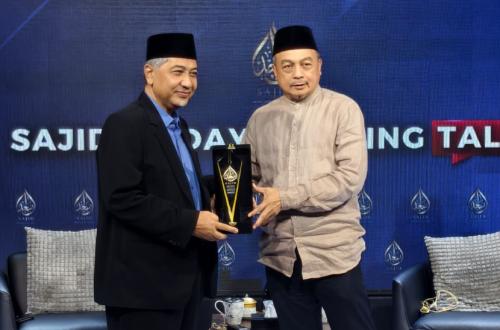
“The education in the pesantren is holistic. People gain much from it,” said Hamid during the SAJID Friday Morning Talk organised by the Indonesian Muslim Journalists Association at the AQL Islamic Centre, Jakarta, on Friday (4/9/2026).
A Pioneer Ahead of Its Time
To understand the greatness of Gontor, one must return to 1926, when the Indonesian Islamic education landscape was split into two opposing poles: traditional pesantren that taught classical texts (kitab kuning) without touching modern sciences, and Dutch colonial schools that separated education from religious roots.
Amidst this dichotomy, which was taken for granted at the time, three young brothers—KH Ahmad Sahal, KH Zainuddin Fananie, and KH Imam Zarkasyi, later known as the Trimurti—chose not to side with either. They built a third way.
On 20 September 1926, in a remote village in Ponorogo, East Java, Gontor was born not merely as a new pesantren, but as a manifesto for Islamic education that was entirely different from what had existed before.
Gontor was the first Islamic educational institution in Indonesia to systematically and consistently integrate religious and general sciences under one roof, one curriculum, and one breath, long before such a concept became a major agenda for national education reform. This was a breakthrough which, in modern academic language, is called epistemological integration: rejecting the separation between religious knowledge and worldly knowledge as two different and opposing entities.
This system was later formalised through Kulliyatul Mu’allim Al-Islamiyah, or KMI, a six-year secondary-level curriculum designed to produce Islamic teachers. It aims to produce students who are not merely memorisers of texts, but educators proficient in Arabic and English, knowledgeable in modern sciences, and possessing deep faith and strong character.
“The idea for Gontor’s education began with the founders’ desire to present an educational model different from the pesantren traditions of that era. They wanted to produce scholars who possessed intellectual capabilities and could keep pace with modern developments without losing their religious foundations,” explained Hamid.
More Than a School: A Small Civilization
However, Gontor does not stop at the curriculum. Indeed, this is where its deepest uniqueness lies, which is difficult to replicate. KMI is merely the formal framework. Gontor’s true strength lies in something not written in any syllabus: the life of the pesantren as a laboratory of civilisation that operates 24 hours a day without pause.
A Gontor student does not only learn in the classroom. They live within an educational ecosystem designed with great precision. Every hour, every interaction, every activity, and even every greeting in the dormitory corridors is part of the process of human formation.
“Therefore, the pesantren holds intrinsic value. Within the pesantren, there is a system of life that schools do not possess,” said Hamid.
Source: jawawa.id (https://jawawa.id/newsitem/the-key-to-gontors-100-years-hamid-fahmy-zarkasyi-identifies-one-secret-word-holistic-1788562320)
Originally published by Republika (https://khazanah.republika.co.id/berita/tkv0rq451/kunci-100-tahun-gontor-hamid-fahmy-zarkasyi-sebut-1-kata-rahasianya-holistik), translated from Indonesian