
The "Kelangan Bondo" Philosophy Becomes Yogyakarta Residents' Resilience Against Earthquakes
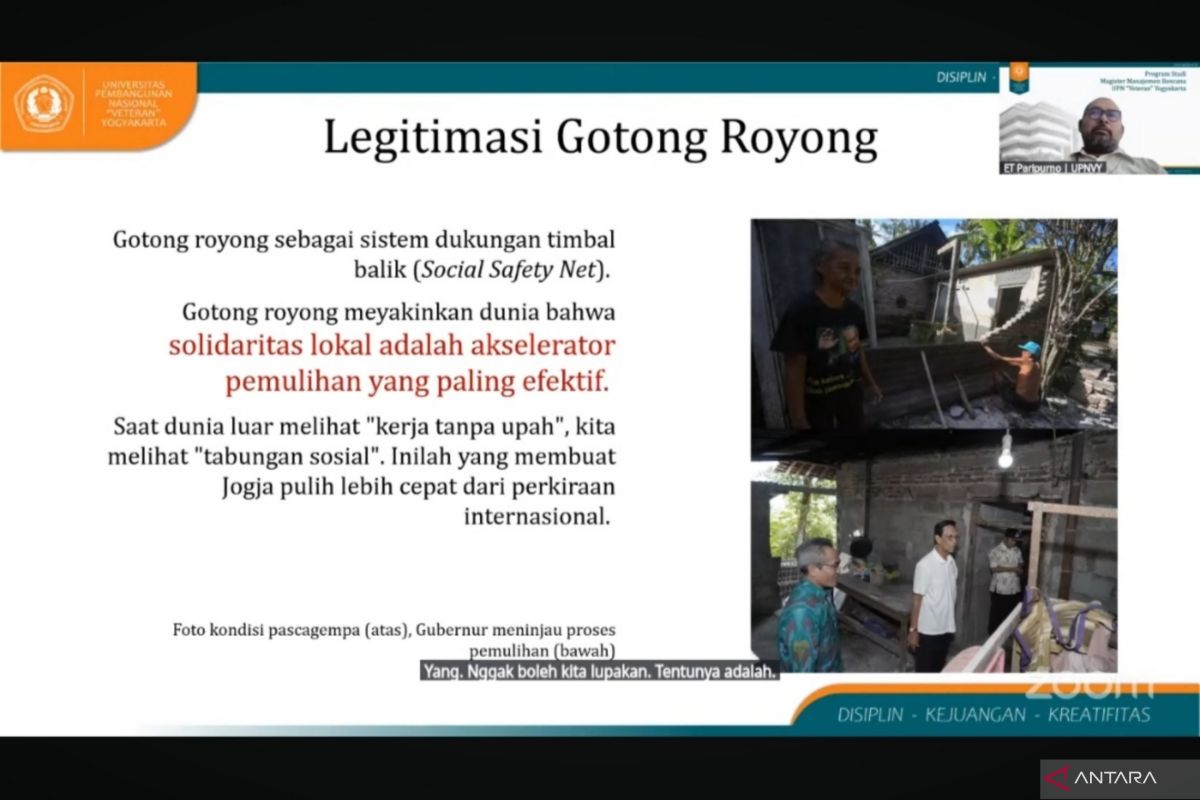
Jakarta (ANTARA) - Professor Dr Eko Teguh Paripurno, Chair of Geological Disaster Management at UPN Veteran Yogyakarta, has revealed that the philosophy of life among the local community is key to the mental resilience of residents when facing the economic impacts after the 2006 Yogyakarta earthquake. During a seminar marking the 20th anniversary of the Yogyakarta earthquake in Jakarta on Thursday, Eko explained the principle of “Kelangan bondo podo karo ora kelangan opo-opo” or “Losing possessions is the same as not losing anything,” which prevents the community from succumbing to prolonged trauma. “Mental strength is the key. The community views the loss of possessions as a test that can be overcome through togetherness. This philosophy serves as learning energy for development and resilience,” said Eko, who is affectionately known as Kang ET. Moreover, according to him, support also came from residents who independently, under government-volunteer guidance, mobilised local resources, from labour to materials, to accelerate economic and livelihood recovery. “Thus, this social modality enabled Yogyakarta’s community to transform from a fragile post-disaster condition into active agents in rebuilding their region,” he stated. As per data from the National Disaster Management Agency (BNPB) presented at the seminar, the 5.9 SR/4.4 magnitude earthquake that struck Yogyakarta and Central Java on 27 May 2006 at 05:54 WIB was one of Indonesia’s deadliest disasters. The disaster resulted in more than 5,700 deaths, tens of thousands injured, and over 300,000 housing units affected. BNPB recorded total economic losses at that time amounting to Rp29.1 trillion, with the housing sector being the largest contributor to the damage. Despite the massive impact, the post-Yogyakarta earthquake rehabilitation and reconstruction process is often cited as one of the fastest and most successful recovery models in the world, due to strong community involvement and local leadership. Raditya Jati, Deputy for Systems and Strategies at BNPB, stated that the event was a major momentum in the birth of Law No. 24 of 2007 on Disaster Management, which shifted the paradigm from mere emergency response to risk reduction. In this regard, Yogyakarta is also regarded as a centre of excellence or national disaster management learning hub due to its extraordinary social capital and strong multi-stakeholder collaboration, from government, academics, to community volunteers. “Yogyakarta is the first place where the Disaster Risk Reduction Forum (PRB) and disaster study centres at universities were formed. Other regions must learn from Yogyakarta’s resilience in rebuilding their areas post-disaster,” said Raditya. The Head of the Yogyakarta Special Region (DIY) Regional Disaster Management Agency (BPBD), Agustinus Ruruh Haryata, hopes that through this 20th anniversary commemoration of the Yogyakarta earthquake, it can serve as a momentum for the government, academics, and survivor communities to continue nurturing collective memory while ensuring that disaster mitigation instruments in earthquake-prone areas are further strengthened for public safety.
Source: jawawa.id (https://jawawa.id/newsitem/the-kelangan-bondo-philosophy-becomes-yogyakarta-residents-resilience-against-earthquakes-1776322251)
Originally published by Antara (Indonesian) (https://www.antaranews.com/berita/5528876/falsafah-kelangan-bondo-jadi-resiliensi-warga-yogyakarta-dari-gempa), translated from Indonesian