
The Irony of Yellowish Rice
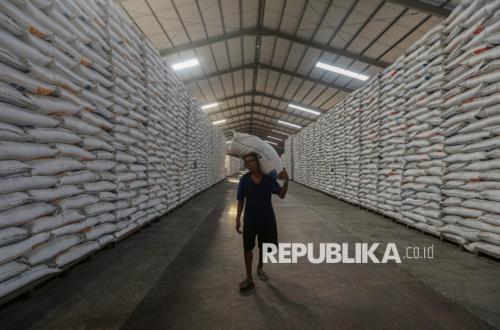
The issue of Bulog rice distributed to beneficiaries in Bangkapan Regency, Madura, has become a heated topic of discussion across various circles. Dozens of villages in the area have ‘rejected’ the government assistance rice.
The reason provided is that the distributed rice has turned yellowish, even leaning towards a light brown colour. Regarding yellowish rice, this is actually not a new phenomenon for aid recipients in this country. In fact, this has persisted since the government launched the Rice for the Poor (Raskin) programme in the early 2000s. Even worse, the rice provided is not only yellowish in colour but also has a musty smell.
Based on experience, Bulog rice distributed to beneficiaries/CBP/Food Assistance often appears yellowish due to three main factors. First, old rice/food reserve stocks. SPHP/Social Assistance rice is taken from the Government Rice Reserve (CBP). Consequently, it is not newly milled rice. The longer it is stored, the more the white colour of the rice can change to a yellowish/ivory hue. This is a natural oxidation and ageing process. The quality remains good if the rice is stored correctly.
Second, variety and milling methods. Bulog receives paddy from farmers across Indonesia. There are varieties where the grain is naturally somewhat yellow rather than clear white. Additionally, Bulog usually mills to a medium grade rather than a premium polish. Thus, the aleurone/bran layer still adheres slightly, making the colour more creamy/yellow. Third, the drying and storage process. Bulog paddy/rice is dried using mechanical dryers to maintain a moisture content of 14 per cent for preservation. If the heating process is too high, the rice can turn ‘yellow’ due to the starch. This is compounded by being stored in large quantities in air-conditioned warehouses or silos for many months.
A critical question remains: why is there still yellowish rice despite Bulog sorting the rice intended for distribution? One might also question how Bulog’s sorting process actually functions.
As understood, upon receiving rice from farmers/millers, the rice enters Bulog warehouses having passed quality tests. The maximum moisture content is 14 per cent, broken grains a maximum of 25 per cent, empty grains a maximum of 2 per cent, along with colour, smell, and taste. This is classified as Medium SPHP rice according to the determined SNI (Indonesian National Standard).
Furthermore, before being packaged in 5kg/10kg weights, there are sieves and stone removal machines to discard pebbles, husks, and paddy. However, Bulog’s machinery is not as precise as premium rice machines. The primary goal is to remove foreign objects, not to achieve 100 per cent selection of non-yellow grains.
Regarding the CBP/Social Assistance standards, because this is reserve rice held in massive volumes of up to millions of tonnes, the tolerance for yellow or broken grains is looser compared to ‘super’ rice. As long as it meets the Medium SNI standard, it is deemed fit for distribution. This is why yellowish or broken grains are sometimes present.
Why does yellowish rice persist? It is possible that Bulog’s colour sorting machines are not as sophisticated as those in private factories. Colour sorter machines are expensive and prioritised for exports/premium products. It could also be due to the pressure to meet distribution targets. For example, in June 2024, Bulog is accelerating the distribution of food assistance and SPHP. If sorting were super strict, the process would take longer, or the CBP stocks may simply have been stored for a long time.
The rejection from several villages in Bangkalan, Madura, regarding the quality of Bulog-managed assistance rice serves as a ‘warning’ for food operators to be more serious in managing rice aid for beneficiaries.
Bulog must learn from past experiences. Faced with such conditions, Bulog should adopt a pattern of ‘listen first, explain later, and improve together’. If they become defensive or force the distribution, rejection from other villages could spread. There are three logical steps for Bulog to undertake.
First, go into the field and listen to the complaints. Rejections of assistance rice are usually not without reason. In Bangkalan/Madura, issues often arise due to:
Rice quality: Some villages complain that the rice is broken, infested with weevils, or differs from expectations. Madura is known for preferring ‘pera’ (dry/firm) rice, so if they receive very ‘pulen’ (soft/sticky) rice, it may be rejected.
Recipient data: The names of recipients do not match the real conditions in the village. For instance, those deemed capable receive aid while those in need are excluded from the list.
Timing/Distribution: Deliveries are late, procedures are complicated, or residents feel the process is being ‘institutionalised’ without consultation.
In this context, Bulog needs to engage with village heads, religious leaders, and the Village Consultative Body (BPD). Sit down together. The goal is validation: is the problem the rice, the data, or the communication?
Second, prioritise transparency and education. If the issue is quality, Bulog must disclose the specifications: this is Medium SPHP rice, and this is the SNI standard. Explain why the colour/texture is as it is. Provide an option: exchange it with the nearest warehouse if it is indeed below standard.
If the issue is data, involve the Bangkalan Regency Government and the Ministry of Social Affairs to rectify the DTKS (Integrated Social Welfare Data) alongside village officials. Bulog itself does not hold recipient data; it acts only as a distributor.
Third, provide space for local solutions. Villages in Madura have strong social structures and village institutions. Bulog could offer two options. First, exchange the rice for a variety preferred by Madura residents, if stocks allow. Second, if the village rejects the physical rice, distribute it through other programmes like Non-Cash Food Assistance (BPNT), or redirect the rice to neighbouring villages that need it, along with compensation funds for the village programme.
What Bulog must avoid is responding through the media with a tone of ‘This is aid, you should be grateful’. That will only cause unrest. Also, do not force unloading and distribution if village heads and leaders have agreed to reject it. The political cost is too high. Ultimately, food assistance is not just about stocks, but about the feeling of being respected. In Madura, ‘consultation’ is the key.
In conclusion, the yellowish colour of rice provided to beneficiaries is truly an irony in the nation’s rice industry.
Source: jawawa.id (https://jawawa.id/newsitem/the-irony-of-yellowish-rice-1781495573)
Originally published by Republika (https://analisis.republika.co.id/berita/tgnldk472/ironi-beras-kekuningkuningan), translated from Indonesian