
The Indonesian Student Movement and Its Relation to PMKRI's Ideological Pilgrimage
The student movement in Indonesia is standing at a bitter crossroads. After passing through the dawn of the 1998 Reformasi, contemporary socio-political dynamics show a worrying tendency towards the domestication of the movement. The proliferation of ceremonial culture and the entrapment of student organisation elites in the circle of practical political transactions at the central level have distanced them from the real grassroots base in the regions. As a result, an epistemological rift has occurred between the discourse debated in the ivory towers of power and the concrete reality of the oppressed people.
This symptom is marked by the weakening of scientific criticism and in-depth policy research before a mass movement is launched. Advocacy often gets trapped within the boundaries of formality, marching with banners without a solid data foundation. When the student movement loses its scientific anchor, it becomes vulnerable to being held hostage by political debts to interest groups, leading to intellectual anaemia. This bitter reality confirms the urgency of a thorough reorientation of the movement as a historical necessity. Student organisations must reforge their axis as independent and sovereign prophetic intellectual wombs to become the nation’s moral and intellectual compass.
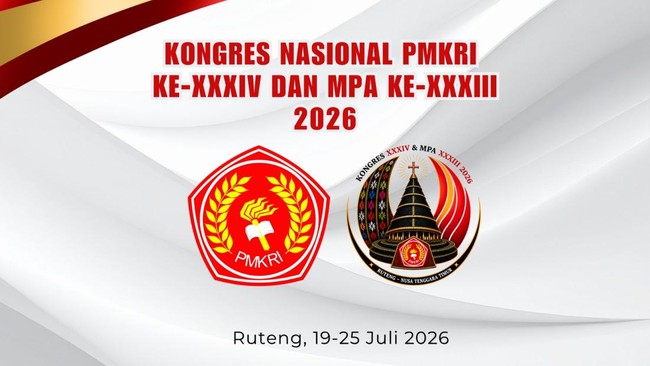
The Perhimpunan Mahasiswa Katolik Republik Indonesia (PMKRI), as an integral part of the national movement’s history, is not immune to this challenge of the times. At 79 years old, the organisation is required to accelerate internal transformation to answer global complexities. The grand gathering at the National Congress and Members’ Consultative Assembly in Ruteng, Manggarai, East Nusa Tenggara, on 19-25 July 2026, is a crucial momentum to ground a new roadmap through the Panca Dharma Transformasi.
The first step of this ideological pilgrimage must begin with cognitive sovereignty through the acceleration of digital and intellectual-based cadre formation. Currently, PMKRI oversees 88 branches across the country, a number set to grow with the planned addition of three new branches. This vast socio-geographical spread presents the challenge of unequal access to knowledge. Overcoming this cognitive disparity requires the establishment of an integrated digital ecosystem to ensure equal access to intellectual modules and leadership training without geographical barriers. Campuses must be restored as the primary base of the movement through advocacy for higher education rights and the expansion of scholarship networks, so that no potential cadre is forced to drop out due to economic constraints.
Furthermore, the movement’s orientation must shift towards prophetic advocacy that translates altar spirituality into street liturgy. Through the marriage of Amor and Ratio, the student movement must evolve into a data-driven pressure force by establishing strategic research institutions. This street liturgy demands that every step of a cadre’s advocacy becomes a prayer in action and every demand is a testimony of faith born from mature research. The organisation must be present as a militant defender of humanity in the public sphere; defending workers discriminated against by algorithms, indigenous communities losing their living space, and leading the narrative of global climate justice.
Institutionally, organisational rejuvenation and inclusive collaboration are absolutely necessary to tear down internal ivory towers. The organisation’s governance must be modernised to be adaptive to automation and digital disruption. At the domestic level, building strategic coalitions with other student organisations in cyberspace is important to safeguard democratic sovereignty from polarisation. Meanwhile, at the global level, strengthening diplomatic positioning in international networks aims to send the best cadres to world youth forums to broaden the movement’s horizons beyond national borders.
However, this entire structure of ideas will be fragile without economic independence and financial sovereignty. The courage of the student movement is often blunted by financial dependence on certain political patrons. This chain of patronage must be broken by building independent business units, such as digital cooperatives and smart agriculture, to bury the culture of begging for proposals from power brokers. Supported by transparent and accountable organisational financial digitalisation, the organisation will gain the absolute trust of all its cadres.
All of this transformative movement culminates in the internalisation of contextual Catholic values. Grounding the Church’s Social Teaching as a moral compass in the age of algorithms is the answer to the challenges of structural poverty, human rights, and even artificial intelligence. Students must reject a sterile faith that hides behind sacred walls. Instead, they must actively become facilitators of interfaith dialogue, re-weaving the fabric of diversity that transcends ethnic, religious, racial, and inter-group barriers, and enlivening an inclusive universal brotherhood.
Through these five contextual pillars of transformation, the PMKRI Congress and MPA in Ruteng in July 2026 must not be reduced to a mere stage for power struggles or elite factionalism. This grand gathering of 88 branches from across the country must be positioned as an ideological convergence point to affirm that this organisation is a living force with a real impact on society. This national pilgrimage in Ruteng must put an end to a sterile faith behind walls of comfort. It is time for every step of a cadre to become a real liturgy that defends the rights of the oppressed and speaks out firmly amidst an increasingly bitter national situation.