
The Indonesian Inventor of the 'Cakar Ayam' Foundation, Who Once Astonished the Dutch
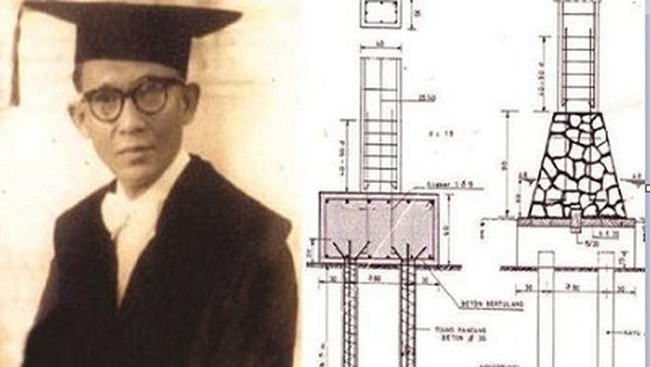
An Indonesian engineer’s project once left the Dutch in awe. His design was considered a deviation from the formulas used by engineers worldwide at the time. Yet, behind this modern engineering approach, the designer also practised Javanese tradition by burying a buffalo head before construction commenced.
The engineer was Sedyatmo, the figure known as the inventor of the ‘cakar ayam’ foundation construction. His name is now immortalised as one of the sections of the Jakarta toll road.
In 1936, two years after earning his engineering degree, Sedyatmo was entrusted by Mangkunegoro VII to build an aqueduct in Wiroko Village, Wonogiri. The bridge was designed to channel water from the Wiroko River for use by local farmers. The project was far from easy; the construction site was remote, access roads were inadequate, and the surrounding area was infested with venomous snakes. Nevertheless, Sedyatmo remained undeterred, designing the bridge with principles of material, cost, and time efficiency, while ensuring a strong and high-quality structure.
Alongside his modern technical approach, Sedyatmo did not abandon the local customs of the community where he worked. Before construction began, he slaughtered a buffalo and buried its head around the project site. In the Javanese beliefs of that era, burying a buffalo head served as an offering to the guardian spirits of the land to ensure smooth construction and the protection of workers. However, in his autobiography, Sedyamento clarified that he did not perform the tradition out of mystical belief, but rather to respect the community involved in the project. “Sedyatmo performed the custom, but not with such belief. He did it solely to provide peace of mind to the community and those helping him,” he stated, as quoted in ‘Prof. Dr. Ir. Sedyatmo: Intuition Sparks Creativity’ (2019).
Following the slaughter, Sedyatmo recalled that the buffalo meat was eaten together by residents and workers as a symbol of togetherness, while the head was buried as it consisted mostly of bone and was difficult to utilise.
Despite the customs, Sedyatmo’s work faced opposition from Dutch engineers. They argued his bridge design deviated from standards because it used thinner concrete than the prevailing technical norms. However, Sedyatmo remained confident, arguing that they were too fixated on textbook theories. “The strength of that bridge was no less than bridges using conventional formulas,” said the man born in 1909.
When the project was completed in 1937, the results exceeded expectations. The Wiroko Water Bridge stood firm, proving Sedyatmo’s calculations were correct. This success became a turning point in his career. His ability caught the attention of a high-ranking official in the Dutch East Indies Public Works Department, Prof. Ir. Bijlaard, who invited the bridge engineer to join the department, making Sedyatmo the first Javanese person to work there.
Sedyatmo’s achievements continued to grow. In 1953, he was appointed Professor at the Bandung Institute of Technology (ITB) in the field of Hydraulic Power. His career reached its pinnacle in 1961 with the invention of the ‘cakar ayam’ foundation construction. The ‘cakar ayam’ is a reinforced concrete slab foundation used on unstable soil. His invention eventually received international patents from dozens of countries, establishing him as one of the most influential engineers in Indonesian history.
Source: jawawa.id (https://jawawa.id/newsitem/the-indonesian-inventor-of-the-cakar-ayam-foundation-who-once-astonished-the-dutch-1785549103)
Originally published by CNBC Indonesia (https://www.cnbcindonesia.com/entrepreneur/20260731184240-25-755597/orang-ri-ini-penemu-fondasi-cakar-ayam-pernah-bikin-geger-belanda), translated from Indonesian