
The Importance of Plant Identification Knowledge for Plant Conservation Staff
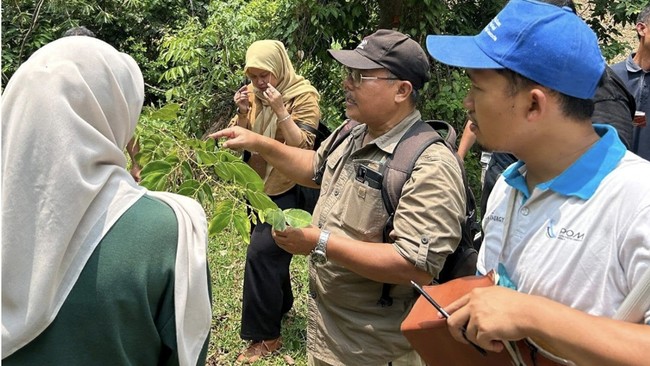
Indonesia is known as one of the countries with the highest biodiversity in the world. This wealth consists not only of fauna but also of flora spread from lowland forests to mountains, from the western to the eastern regions of Indonesia.
Various types of plants live naturally in forests, while others are collected, propagated, and planted in plant conservation areas, including botanical gardens. This wealth is a national asset that must be well-known, understood, documented, and preserved.
In this context, plant identification knowledge and ability are essential competencies for staff who interact with plants daily. This skill should not be limited to researchers or botanists, but should also be possessed by field staff, collection managers, technicians, conservation workers, nursery staff, maintenance personnel, and any other staff whose work involves direct interaction with plants.
Staff working within the Ministry of Forestry (Directorates General of PHKA and Planology), Bogor Botanical Gardens, Cibodas Botanical Gardens, Purwodadi Botanical Gardens, Eka Karya Bali Botanical Gardens, Cibinong Botanical Gardens, and various regional botanical gardens across Indonesia, essentially maintain a very close relationship with plants.
They do not merely view plants as objects to be cared for, but also deal directly with various species, genera, and families of plants that possess different characteristics and needs. The question then arises: to what extent has plant identification knowledge become a fundamental skill for these staff members?
This question is vital because errors in recognising plants can have numerous consequences. Plants sharing the same local name are not necessarily the same species. Conversely, a single plant species may have many different regional names.
Furthermore, some plants that appear similar at first glance are actually different species. Without good identification skills, errors in naming and recording can occur, ultimately affecting collection management and conservation activities.
Plant Identification is the Foundation of Collection Management
Plant identification is essentially the ability to recognise and determine the identity of a plant based on its characteristics. These characteristics can include the shape and arrangement of leaves, stems, flowers, fruit, seeds, bark, or other features. At an advanced level, identification can utilise determination keys, herbaria, botanical literature, and various scientific information sources.
For institutions managing plant collections, identification is not an optional task; it is the foundation of collection management. A plant planted in a conservation area must have a clear identity.
From that identity, the scientific name, family, collection origin, geographical origin, conservation status, and various other necessary management information can be determined. If the initial identity is incorrect, all subsequent information is also prone to error.
This situation becomes even more critical when discussing botanical gardens. Plant collections in botanical gardens are not merely ornamental. Every individual plant is part of a scientific collection and a genetic resource with conservation, research, educational, and utilisation value.
Therefore, staff working with plant collections should ideally possess at least the minimum ability to recognise the plants they handle. Not all staff need to be taxonomists, but they need sufficient basic knowledge to differentiate plant groups, recognise important characters, understand scientific names, and know when a plant requires further identification by experts.
Field Staff are on the Front Line
Field staff are in a very strategic position. They are the individuals who interact directly with plants every day, performing maintenance, watering, fertilising, pruning, nursery work, propagation, planting, monitoring, and data collection.
In these activities, the ability to recognise plants is essential. Imagine a staff member discovering a plant growing naturally within a forest area where the species is not yet certain.
If the staff member possesses basic identification knowledge, they can perform an initial observation: examining the shape and arrangement of leaves, stem characteristics, and flowers or fruit if available, then recording and documenting them. This data can serve as vital material for further identification processes.
The same applies to plant conservation areas. When a staff member notices a plant with abnormal growth, a missing label, or a plant suspected to be inconsistent with collection records, identification skills will help detect these issues early.
Thus, field staff are not merely technical executors but can also function as the first eyes and ears in managing plant biodiversity.
Crucial for Native Forest Plants
Plant identification knowledge is increasingly important for staff working in forest areas. Indonesia possesses forests with highly diverse plant compositions. Many plant species are not widely known to the public, and some exhibit high morphological similarity.
In activities involving inventory and field monitoring, the ability to recognise species is the primary asset. Identification errors can lead to inaccurate plant diversity data.
Source: jawawa.id (https://jawawa.id/newsitem/the-importance-of-plant-identification-knowledge-for-plant-conservation-staff-1789354539)
Originally published by CNBC Indonesia (https://www.cnbcindonesia.com/opini/20260914092158-14-767601/pentingnya-pengetahuan-identifikasi-tumbuhan-staf-konservasi-tumbuhan), translated from Indonesian