
The Importance of Early Emotional Regulation: Building Mental Health Literacy in Primary Schools
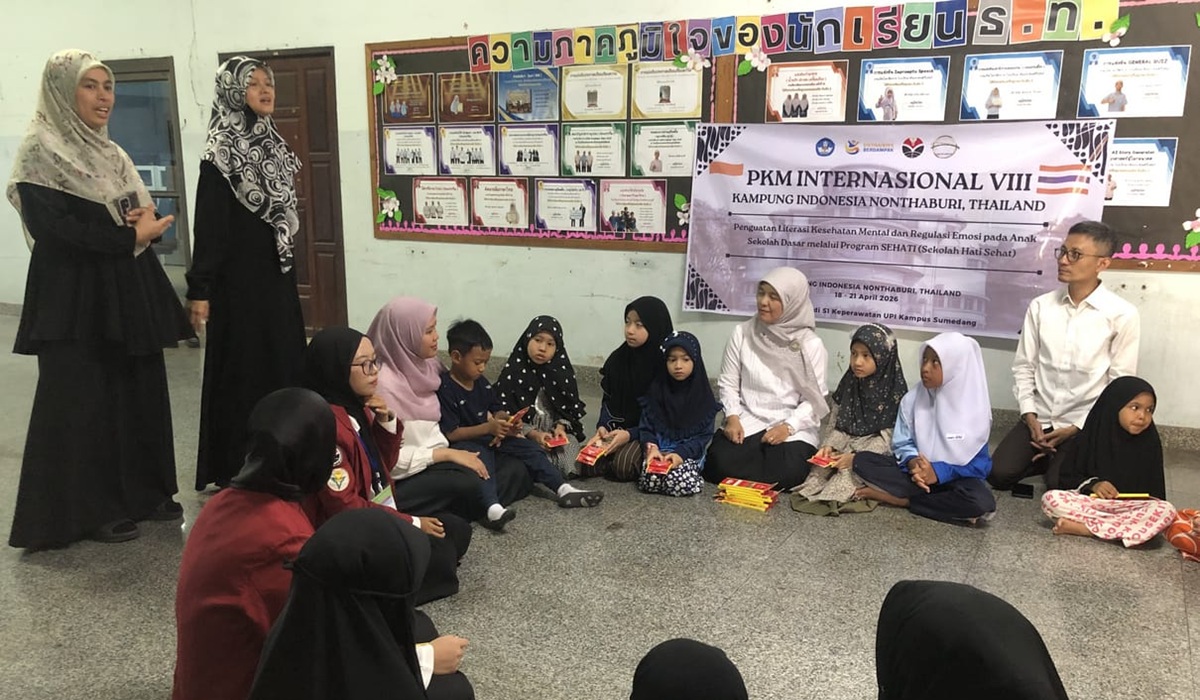
Mental health literacy among children is often neglected amid the dominance of an emphasis on academic achievement in the primary education system. Yet primary school age is a crucial phase for children to learn to recognise and manage their emotions to prevent bullying and withdrawal from social environments. To address these challenges, a community service team from the S1 Nursing programme at Universitas Pendidikan Indonesia (UPI), Sumedang Campus, undertook tangible actions on the international stage. Through a programme titled SEHATI (Sekolah Hati Sehat – Healthy Heart School), the team provided education on strengthening mental health literacy and emotional regulation for students in Thailand. The activities took place from 18-21 April 2026 and targeted students at Thammislam Foundation School, Nonthaburi. The programme was led by Sri Wulan Lindasari, with the involvement of lecturers Heri Ridwan and Ria Inriyana, and a student, Putri Karmilah. Here are details of the community service programme: Low mental health literacy means many children do not have an adequate “emotion language” to describe how they feel. Consequently, unregulated emotions often erupt into maladaptive behaviours. Through SEHATI, pupils are invited to recognise a range of emotions such as happiness, sadness, anger, and fear as normal. It is not only theoretical; children are trained in simple emotion-regulation techniques, such as: “SEHATI presents an educational endeavour to instil mental health understanding among primary school pupils through interactive, enjoyable activities that are appropriate to the child’s stage of development,” said Sri Wulan Lindasari. For UPI, this initiative is a tangible implementation in supporting the Sustainable Development Goals (SDGs). The programme touches on three key SDGs, namely: The experience in Nonthaburi confirms that issues surrounding child mental health are universal. The success of the SEHATI programme demonstrates that building a future generation requires more than intellectual prowess; it also requires emotional and social resilience from an early age. (Z-1) Professor Semiarto Aji Purwanto of Universitas Indonesia (UI) disclosed a shift in the trend of young people’s comfort from material comfort to experiential comfort. Psychologist Kasandra Putranto explains the fundamental difference between burnout and ordinary physical fatigue, particularly for people engaged in side hustles. Psychologist Kasandra Putranto outlines the signs of burnout from physical, psychological, and behavioural perspectives, as well as recovery steps through mental health services. Indonesia Sehat Jiwa appears as a safe space for mental health among young people in Malang, challenging stigma through a biopsychosociospiritual approach. The Ministry of Health asserts that SSRI antidepressants are not addictive and effective in treating depression. Stigma around mental health medications remains a major challenge. Clinical psychologist Teresa Indira Andani explains the fundamental difference between emotions and stress and how best to support someone who is feeling overwhelmed. Emotional eating is one form of eating behaviour driven by emotional control rather than hunger. Simple steps such as practising gratitude and forgiving oneself are effective ways to maintain emotional balance amidst work pressures. Parental emotional outbursts are often triggered by unstable physical and psychological conditions. Fasting can increase Brain-Derived Neurotrophic Factor (BDNF), a protein crucial to cognitive function and the ability to regulate emotions.