
The impact of forest and land fires on Bornean orangutans goes beyond the flames
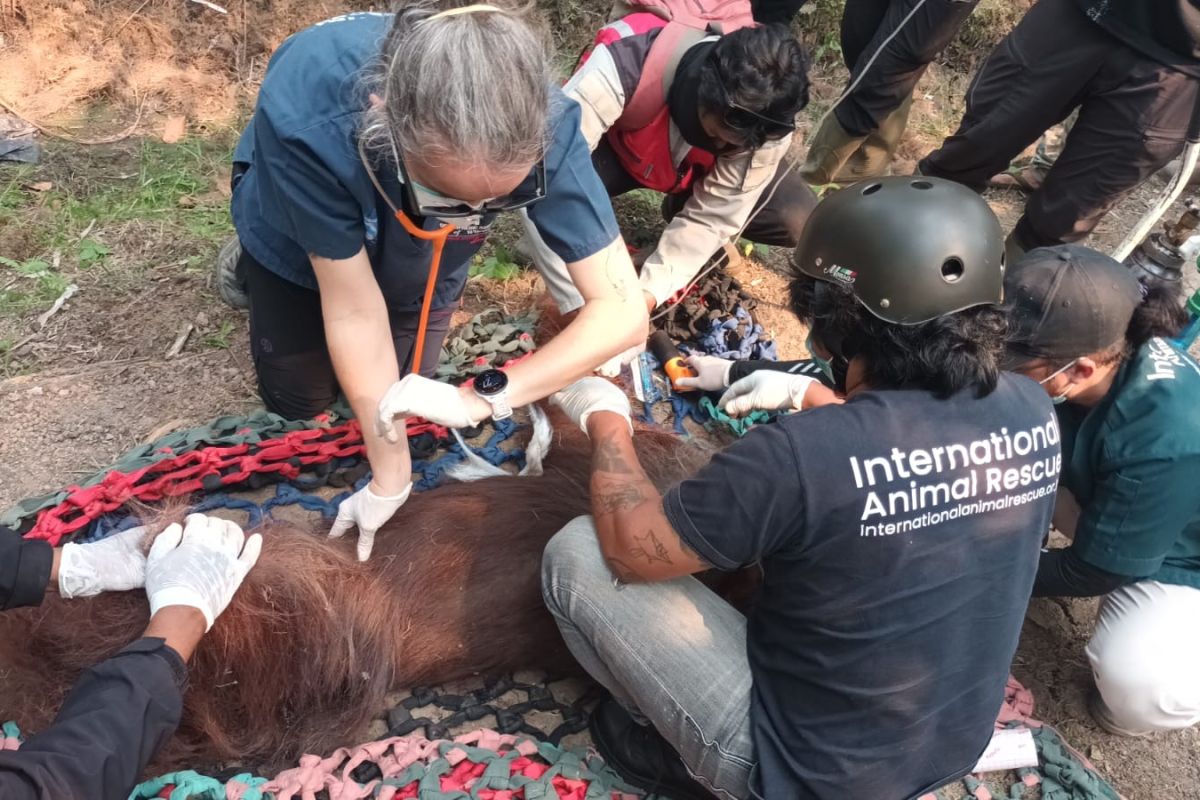
Jakarta (ANTARA) - The death of a Bornean orangutan named Sempurna has brought sorrowful news amid the forest and land fires sweeping several areas of Kalimantan. The adult male orangutan was found in a severely weakened state suffering from respiratory distress at an oil palm plantation in Ketapang Regency, West Kalimantan, on Sunday (30/8).
According to the West Kalimantan Natural Resources Conservation Centre (BKSDA), Sempurna was discovered in a dry ditch, unable to stand. The BKSDA team, together with the International Animal Rescue Indonesia foundation (YIARI), carried out an evacuation and provided treatment in the form of oxygen therapy and intravenous fluids.
However, Sempurna’s condition continued to deteriorate until he was pronounced dead later the same day. The results of a necropsy on 1 September revealed pathological changes in several organs, particularly the lungs, heart, and kidneys. The lungs showed congestion and partial atelectasis which, based on his clinical history and examination, is suspected to be linked to smoke exposure that can cause acute hypoxia, or a lack of oxygen in the body.
Sempurna’s story serves as a reminder that forest and land fires are not merely about burnt land or smoke disrupting human activities. For orangutans, fires can threaten their future by destroying the habitat where they live, forage, and breed.
The Bornean orangutan (Pongo pygmaeus) is a species heavily dependent on the forest. Their lives are closely tied to the presence of trees, which provide both food and a place for activity and shelter.
When a forest burns, the problem is not simply the loss of a number of trees. If the affected area is extensive enough, orangutans can lose part of their roaming range and their food sources at the same time.
The fires then compound that pressure.
The Borneo Orangutan Survival (BOS) Foundation notes that every fire in the forests of Kalimantan can mean the loss of homes and food sources for wild orangutans. In the Mawas area of Central Kalimantan, for instance, more than 43 hectares of peat swamp forest within the BOS conservation landscape had burnt or been affected as of August 2026.
When forest burns, food disappears with it
Orangutans require a wide variety of food sources found in the forest. Fruit, leaves, bark, flowers, and other plant parts all form part of their diet.
Fire can wipe out this vegetation. Even after the flames are extinguished, a burnt forest will not necessarily immediately provide food in the same quantities as before.
Forest recovery takes time. In certain ecosystems, especially peatlands, the recovery process can take an extremely long time.
This means that orangutans that manage to escape the flames still face problems after the fire. They must search for food in areas that may have changed drastically.
This situation can drive orangutans to travel ever further to find food sources. Not infrequently, these journeys bring them to plantations or areas close to human activity.
Sempurna’s death shows that the threat posed by forest fires is not always visible in the form of burns.
Sempurna was found without open wounds or severe burns, but was suffering from respiratory distress. The necropsy subsequently revealed changes in the lungs suspected to be linked to smoke exposure and oxygen deprivation.
The threat of smoke has also become a concern at the Nyaru Menteng Orangutan Rehabilitation Centre in Central Kalimantan. The BOS Foundation reported that smoke from fires in the surrounding area had begun to be felt at the rehabilitation centre and air quality was deteriorating. Although there were no cases of acute respiratory infection among the orangutans at the centre at the time, the situation continued to be monitored, as prolonged exposure could affect the animals’ health.
This demonstrates that protecting orangutans during forest and land fires requires monitoring that looks not only at the presence of flames, but also at air quality and the animals’ health.
The orangutans’ future is determined by the state of the forest
The greatest threat to orangutans is not a single fire event. What needs attention is how repeated fires can affect habitat conditions over the long term.
Imagine a forest that burns repeatedly. Large trees diminish, the plants that serve as food sources disappear, and the area becomes increasingly fragmented.
For orangutans, such conditions transform habitat that once supported life into areas that are increasingly difficult to inhabit.
That is why the future of the Bornean orangutan is closely tied to humanity’s ability to protect the forests that remain while restoring areas that have already been damaged.
Conservation efforts cannot be limited to responding when orangutans are injured or trapped in burnt areas. Measures such as evacuation and rehabilitation are indeed important, but fire prevention and habitat protection are far more fundamental tasks.
When forests lose their food sources, orangutans may move towards plantations or settlements.
For communities, the appearance of wild animals near their gardens naturally raises concerns. However, such movement does not always mean orangutans want to be near humans.
They may simply be searching for food or a safer place after their habitat has been disturbed.
This is one reason why forest and land fires also carry the potential to increase conflict between humans and wildlife. The more habitat is damaged, the greater the likelihood that animals will leave the forest.
Handling orangutans that enter human areas also requires personnel and institutions with conservation expertise. Communities can help by reporting the presence of wildlife to the authorities so that rescue operations can be carried out properly.
There is still hope to save them
Amid these various threats, the future of the Bornean orangutan is not without hope.
Rapid responses to affected animals show that there are still individuals that can be saved when help arrives.
In August 2026, for example, conservation teams in West Kalimantan rescued a number of orangutans affected by forest and land fires. In Central Kalimantan, teams at the rehabilitation centre continued to monitor the orangutans’ condition as air quality deteriorated due to smoke.
The government is also continuing to strengthen its response to forest and land fires across various regions. The Ministry of Forestry recorded 946 high-confidence hotspots nationally up to 30 August 2026, with 455 points in West Kalimantan and 308 points in Central Kalimantan. These data serve as one basis for verification and field response.
However, these efforts must go hand in hand with habitat protection. For rescuing orangutans one by one will not be enough if the forests where they live continue to be degraded.
Sempurna is indeed gone. But his story leaves behind a message far greater than the news of one animal’s death.
It shows how a fire in one area can have consequences reaching the very body of an animal that has no choice to easily seek clean air or a new home.
Behind every orangutan successfully evacuated, there may be others still within affected areas. Behind every burnt patch of forest, there are also food sources and living spaces that will take time to recover.
That is why protecting the future of the Bornean orangutan means protecting the forest before the fire arrives. Fire prevention, habitat protection, forest restoration, wildlife monitoring, and community involvement must all work together.
For the orangutans’ future is determined not only by how many animals are rescued when fires occur.
Their future is also determined by one simple question: is there still a safe forest left for them to live in?
Source: jawawa.id (https://jawawa.id/newsitem/the-impact-of-forest-and-land-fires-on-bornean-orangutans-goes-beyond-the-flames-1788828835)
Originally published by Antara (Indonesian) (https://www.antaranews.com/berita/5730677/dampak-karhutla-bagi-orangutan-kalimantan-bukan-cuma-kebakaran), translated from Indonesian