
The hum of sewing machines in Nusakambangan changes the lives of inmates
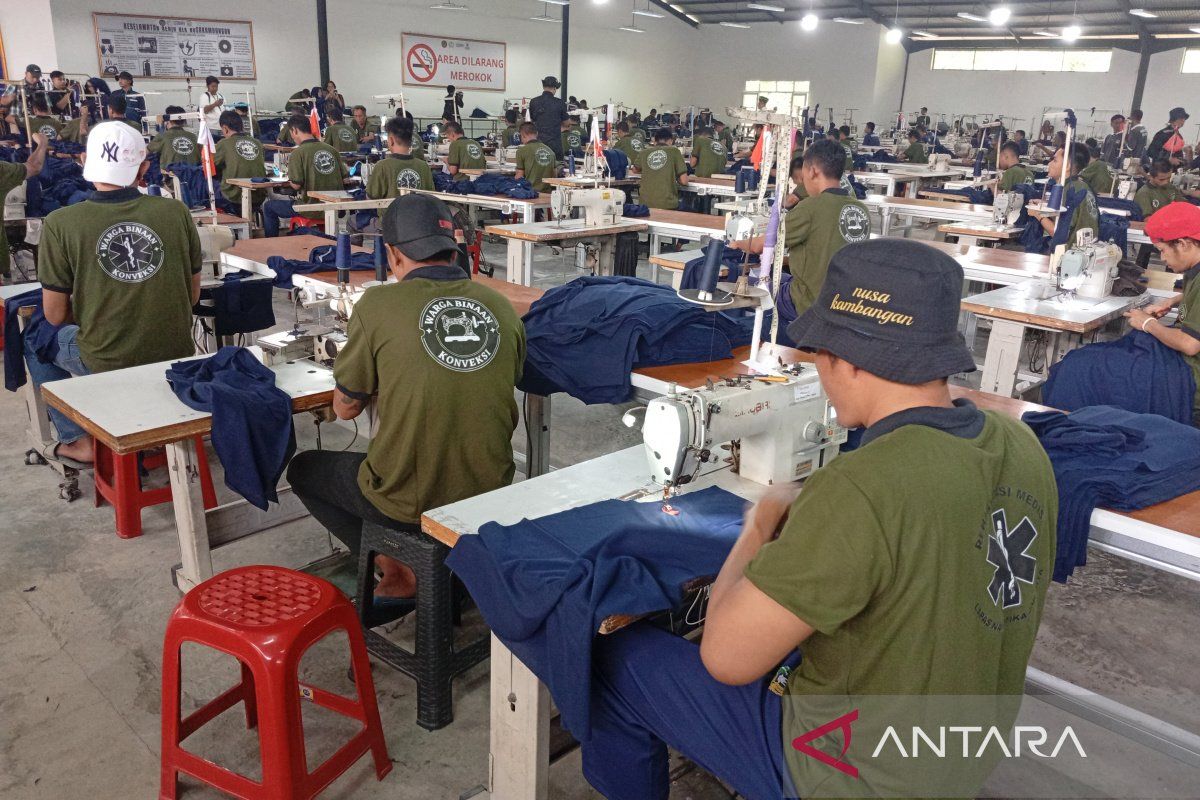
On Nusakambangan Island, the hum of sewing machines produces not only clothing but also, slowly, a change in the lives of those given the chance to start again.
Cilacap (ANTARA) — The hum of hundreds of sewing machines breaks the silence in a building at the Garment Vocational Training Centre (BLK) run by Nirbaya Prison on Nusakambangan Island, Cilacap Regency, Central Java.
The sound of needles piercing fabric blends with the drone of overlocking machines and brief instructions from the trainers. The scene presents another face of Nusakambangan, an island long known primarily as the site of high-security correctional facilities.
In a room arranged to resemble a garment factory, hundreds of inmates sit in rows before sewing machines.
Each person concentrates on completing their task, from cutting fabric, sewing and overlocking, to attaching labels and finishing the final stages. No one works in a rush.
Every seam is checked carefully, because product quality is a shared responsibility.
In one corner of the room, an inmate guides dark blue fabric beneath the needle of his machine.
He pauses occasionally to make sure the seam stays straight before pressing the pedal again. Across the back of his green T-shirt are the words “Garment Trainee” (Warga Binaan Konveksi).
Similar scenes can be seen almost everywhere in the room. Rolls of thread are neatly stacked on shelves, piles of fabric await processing, and on the wall hangs a sign reading “Sewing Training for Trainees, Nusakambangan Vocational Training Centre”.
The room is a place of learning as well as a place for building new hope for those serving their sentences.
The Garment BLK is one of the self-reliance development programmes run by Nirbaya Prison. Through the programme, inmates are equipped with sewing skills using industrial machines so they have something to rely on when they return to society.
They learn not only basic techniques but also take part in the production process, just as in the garment industry generally.
The learning process begins with identifying fabric types, reading patterns, operating sewing machines, using overlockers, and understanding production quality standards. Once they have mastered the basics, inmates are gradually involved in production work.
For most participants, the garment world is a new experience. One of them is Eko Cahyono, an inmate from Purwodadi Regency who was previously transferred from the Purwokerto Narcotics Prison to Nirbaya Prison.
After only about two months of training, Eko can already operate a sewing machine and has joined the production line.
According to Eko, the learning process moves quite quickly. After roughly a week of basic training, participants are immediately given the chance to put their skills into practice in daily production.
“I feel comfortable taking part in activities like this rather than sitting idle in my cell. It is better to have something to do and gain a useful skill,” he said.
More productive
For Eko, the activities at the BLK make his days more productive. Time that once simply passed by is now filled with learning skills he believes will be useful after his release.
A similar experience is shared by Naryanto, an inmate from Semarang. Before serving his sentence, he worked in wedding decoration and had never touched a sewing machine.
Yet after joining the training at the BLK, he can operate a machine and help produce clothing alongside his fellow trainees.
“I could not do it at all before, but now I can. God willing, when I am released this skill will be my capital to work as a tailor,” he said.
He estimates only a few months remain on his sentence. Every day at the BLK is therefore an opportunity for him to deepen his sewing ability so he has something to rely on when he returns to society.
Another story comes from Muhammad Ridwan, an inmate who is now trusted to serve as an instructor at the Garment BLK. When he first joined the training after the centre opened in October, he admitted he was truly starting from zero.
At the time, he did not know how to operate a sewing machine, read patterns, or use an overlocker.
Through continuous learning, Ridwan’s abilities kept developing until he was eventually entrusted with mentoring new participants. He no longer merely sews; he also guides other inmates so they can master the same skills.
“At first I was learning to sew and could not do anything. Thank God, now I am trusted to be an instructor and help teach the new arrivals,” he said.
He also explained that being a tailor is not just about operating a machine. Patience, precision, and perseverance are the main assets needed to ensure the finished sewing meets quality standards.
Around 100 inmates currently take part in the Garment BLK. They are divided into several work groups with different tasks. Some cut fabric, others sew, overlock, attach labels, or carry out the final finishing stages.
In a single day, each group can produce around 100 to 200 garments, which are then distributed to meet the needs of correctional institutions and detention houses across Central Java.
Bonuses
Besides gaining skills, inmates also receive productivity bonuses from the production output. The system is not only a form of appreciation for their work, but also encourages them to perform better.
The bonuses received can be saved and used as capital during their sentence as well as after release.
For Ridwan, the experience of becoming an instructor has changed his outlook on the future. He hopes to work for a garment company or a convection business after returning to society, making use of the skills he gained during his rehabilitation.
The working atmosphere at the BLK is disciplined. Every seam is inspected before being passed to the next stage.
If a mistake is found, the product is returned for correction. Such a work pattern habituates inmates to value quality, responsibility, and teamwork.
Self-reliance development through garment work also teaches that skills do not come instantly. It requires repeated practice, a willingness to learn, and openness to correction. These values form part of the rehabilitation process alongside the technical aspects of sewing.
The programme drew the attention of the Head of the Presidential Staff Office (KSP), Dudung Abdurachman, when he visited the Garment BLK together with the Minister of Immigration and Correctional Services, Agus Andrianto.
During the working visit on Tuesday (28 July), Dudung witnessed the production process first-hand, from fabric cutting and sewing through to final finishing.
He judged that the rehabilitation applied at Nirbaya Prison gives inmates the opportunity to gain work experience alongside skills they can use after release.
“This is an extraordinary development. Besides serving their sentences, inmates come away with skills, so that when they are released they have the hope of doing better and being able to earn a living,” he said.
According to Dudung, this model of rehabilitation deserves to be developed at other correctional institutions, because it focuses not only on serving sentences but also on the process of social reintegration.
Skills gained are expected to make it easier for former inmates to find work and reduce the risk of reoffending.
Behind the walls of Nusakambangan, the Garment BLK presents a different narrative. The place is not merely a clothing production space, but also a space for change.
Every day, hundreds of inmates learn to align their hand movements with the rhythm of the machines, correct mistakes, and complete their work responsibly.
For Eko, Naryanto, Ridwan, and the other inmates, the sewing machine is no longer merely a production tool. The machines have become a bridge between the past and the future.
From behind their hum, new skills are born, confidence grows, and the belief emerges that a second chance can always be seized.
In the end, every garment produced at the Nirbaya Prison Garment BLK carries a story far bigger than the sewing process itself. Within every seam lie hard work, learning, and hope.
On Nusakambangan Island, the hum of sewing machines produces not only clothing but also, slowly, a change in the lives of those given the chance to start again.