
The 'Home Bias' Phenomenon and Extreme Rupiah Depreciation
Two American economists, Maurice Obstfeld of the University of California, Berkeley and Kenneth Rogoff of Harvard University, have long been references in international macroeconomic studies. In their highly popular article entitled ‘The Six Major Puzzles in International Macroeconomics: Is There a Common Cause?’, they identified six main puzzles in international macroeconomics. One of these puzzles, relevant to the phenomenon of the extreme depreciation of the rupiah against the US dollar, is the home bias puzzle. Home bias is defined as the tendency of investors to invest in their own country’s assets, even though holding another country’s assets could yield higher returns. Since the 1990s through the early 2000s, approximately 94 per cent of US investors invested in their own country’s assets. This home bias puzzle can also explain why monetary models for determining exchange rates using fundamental factors become inaccurate in predicting exchange rate movements.
This is reminiscent of the question posed by Queen Elizabeth II during a visit to the London School of Economics (LSE) in November 2008. The Queen challenged the esteemed economists at LSE regarding the devastating 2008 financial crisis, the largest in history. Her question was simple yet profound: ‘Why did no one see the financial crisis coming?’ This question subsequently became a main headline for global media outlets such as The Guardian, The Telegraph and The New York Times. The frequency of financial crises has increased, and not one of these crises could be precisely predicted by economists. Economic projection models were expected to be like weather projection models that can determine when rain or sunshine will occur. Economists and economics must fundamentally reform. As a result, until her passing, Queen Elizabeth II never received an answer to her question from economists. This aligns with a lecture by Nobel Prize-winning economist Paul Krugman at LSE entitled ‘Crisis in the Economy and Economics’. This lecture was later published in the globally popular, London-based magazine The Economist, with an article titled ‘Dismal Science’.
The same point was emphasised by senior US economist Ben Bernanke (2009), who stated that economists must work with highly complex systems (economic models) because the economy faces random pressures, limited data availability and perpetually imperfect knowledge. Mathematician and meteorologist Edward Lorenz (1917-2008) introduced the term ‘butterfly effect’. In making projections, even the smallest change in the initial condition will affect the projection results. For example, the monetary model for predicting exchange rates using fundamental factors is the most popular and widely used by policymakers. This approach has been the dominant paradigm from the 1970s to the present.
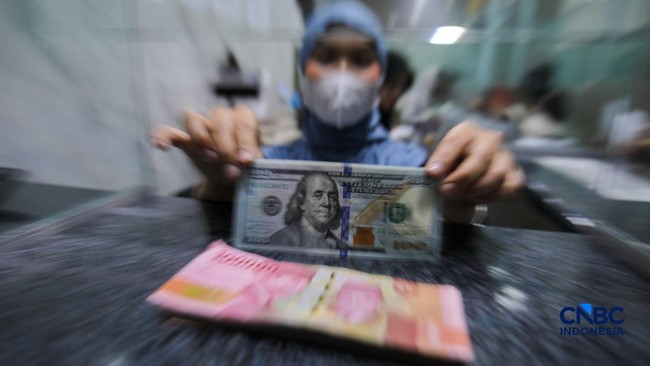
The monetary exchange rate projection model is based on two main building blocks: the condition that Purchasing Power Parity (PPP) and Uncovered Interest Rate Parity (UIP) hold. The exchange rate is expressed as the difference in prices and interest rates between two countries. The change in the rupiah per US dollar exchange rate depends on the difference in inflation (changes in the Consumer Price Index) between Indonesia and the US. A rise in US inflation causes the rupiah per US dollar exchange rate to strengthen. Conversely, a rise in inflation in Indonesia causes the inflation differential between Indonesia and the US to increase, which causes the rupiah per US dollar exchange rate to weaken. In recent months, the rupiah per US dollar exchange rate has weakened from Rp 16,669.8 per US dollar on 1 January 2026 to Rp 18,161 per US dollar on 10 June 2026.
The fluctuation of the rupiah per US dollar exchange rate also depends on the interest rate differential between Indonesia and the US. Indonesia’s interest rate is measured by the Bank Indonesia (BI) reference rate, called the BI rate. The US interest rate is measured by The Fed policy rate, the Federal Funds Rate (FFR). An increase in the FFR causes the interest rate differential between Indonesia and the US to rise. The expectation of rupiah depreciation against the US dollar also increases. Therefore, to reduce pressure on the rupiah per US dollar exchange rate, an FFR increase will be followed by an increase in the BI rate. The hope is that depreciation expectations will subsequently decline.
In short, according to Meese and Rogoff (1983a), the fluctuation of a currency’s exchange rate depends on several macroeconomic indicators commonly referred to as fundamental factors. If the fundamental factors are poor, the exchange rate weakens. Conversely, if the fundamental factors are good, the exchange rate strengthens. This means the fluctuation of the rupiah per US dollar exchange rate is determined by the difference in money supply growth, economic growth, interest rates, balance of payments and inflation between Indonesia and the US. In fact, at a time when the rupiah’s fundamental conditions are sound, the rupiah continues to weaken against the US dollar. The phenomenon can be caused by home bias behaviour, which triggers a net outflow of foreign capital from domestic financial instruments. Home bias behaviour then triggers extreme depreciation of the rupiah per US dollar, pressures the Jakarta Composite Index and causes the price of government bonds to fall (with their yields rising).
What steps can the government and Bank Indonesia take? First, eliminate information asymmetries among market participants, making the cost of seeking and processing information very low. Second, remove regulatory barriers to investing in various domestic financial instruments, ensuring no different rules apply.