
The History of Santri and Pesantren
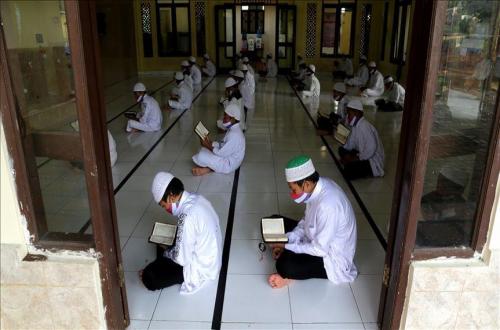
GRESIK — Santri Day is commemorated every 22 October, and many pesantren and Islamic institutions mark the occasion.
Thousands of pesantren remain active across Indonesia, producing graduates who go on to work in a range of fields. But what are the origins of santri and pesantren? Southeast Asia has distinctive traditions of Islamic preaching and education, with pesantren among their examples, according to Howard M. Federspiel in The Oxford Encyclopedia of the Islamic World. The term pesantren is widely used in Java.
In Sumatra, equivalent institutions are known as surau or meunasah in Aceh. Elsewhere in the Malay world, including Malaysia and Cambodia, pondok is the more familiar term, while people in the Philippines and Singapore use madrasah.
In his book Tradisi Pesantren (2011), Zamakhsari Dhofier discusses the possible origins of the term pondok pesantren. Pondok derives from funduq, the Arabic word for “hostel”. Pesantren, meanwhile, comes from santri. Dhofier cites several historians: Professor Johns, for example, says santri comes from Tamil and means “teacher”.
CC Berg offers a similar account, suggesting that santri derives from the Sanskrit words shastri or cantrik, meaning “a person who knows the contents of sacred books” or “someone who always follows a teacher”. M. Chaturverdi and B.N. Tiwari, meanwhile, link the word to shastra, meaning “book”.
Santri diligently pursue their studies and are known for observing religious teachings and following their kiai. History shows that they were among those at the forefront of Indonesia’s struggle for independence.
Accounts of the term pesantren generally point to the institution’s origins being connected to Indian cultural influence. In Indonesia, particularly Java, as Hindu-Buddhist influence waned and Islam spread, kiai including the Wali Songo adapted educational institutions inherited from those two religions. They went on to develop a more Islamic system: the pesantren as it is known today.
In an article published in the journal Ibda in December 2011, Hasani Ahmad Said described pesantren as the oldest Islamic educational institutions in the archipelago. Some historians say they existed before Europeans arrived in the archipelago in the 16th century. The term pesantren refers to a place of study for Muslim intellectuals known as santri. They inherit and sustain Islamic scholarly traditions, tracing their transmission back to the preaching of the Prophet Muhammad.
Sanad, or chains of scholarly transmission, are highly valued in pesantren. In Indonesia, their role has extended beyond education to include the struggle for independence. Harry J. Benda, a Southeast Asian researcher, made a similar point in his book on the Japanese occupation of Indonesia, arguing that the history of Indonesian Islam is the history of the spread of santri civilisation and its influence on the country’s religious, social and political life.
Federspiel explains that by the late 17th century, pesantren in Java had become a counterweight to the power of the royal courts. The abangan culture accommodated by the courts was set against the santri Islamic tradition. Santri studied kitab kuning, or “yellow books”, published from the mid-13th century onwards.
Their studies generally covered a range of subjects, including Arabic grammar (nahwu and sharaf), Quranic exegesis and recitation (qiraat), theology, the jurisprudence of the four schools—particularly that of Imam Shafi‘i—ethics, logic, history and Sufism. The use of Jawi script, Arabic letters used to write Malay, further established pesantren as centres of knowledge that preserved the distinctive character of the archipelago within the wider Islamic world.
Pesantren education has several distinctive features, including close relationships between the kiai, or founder, and the santri. Other characteristics include a simple life, approaching the ascetic ideal of zuhud; independence; mutual cooperation; strict observance of religious rules; and a role within the community as a source of support and solutions rather than as an isolated institution. Its teaching methods are also distinctive.
Halaqah study circles and the memorisation of foundational religious texts are among the examples. Dhofier identifies five basic elements in every pesantren: dormitories, a mosque, santri, the teaching of kitab kuning, and the central figure of the kiai. A kiai’s standing can make a pesantren an emblem of the town where it is located.
Source: jawawa.id (https://jawawa.id/newsitem/the-history-of-santri-and-pesantren-1792720313)
Originally published by Republika (https://khazanah.republika.co.id/berita/tnc4w5430/sejarah-santri-dan-pesantren), translated from Indonesian