
The History of Pancasila
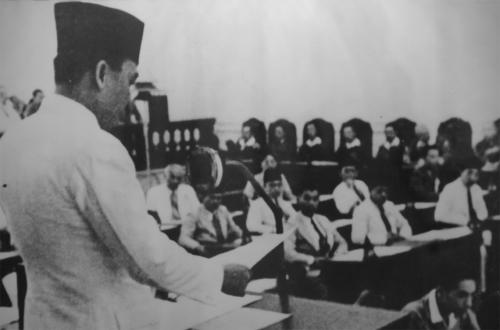
Pancasila was born from very long intellectual and political debates in Indonesian history. This ideology and state foundation did not descend from the heavens, nor is it the result of a single figure’s thought. It is the product of a struggle of ideas, political compromise, and national consensus formed through a long process since the era of the national movement. And to this day, that struggle continues.
Before 1945
Since the 1920s and 1930s, leaders of the national movement had debated religion and the state. One of the most famous polemics occurred between Soekarno and Mohammad Natsir. Soekrolno tended to desire a national state that was not based on any specific religion. Conversely, Natsir argued that Islam was not merely a ritual religion, but also a value system with social and political dimensions.
This debate reflected two major currents that would later dominate the process of forming the Indonesian state: secular nationalism and Islamic nationalism. When Japan formed the Dokuritsu Junbi Cosakai or BPUPK (Investigative Committee for Preparatory Work for Independence) in mid-1945, these two currents of thought met in an official forum to determine the foundation of an independent Indonesia.
A Great Compromise
In the BPUPKI sessions, Mohammad Yamin, Soepomo, and Soekarno presented their respective ideas regarding the state foundation. However, Soekarno’s speech on 1 June 1945 held special significance because it was the first time the term “Pancasila” was used as the name for the five basic principles of the state.
Nevertheless, the debate regarding the relationship between Islam and the state remained unresolved. Islamic groups desired a stronger position for Islamic law (Sharia) in the constitution, while secular groups wanted a state that could encompass all citizens without religious distinction.
Compromise was reached through the Committee of Nine, which produced the Jakarta Charter on 22 June 1945. In that text, the first principle stated: “Belief in God with the obligation to carry out Islamic law for its adherents.” However, only hours after the Proclamation of Independence, objections arose from Christian communities in Eastern Indonesia. Mohammad Hatta subsequently lobbied Islamic leaders. To maintain the unity of the newly born nation, those seven words were ultimately deleted and replaced with “Belief in the One and Only God.”
This decision was one of the greatest political compromises in Indonesian history. Islamic figures were willing to concede for the sake of the nation’s integrity, while secular groups obtained a state foundation that was more acceptable to all citizens.
An Unfinished Debate
The removal of those seven words did not end the debate. Following the 1955 General Election, the issue of the state foundation resurfaced in the sessions of the Constituent Assembly, the body tasked with drafting the Constitution. Islamic parties (Masyumi, NU, PSII, and Perti) wanted Islam as the state foundation, whereas secular, socialist, and communist groups maintained Pancasila. The debate lasted for almost three years without reaching an agreement. This deadlock ended with the Presidential Decree of 5 July 1959, which dissolved the Constituent Assembly and reinstated the 1945 Constitution.
Since then, formally, the debate regarding the state foundation has ended. However, substantively, the discussion regarding the relationship between religion and the state continues to this day.
Pancasila as a Tool of Power
After 1959, the primary issue was no longer whether to accept or reject Pancasila, but how to interpret it. During the Guided Democracy era, Soekarno placed Pancasila within the framework of Nasakom (Nationalism, Religion, and Communism). Pancasila was positioned as an ideological symbol to unite various political forces.
When the New Order came to power, the approach differed. The Soeharto administration made Pancasila the sole principle (asas tunggal) for all political and social organisations. Through the P4 indoctrination programmes, the state became the primary interpreter of Pancasila. Ironically, during this period, Pancasila—which originally emerged from dialogue and compromise—transformed into a jargon used to control politics. Criticism of the government was often regarded as an anti-Pancasila stance. Consequently, many in society viewed Pancasila as state indoctrination. This trauma explains why, after the 1998 Reformation, Pancasila felt ignored, avoided, rejected, or deemed unnecessary.
Reformation and Ideological Vacuum
After the fall of Soeharto, various Pancasila indoctrination programmes were disbanded. Pancasila education declined. While this opened up wider democratic space, it also created a serious ideological vacuum. Amidst the heavy flow of globalisation, the Indonesian people faced various new ideologies. Some groups promoted the idea of a caliphate and an Islamic state, while others were influenced by liberalism emphasising extreme individualism. Simultaneously, identity politics became increasingly sharp in various political contests.
This situation sparked a new awareness that Pancasila remains necessary as the glue for national life. Therefore, since the 2010s, the government has revived Pancasila education and formed the Agency for the Strengthening of Pancasila Ideology (BPIP). Unlike the New Order era, Pancasila is now more frequently understood as an open ideology that continues to engage in dialogue with the changing times.
The Real Challenge
However, the greatest challenge for Pancasila today does not seem to be an ideological issue. Almost no major political force openly rejects Pancasila as the state foundation. Even if it has not disappeared, the debate regarding an Islamic state versus a Pancasila state no longer dominates the public sphere as it did in the 1950s. The true challenge lies in the implementation and the manifestation of Pancasila’s values.