
The Hijab Issue Finally Resolved
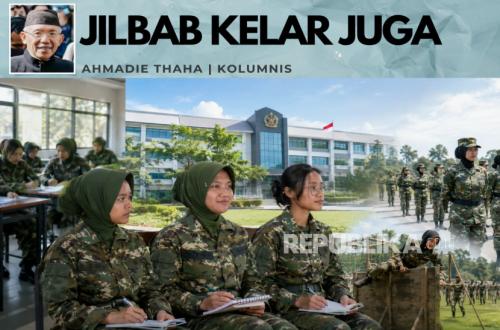
Finally, it is resolved. A piece of hijab that has been circulating between campuses and ministries, from press releases to social media over the last few days, has finally found its rightful place: a written regulation.
As we know, this issue regarding the hijab emerged after Asma Wafa Ahdinayang resigned as a student of the Defence University of Indonesia due to hijab-related issues. She believed her decision was part of an effort to uphold her religious teachings.
Responding to public demands, the Rector of the Defence University of Indonesia has issued a Circular Letter regarding the Use of the Hijab within the Unhan environment. It officially provides normative certainty that Muslim female undergraduate and diploma students are permitted to wear the hijab in all educational and training activities at Unhan RI.
The Circular Letter serves as a written legal product at the university level that can be read, understood, and used as a shared operational guideline. It moves from the passive phrasing of “there is no prohibition” to the explicit affirmation of “is permitted”; from a grey area prone to multiple interpretations to a clear regulatory sentence.
In practical government bureaucracy, such a change in phrasing is not a trivial matter. A single piece of written legal documentation is far more valuable than a thousand verbal explanations. Normative documents are institutionally binding and can be read by all levels of the hierarchy, whereas personal interpretations are at risk of being misconstrued.
However, a fundamental question now arises that is far more troubling in our public governance. We must ask why a country that has undergone such a long democratic process must still continuously drain national energy to resolve administrative polemics that follow a repetitive pattern?
Historical records bring memories of past governance to mind. On 17 March 1982, the government, through the Decree of the Director General of Primary and Secondary Education Number 052/C/Kep/D.82, established national school uniform guidelines. In the text of that regulation, the decree did not explicitly contain a clause stating “hijab is prohibited.”
However, the lack of explicit tension and the absence of clear legal norms were instead interpreted by school authorities at the time as a legal basis to prohibit Muslim female students from wearing the hijab. The impact lasted for a long time. Polemics ensued for almost a decade, and demonstrations erupted.
Matters regarding the hijab or headscarf triggered social tension, debates in the public sphere, and even forced female students to choose between their right to access education or maintaining their faith. It was only in 1991, a decade later, that the government issued Decree Number 100/C/Kep/D/1991, which firmly allowed Muslim students to wear the hijab in public schools.
Sociologically and legally, the issue of uniforms in public educational institutions was considered resolved at that time. However, more than four decades after the 1982 uniform decree, or thirty-five years after the 1991 decree was issued, our social-policy dynamics have suddenly encountered a similar fragment of the problem.
The difference now lies in the locus and the institution. While the hijab polemic previously revolved around the general secondary school environment of the New Order era, the issue has now emerged at the Defence University. This is despite the fact that the political system has undergone much more modern governance consolidation, and eras and times have long since changed.