
The Hidden Staircase in Puncak: Tracing the History of Soekarno's Riung Gunung Coffee House
For those who frequently travel the Puncak route, the sight of a staircase climbing from the roadside in the Riung Gunung area is likely familiar. The staircase appears long, then disappears among the trees. Where does it actually lead? Curiosity about the staircase resurfaced after someone posted a photo of the site on social media, prompting various speculations from netizens, ranging from an old villa and a historic building to a place that has long been unused.
The staircase leads to Vila Riung Gunung, a historic building hidden behind the trees. Built between 1955 and 1957, the villa is known as one of the places where Soekarno, the first president of the Republic of Indonesia, stopped and rested when he was in the Puncak area.
Soekarno’s connection to Vila Riung Gunung is also recorded on an inscription still present at the building. The inscription states that the villa was built under his leadership, with Soedarsono as its architect.
Beyond the inscription, stories of Soekarno coming to rest at Riung Gunung have long been told by the surrounding community. Entering the 1960s, the site’s history began to be recorded more clearly when Vila Riung Gunung became known as the Riung Gunung Coffee House.
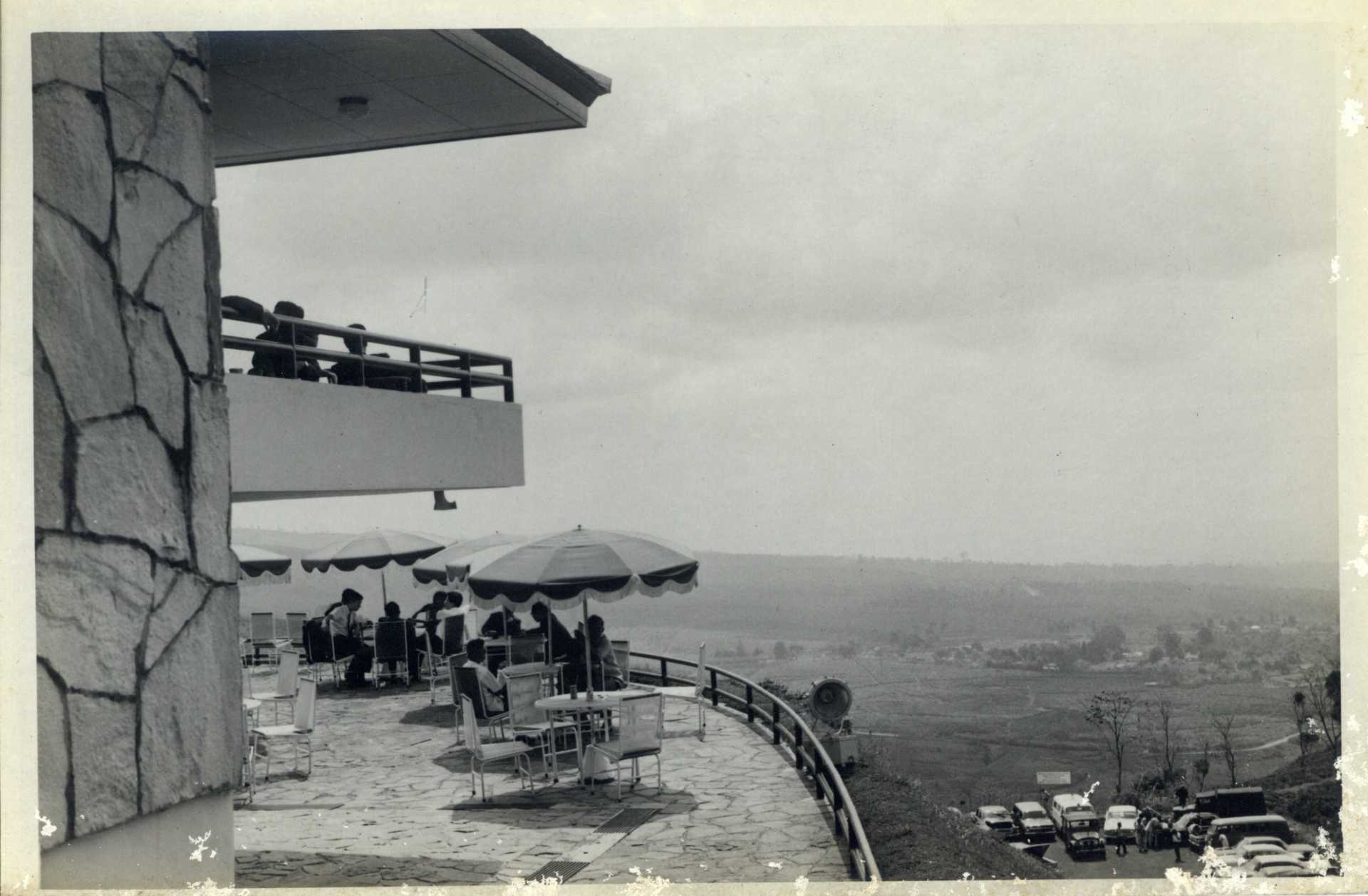
Imagine travelling from Jakarta to Bandung in the 1960s. Entering the Puncak area, the winding journey through the hills brings you to Riung Gunung. From the roadside, a long staircase climbs towards a building where visitors could stop for a while, enjoy coffee, and gaze at the mountain landscape. At the top of the staircase stood the Riung Gunung Coffee House.
At that time, Vila Riung Gunung was operated by Hotel Indonesia as a coffee house.
For Kuki Nasution, who came from Bogor and visited the site in the 1960s, the atmosphere remains vivid to this day.
“Yes, I have visited Riung Gunung. Because I am from Bogor, the distance to Puncak is not too far. At that time there were not many good cafes or restaurants, so I really liked the atmosphere. It was very pleasant. There were many plants inside the restaurant. The layout already felt like a modern restaurant—homey, cosy, and warm,” said Kuki.
However, the Riung Gunung Coffee House was not merely a stopping place for visitors passing through Puncak. Several archives also record it as part of official activities and visits.
In January 1964, a document stored at the National Archives of the Republic of Indonesia recorded a visit by Prince Norodom Sihanouk of Cambodia and his wife, together with Soekarno, to Riung Gunung. In the same year, other documentation recorded a coffee break at the site as part of preparations for the Second Asia-Africa Conference.
Three years later, Riung Gunung appeared again in official visit records. In October 1967, Japanese Prime Minister Eisaku Sato and his wife visited the site as part of their visit to Indonesia.
Entering the early 1970s, Riung Gunung was no longer used as a coffee house and subsequently became better known as a private villa with limited access.
Gradually, the atmosphere once filled with the arrival of guests and receptions faded from view. From the roadside, people could only see the long staircase climbing upwards, while the building above became increasingly hidden behind the trees.
For years, the story of Riung Gunung has survived through the memories of local people, old photographs, and fragments of archives from various periods. For many who pass through the area, the villa became better known as a mysterious building behind the staircase visible from the road.
The limited access to the villa at that time is also remembered by Wiwin Trinarti, a lecturer in the Arabic Studies Programme at the Faculty of Humanities, University of Indonesia, who visited in the 1980s.
“I have been there twice, one of which was in 1983 for an initiation activity for new students of the Arabic Studies Programme at UI. From the start, we were reminded not to use the Riung Gunung staircase because its condition was poorly maintained. Going forward, I hope the staircase and bridge can be used again. It must involve parties who truly understand its construction, so that it can be utilised by many people without losing its historical value,” said Wiwin.
The limited access and the building not being visible from the road have kept curiosity about Riung Gunung alive. That is why a simple post about the staircase in Puncak could invite so many questions. The staircase turned out to be the path to a place that was once part of life in Puncak during the 1960s.
In the reply columns and other conversations that emerged after the post, a number of netizens expressed hope that Vila Riung Gunung could be visited again.