
The Gunung Kawi Fortune Teller Behind the Salim Business Empire
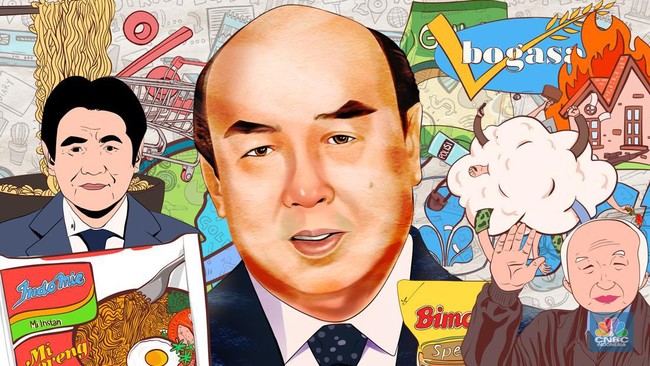
An unexpected meeting between Sudono Salim, also known as Liem Sioe Liong, and Mochtar Riady took place on a flight to Hong Kong in 1975. During their conversation, Riady outlined his plans to develop a new bank. Meanwhile, Salim admitted he was looking for someone to manage Bank Windu Kencana, Bank Dewa Ruci, and BCA. Recognising Riady’s capabilities, Salim proposed a partnership. Their shared vision subsequently led them to build BCA. Under Riady’s leadership, BCA transformed into Indonesia’s largest private bank from the 1980s to the present day. Had Salim not appointed Riady, the story might have unfolded differently. Salim may have anticipated this outcome, as his selection of Riady was not arbitrary. It involved precise and special calculations, not through mathematical or economic analysis, but through the advice of a fortune teller.
‘Upon returning from Gunung Kawi [after visiting a fortune teller], he said with conviction that “I will become a Tang Sheng for Mochtar,”’ Salim stated, as quoted in ‘Liem Sioe Liong and the Salim Group: Pillars of Soeharto’s Business’ (2016) by Richard Borsuk and Nancy Chng. According to ‘Gunung Kawi: Facts and Myths’, the mountain is renowned as a destination frequently visited for mystical purposes, including seeking predictions from shamans. Salim had a specific mission each time he went there. In the account by Richard and Nancy, Salim regularly travelled back and forth between Surabaya and Gunung Kawi, a journey of three hours. He would go there three to five times a year to spend time in seclusion at a Chinese temple. Whenever he was about to embark on a major business venture, he had to go there to seek advice from a fortune teller and perform certain rituals.
‘In the temples where he worshipped, Liem often relied on supernatural methods to help him decide what steps to take. One commonly used method involved shaking a bamboo tube filled with sticks bearing specific inscriptions until one stick fell out. The inscription on that stick was then read and interpreted by a monk or fortune teller,’ Richard and Nancy wrote. Every time the fortune teller spoke, Salim clearly believed it. He did not want to make a misstep and suffer huge losses by not ‘obeying’ the fortune teller. Salim did this not only for starting businesses but also for predicting the fortune of a building or a location.
There is a particular story about this. In 1968, he and the ‘Gang of Four’ conglomerate, consisting of Sudwikatmono, Djuhar Sutanto, and Ibrahim Risjad, wanted to start a business. He decided to begin the partnership from a small, cramped room rather than a large, comfortable one. The room had only one telephone, one table, and two chairs without air conditioning. Salim insisted on keeping that room because it was very auspicious in terms of feng shui. Later, that belief proved true. Salim’s business through the ‘Gang of Four’ flourished. Moreover, thanks to his belief in mystical matters, Salim’s other businesses expanded further, making him immensely wealthy.
Source: jawawa.id (https://jawawa.id/newsitem/the-gunung-kawi-fortune-teller-behind-the-salim-business-empire-1781664699)
Originally published by CNBC Indonesia (https://www.cnbcindonesia.com/market/20260603130456-17-739746/sosok-peramal-gunung-kawi-di-balik-kesuksesan-bisnis-salim), translated from Indonesian