
The Geopolitics of the Human Stomach
Behind the history of human civilisation, there is one simple truth that is often forgotten: a nation that can feed its people will endure; a nation that fails to do so will be fragile. Weapons, technology, and military strength are indeed important. However, without food, all of it loses meaning.
History has repeatedly shown that hunger is often more deadly than bullets. Many wars are not won solely by military strategy, but by food logistics capabilities. In simple terms: a hungry army cannot fight for long. Therefore, discussions about food are not merely about agriculture or the economy. They touch on national dignity, public health, and even geopolitical stability.
From the dawn of human history, food has always been the foundation of civilisation. Without stable food production, there would be no cities, no states, no science. Great civilisations arose from strong food systems. Ancient Egypt flourished due to the fertility of the Nile Valley. Chinese civilisation grew in the Yellow River Valley. The Nusantara itself has long been known as a region rich in tropical food sources.
However, in the modern era, humanity’s relationship with food has often become obscured. Many urban societies live far from fields and paddies, as well as aquatic ecosystems. Food arrives on the dining table without them knowing its origin. Yet behind every grain of rice, every fruit, every vegetable, every piece of fish, there is the sweat of farmers and fishermen working under the scorching sun.
Hunger in the History of War
In military history, food has often been a determining factor. When Napoleon Bonaparte invaded Russia in 1812, he brought more than half a million troops. However, such a large force could not last long. Russia employed a scorched earth strategy: fields were burned, food warehouses destroyed. Napoleon’s army ultimately lost not only due to battles, but because of hunger and logistical shortages.
Similar stories have occurred repeatedly in history. An army without food supplies will lose its combat effectiveness. Therefore, military strategists often say: “An army marches on its stomach.” This means that military capability depends on food availability.
In the 20th century, food was no longer just a matter of fields and kitchens. It rose to become an instrument of geopolitics. One figure often associated with this view is Henry Kissinger, the architect of US foreign policy during the Cold War era. In various geopolitical discourses, he is known for the often-quoted phrase: “Control oil and you control nations. Control food and you control people.” (Control oil and you control nations. Control food and you control people.) This statement—regardless of academic debates about its context—reflects a reality: food can be a tool of global power.
Nations that dominate global food production and distribution have significant influence over countries dependent on imports.
On the other hand, from the African continent comes a countervailing voice. It comes from Thomas Sankara, the revolutionary leader of Burkina Faso nicknamed the “Che Guevara of Africa”. Sankara viewed food issues not from the angle of global power, but from the angle of national independence. He once stated firmly: “He who feeds you controls you.” — “He who feeds you controls you.” For Sankara, a nation that relies on food imports will always be in a weak position. Therefore, he encouraged his people to plant local food, strengthen farmers, and build agricultural self-reliance. During his years in government, Burkina Faso’s food production trended significantly upwards, and dependence on food aid declined.
These two figures represent two major paradigms in global food geopolitics. The first paradigm sees food as a tool of domination: controlling food means controlling people. The second paradigm sees food as a tool of liberation: producing food oneself means safeguarding national independence. The struggle between these two paradigms continues to this day—in farmers’ fields, in global food markets, and in the agricultural policies of countries around the world.
In the end, history will prove one simple thing: a nation that can feed its own people will stand taller on the world stage. Because food is not just about a full stomach, but also about dignity, sovereignty, and a nation’s future. History also records that we have regained the era of rice self-sufficiency in the current era. Something we must be grateful for.
Survival Crops: Food in Crisis Situations
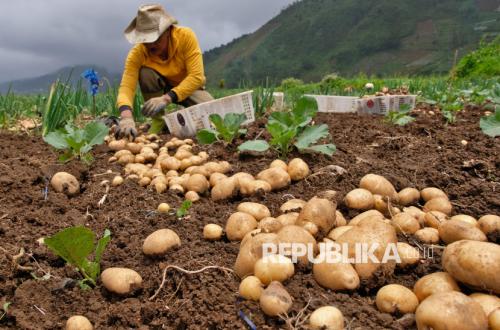
History also shows that in crisis situations, humanity is often saved by simple yet resilient crops. Potatoes saved many European societies from famine in the 18th century. Cassava became a lifesaving food in many tropical regions because it can grow in poor soil and is drought-resistant. Sweet potatoes, maize, and various local crops often serve as food reserves when modern food systems are disrupted.
In tropical regions, crops like breadfruit, pumpkin, banana, and various tubers actually have great potential as resilient food.
These crops have important characteristics: easy to grow, high productivity, do not require expensive technology, and can be cultivated by rural communities. From an ecological perspective, such crops are highly aligned with the nature of the tropics.
Interestingly, the Al-Qur’an speaks extensively about food and agriculture. In one verse, Allah says:
فَلْيَنظُرِ الإِنسَانُ إِلَىٰ طَعَامِهِ
“Let man then consider his food.” (QS ’Abasa: 24)
This verse invites humans to reflect on the origins of the food they consume. The Al-Qur’an then explains the process: rain falls, the earth splits, and then various things grow.
Source: jawawa.id (https://jawawa.id/newsitem/the-geopolitics-of-the-human-stomach-1778781526)
Originally published by Republika (https://analisis.republika.co.id/berita/tf0suu393/geopolitik-perut-manusia), translated from Indonesian