
The General His Men Loved Too Much
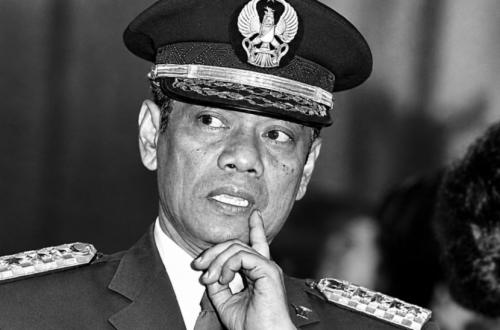
Bang! General M. Jusuf’s hand slammed down on the table one night at Jalan Cendana. The senior officials present fell silent. A room that had been alive with political conversation suddenly became quiet. The atmosphere was like an examination hall when an invigilator catches a candidate cheating.
The cause was no trivial matter. Jusuf’s popularity among the troops had begun to arouse suspicion. His closeness to his subordinates was seen as an attempt to build his own power base. There was even concern that the soldiers’ strong loyalty to him could become a threat to President Soeharto.
Hearing the accusation, Jusuf could not contain his anger.
“Lies! None of that is true! I was asked to become Defence and Security Minister/Armed Forces Commander on the President’s orders. I am Bugis; I myself do not know what the Javanese word ‘kemanunggalan’ means, but I carried out the order to the best of my ability!”
The room fell silent. Soeharto then ended the meeting and asked Jusuf to speak with him separately. Atmadji Sumarkidjo’s biography, General M. Jusuf: Commander of the Soldiers, recounts that after this incident Jusuf no longer attended cabinet meetings chaired by the President in person. He more often sent Admiral Sudomo to represent him.
The incident at Cendana is striking. A general known for his closeness to the troops had to contend with suspicion precisely because of that closeness.
In New Order politics, being popular was not always an advantage—especially when that popularity came from people under one’s command.
What soldiers regarded as care and concern could be interpreted by those around the seat of power as an effort to build political influence.
Yet it was precisely this closeness that earned M. Jusuf such respect.
In the 1980s, he was well known not only in military circles but also among the wider public. His popularity was not built through billboards, advertising or image-making teams. Social media did not yet exist. Jusuf was known for one simple thing: he was willing to go out and meet the people he led.
That is why it seems a shame that younger generations today know little about him. M. Jusuf’s name may not loom as large as those of the presidents or leading figures of the New Order, but his leadership offers lessons that remain relevant, particularly when we consider how titles can often overshadow responsibility.
It happens that today, 10 November 2026, the government is scheduled to confer the title of National Hero on M. Jusuf. For the people of South Sulawesi, this recognition fulfils a long-held hope.
Hearing the news, I was reminded of a book I had once read: Atmadji Sumarkidjo’s General M. Jusuf: Commander of the Soldiers.
It contains many interesting stories, including one about how Jusuf viewed identity and status.
He came from a Bugis aristocratic family and was entitled to use the title Andi. But when he entered military life, he gave it up. He did not want it to create distance between him and the soldiers he commanded.
His reasoning was simple. On duty, all soldiers faced the same risks. Bullets never asked who was descended from aristocrats and who came from an ordinary family.
This was more than a slogan about humility; it was reflected in his everyday habits.
Jusuf was not the sort of general who relied solely on reports from his subordinates. He preferred to see conditions among the troops in the field for himself. He would even often drive his official vehicle himself. As a result, the security detail following behind frequently had to work hard to catch up.
Another habit may sound trivial, but it says a great deal about his approach to leadership: inspecting the barracks’ kitchens.
For some officials, the kitchen might not seem important. But Jusuf considered the food soldiers ate part of a leader’s responsibility. How could a commander demand discipline and high performance if he did not even pay attention to his subordinates’ meals?
He seems to have understood that concern for those under one’s command need not be expressed through speeches or grand orders. Sometimes it was enough to ensure that their food was decent and their daily needs were met.
There are also stories of his remarkable memory. Jusuf was said to remember the names of drivers, aides and even lower-ranking soldiers he had met years earlier.
Imagine a general with so many responsibilities still remembering the names of people who, to another official, might have seemed like insignificant members of the entourage.
This may seem like a small thing. But for those on the receiving end, being remembered by a leader must mean something. Not everyone needs grand gestures of attention. Sometimes simply having one’s name remembered is enough to make someone feel valued.
Of course, M. Jusuf’s story should not be viewed through the lens of historical romanticism.
He was still part of the New Order’s military and political elite, working within a system that remains the subject of considerable debate, from the concentration of power to the military’s influential role in political life.
Admiring M. Jusuf’s personal qualities does not mean endorsing the entire system in which he built his career.
This is precisely what makes his story interesting. Amid competition for influence and political suspicion, he was known for his closeness to the people he led.
The irony is clear in the Cendana incident. The soldiers saw Jusuf’s closeness as a sign of care. Some in the circle of power saw it instead as a potential threat.
One action, but two very different judgements.
After no longer serving as Armed Forces Commander, Jusuf did not appear to try to preserve his political influence by building a personal following. After leading the Audit Board of Indonesia, he chose to return to Makassar and live a relatively modest life with his wife, Elly Saelan.
That choice may sound ordinary. Yet in a country where people often use public office to extend their hold on power, the decision to return to a simple life is worth noting.
In the end, we may forget how many stars a general once wore on his shoulders. We may also forget how long he held high office.
But the people he led may still remember how he treated them.
The stars on one’s shoulders may make a person appear elevated. It is attention to ordinary people that makes them truly great.
Source: jawawa.id (https://jawawa.id/newsitem/the-general-his-men-loved-too-much-1794307859)
Originally published by Republika (https://analisis.republika.co.id/berita/toa61w393/jenderal-yang-terlalu-dicintai-anak-buah), translated from Indonesian