
The Gedebage-Tasikmalaya Corridor Awaits Its Value
President Prabowo Subianto, speaking at the first anniversary of Danantara Indonesia some time ago, stressed that success in managing state assets depends on good management, disciplined governance and a long-term outlook.
The target of contributing up to Rp800 trillion a year, assuming a return on assets of at least 5 per cent, is not merely a fiscal figure. It invites us to ask whether strategic state assets, including toll roads, are really generating value commensurate with the scale at which they are managed.
The direction set by Coordinating Minister for Infrastructure and Regional Development Agus Harimurti Yudhoyono reinforces that question. He has stressed that infrastructure must not remain an inert object; it should become a healthy, clean and beautiful ecosystem.
The commitment to net-zero emissions must likewise be more than a slogan and should be translated into concrete action. These two directives point to one conclusion: state assets should not merely be maintained, but made to generate value.
For decades, toll roads have been seen as routes for mobility. Their success has been measured by the length of road, vehicle volumes and toll revenue. This perspective is not wrong, but it is no longer enough. A toll road is a much richer economic corridor. Along it are land, space, data and people on the move—a store of wealth that has largely remained untapped.
Jasa Marga has begun moving in a different direction. By the third quarter of 2026, its operating revenue had reached Rp15.6 trillion, up 7.9 per cent year on year, with net profit of Rp2.7 trillion and an EBITDA margin of 67.0 per cent.
The company’s main engine is still running strongly. However, toll revenue continues to dominate, at Rp14.3 trillion. That is precisely the issue: non-toll revenue, including preservation and prospective businesses, rose 21.5 per cent to Rp1.3 trillion, pointing to growth potential that has yet to be fully realised.
The clearest example is Travoy Hub Taman Mini, inaugurated in September 2025. Developed by PT Jasamarga Related Business under a Toll Corridor Development concept at Rest Area KM 05 on the Jagorawi Toll Road, the site is integrated with the Taman Mini LRT Jabodebek station and includes retail space, facilities for micro, small and medium-sized enterprises (MSMEs), and Brawijaya Hospital.
The first phase has recorded high tenant occupancy, and vertical housing is planned for the future. Its ambitions for integration extend beyond the LRT: Jasa Marga has reached an understanding with PT MRT Jakarta to study a connection to the MRT Phase 4 corridor. This is no longer a rest area in the traditional sense. It is an urban hub growing along a toll-road corridor.
The network is also continuing to expand. From October 2026, the 24-kilometre Gending-Paiton section of the Probolinggo-Situbondo-Banyuwangi Toll Road officially began operating as a tolled road. Jasa Marga now operates a total of 1,318 kilometres of toll roads, accounting for about 42 per cent of Indonesia’s commercial toll-road market. By the third quarter of 2026, vehicle transactions had exceeded 981 million.
These figures confirm Jasa Marga’s position as a dominant player. But dominance in traffic volumes and road length does not automatically mean dominance in value. This is why the question of monetising corridor assets has become urgent.
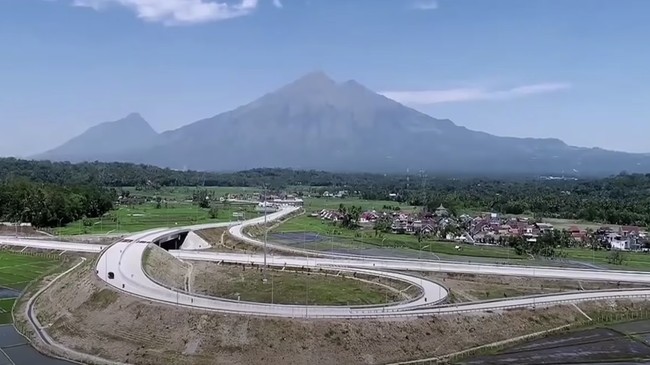
Planning in West Java, Indonesia’s most populous province, is moving faster. A population of more than 50.9 million represents a vast market for corridor-based services. The Gedebage-Tasikmalaya Toll Road, part of the Getaci network, is about 95.5 kilometres long and is at the stage of updating its feasibility study.
Plans for developing the area around the Tegalluar Toll Gate explicitly mention integration with the 340-hectare Tegalluar High-Speed Rail Station transit-oriented development (TOD). The regional government also views connectivity between toll roads, public transport and area development as a single package.
For Jasa Marga, West Java is not only a large market but also a testing ground for whether the Travoy Hub model can be replicated and adapted. If Travoy Hub Taman Mini succeeds because it is located at a busy transport interchange, what could be done along corridors in southern West Java, where the economy is still dominated by agriculture and tourism?
Could a rest area there become a collection centre for agricultural produce, or a distribution hub connecting farmers with markets in Bandung and Jakarta? Such questions do not arise if we see a toll road only as a strip of asphalt.
They arise when we recognise that every corridor has a different economic character. Consider what could be done with existing corridors and those still being planned.
In Malaysia, toll-road operators have invited telecommunications providers to upgrade fibre-optic networks along their corridors through revenue-sharing arrangements. In the United States, a Michigan Department of Transportation study concluded that fibre commercialisation was a viable opportunity, with potential customers ranging from mobile operators to data centres.
Jasa Marga has corridors stretching from the western to the eastern end of Java. The fibre-optic ducts along them are passive assets that can be leased without disturbing a single centimetre of existing road surface.
Energy also offers opportunities that have received little attention. Germany is trialling solar panels along the Autobahn, while the Netherlands has integrated solar panels into the A2 motorway. Jasa Marga is a major electricity consumer.
Filling medians and road shoulders with solar panels could reduce energy costs, while surplus electricity could be sold to PLN or directly to rest-area tenants. But another layer of value has potential that is now converging with a major government agenda.
Fibre-optic ducts along toll-road corridors could support the government’s efforts to extend digital connectivity to remote areas, including Islamic boarding schools and pesantren cooperatives. Data from the Ministry of Cooperatives and the Ministry of Religious Affairs records about 42,000 pesantren in Indonesia, but only around 6,000 have a Koperasi Pondok Pesantren, or Kopontren.
The government is explicitly encouraging Kopontren to adapt to digital technology. This points to a real and large-scale need for connectivity infrastructure. If Jasa Marga builds a fibre backbone along its toll-road corridors and gives providers access to reach educational and economic centres in communities near those corridors, fibre would no longer be merely a source of rental income. It would become part of a national solution for narrowing the digital divide.
Jasa Marga does not need to become an internet service provider; it need only provide roads for data, just as it provides roads for vehicles. Rest areas, too, can move up a level. In Japan, facilities such as EXPASA offer far more than food, with amenities ranging from fish markets to hotels.
In the United States, travel centres provide logistics warehouses and services for drivers. Rest areas could become last-mile logistics hubs where lorries can rest, transfer loads or store goods temporarily.
Jasa Marga would not need to do this alone. Danantara’s logistics holding company, now undergoing consolidation, is preparing to make PT Pos Indonesia its parent company, with dozens of warehousing and freight entities to be brought under it. It would be a suitable partner for connecting toll-road corridors to the national distribution network.
Rest areas equipped with small warehouses and cold storage, and connected to the fleet managed by that holding company, would turn toll-road corridors from vehicle routes into arteries for goods. All these opportunities, however, depend on one non-negotiable condition: security.
A rest area vulnerable to crime will never become a valuable commercial asset. A target of zero crime at every rest area, backed by CCTV with artificial-intelligence analytics, smart lighting, coordinated patrols and emergency posts linked to a control centre, is not simply a security programme.
It is a prerequisite for tenants to be willing to pay more and for users to stay longer. Drawing these strands together leads to one conclusion. Monetising toll-road corridors is not about collecting more in tolls. It is about leasing access to existing assets—land, space, ducts and data—within an adequate governance framework.
That is the real challenge for Jasa Marga. The company has innovated in its services and continues to expand its network, but innovation in value creation, particularly through non-toll assets, is still lagging.
The transformation from infrastructure to ecosystem requires oversight systems that can ensure commercial expansion does not undermine financial discipline, carbon initiatives have clear accountability, and new assets are managed to standards of governance equal to those applied to core infrastructure assets. In my view, this is what Jasa Marga most needs in the years ahead. The company is not short of engineers who know how to maintain roads.
That is a core competence already embedded in the company’s DNA. What it does not yet fully possess is the capacity to view toll-road corridors as integrated business ecosystems: entities that generate value from retail, energy, logistics, carbon and data, while remaining subject to strict governance, risk management and public accountability.
I have worked in two fields that may seem far removed from toll roads, but are in fact closely connected to this central issue. As a restaurant general manager at an international fast-food chain, I learnt that customers do not come only because a place is clean or the food is good. They come because the experience is managed to a consistent standard.
I later owned and operated an international-branded petrol station in Indonesia, an experience that taught me that energy businesses along roads are not simply about selling fuel. They combine strategic locations, driver behaviour, rigorous safety standards and partnerships with global suppliers.
These experiences intersect directly with what Jasa Marga is building at its rest areas and along its toll-road corridors. The combination matters not because I have run both types of business, but because each requires the same outlook: seeing assets not as inert objects, but as spaces that must deliver experience and value sustainably.
Experience in retail and energy alone, however, is not enough. Both must operate within clear governance frameworks. This is where my experience as a practitioner in governance, risk management and audit becomes an indispensable complement.
Without that discipline, commercial expansion could turn into fiscal risk, carbon initiatives could remain mere rhetoric, and new assets could become liabilities rather than sources of value. One dimension can no longer be separated from this way of thinking: the Sustainable Development Goals (SDGs), environmental, social and governance (ESG) considerations, and carbon economic value are no longer three separate agendas, but a single, necessary policy package for Jasa Marga.
A company managing Indonesia’s largest toll-road network can no longer report on sustainability merely as an annual appendix while leaving its carbon assets idle. I was once assigned to the Presidential Staff Office’s Task Force for Accelerating the Implementation of the Carbon Exchange, a role that brought technical understanding of carbon mechanisms together with the realities of complex inter-ministerial bureaucracy.
That experience taught me that carbon policy does not fail for lack of vision, but because there is no governance framework capable of translating that vision into institutional structures, incentives and accountability.
Therefore, the capacity Jasa Marga’s holding company needs in the future is not a single, purely technical capability. It needs multidisciplinary capacity embedded throughout the organisation, from management to operational teams.
The company needs talent with the entrepreneurial instinct to see opportunities where others see only asphalt, while also having a mature understanding of how government and regulation work, and sensitivity to carbon emissions and sustainability issues.
This combination of abilities can no longer be treated as a luxury possessed by only a handful of people. It must become a collective competency at Jasa Marga, because only with this holistic outlook can the company ensure that economic growth is never separated from environmental and social accountability.
The toll-road network continues to grow, from Probolinggo to Banyuwangi. What is still missing is a way of seeing it all as a single pool of wealth waiting to be developed, and the management capacity to turn that perspective into reality.
Imagine what could happen if the same approach were applied to the long-awaited Gedebage-Tasikmalaya Toll Road. There, Travoy could be more than a stopping place for passing vehicles. It could become a catalyst for the regional economy, with hotels and hospitals alongside a range of multi-service facilities, creating an ecosystem that serves not only road users but also nearby communities.
Travoy hubs in West Java, with its huge population and fast-changing economy, could become showcases for Jasa Marga’s innovation. More than that, toll-road exits in the province could be designed to connect directly with growing industrial estates and Special Economic Zones.
In this way, Travoy hubs and toll gates would be more than stopping points or places to pay. They could become logistics hubs and growth centres that connect the movement of people, the flow of goods and the pulse of the local economy in one integrated system.
That brings us back to the real question: will we continue to measure roads by their length, or start measuring value by what grows along them?
Source: jawawa.id (https://jawawa.id/newsitem/the-gedebage-tasikmalaya-corridor-awaits-its-value-1793764249)
Originally published by CNBC Indonesia (https://www.cnbcindonesia.com/opini/20261104092728-14-782139/koridor-gedebage-tasikmalaya-yang-menanti-nilainya), translated from Indonesian