
The Future of Indonesia’s Transport Aircraft Industry Amid Global Challenges
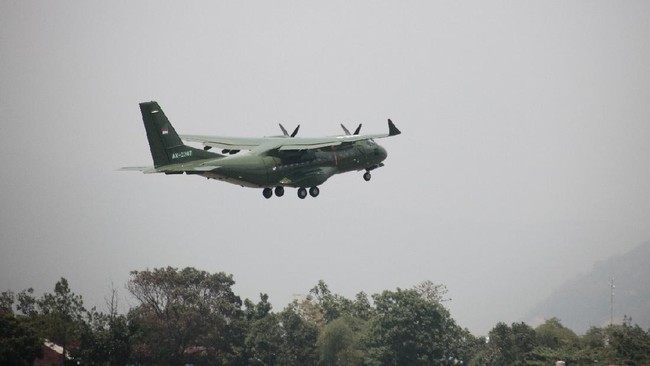
In Abu Dhabi on 18 November 2021, Indonesia and Airbus Defence and Space signed a contract for the acquisition of two A400Ms, following an intensive marketing campaign by the European manufacturer that began in 2016. On the same occasion, Indonesia also signed a Letter of Intent (LOI) for the potential procurement of four more A400Ms.
In return, if Indonesia were to purchase six A400Ms, the manufacturer of the C295 would grant PT Dirgantara Indonesia autonomous rights for the CN235, enabling all CN235-220 components to be manufactured in Bandung. The two transport aircraft, each with a 37-tonne payload, have since been delivered to Indonesia and have contributed to humanitarian operations responding to natural disasters in several regions.
The 2025–2029 Medium-Term Defence Equipment Requirements document identifies a need to purchase at least two additional A400Ms. However, it remains unclear whether the procurement programme for the combat-proven transport aircraft is included in the 2025–2029 Special Medium-Term Foreign Loan Plan List (DRPLN-JM).
The issue surrounding a second A400M procurement is not fiscal capacity: foreign loan allocations of US$34.8 billion would be more than sufficient. Rather, it is a question of political will among decision-makers in Jakarta. If Indonesia acquired four A400Ms at once, the programme would cost about US$1.2 billion, rising to no more than US$1.4 billion if an Integrated Logistic Support (ILS) package were included.
To date, the Ministry of Defence has shown no sign of placing a repeat order for A400Ms with Airbus Defence and Space. Some observers suspect Indonesia will not honour the LOI signed in the United Arab Emirates five years ago, because the original equipment manufacturer (OEM) applied strict good-governance and compliance standards during the acquisition of the two A400Ms.
Yet under the 2025–2029 Optimum Essential Force (OEF), the prevailing climate for defence procurement in Indonesia is one of lax good governance and compliance, with brokers used in contract transactions. Airbus Defence and Space’s strict approach to good governance and compliance is plainly at odds with the prevailing environment for defence acquisitions in Indonesia.
It is reasonable to suspect that plans to buy A330 MRTTs to meet the Indonesian Air Force’s need for aerial refuelling will not proceed under the 2025–2029 OEF, despite the programme having appeared in the same Requirements document as the A400M.
Rather than import a tanker suited to the Indonesian Air Force’s needs, the Ministry of Defence is instead looking to acquire the Il-78, whose aerial-refuelling capability is not significantly different from that of the C-130B and A400M.
The A330 MRTT is not only a tanker; it can also serve as a VIP transport aircraft for senior officials, including heads of state or government. For example, the Australian prime minister often uses an RAF A330 MRTT for long-distance overseas trips, such as journeys to Europe or North America.
If the prediction that Indonesia will not honour its LOI for additional A400Ms proves correct, one consequence will be that Airbus Defence and Space will not transfer autonomous CN235 rights to PT Dirgantara Indonesia. Components such as the centre wing, nose fuselage, nose landing gear and nose landing gear door would therefore continue to depend on supplies from Airbus’s production facilities in Spain.
Indonesia has long sought to move production of CN235 components, which have been made in Spain since 1986, to Bandung, alongside the closure of the turboprop aircraft’s production line in Seville. Airbus Defence and Space had agreed from the outset to transfer manufacture of those components to PT Dirgantara Indonesia’s facilities, but on condition that Indonesia purchased six A400Ms.
Beyond the transfer of CN235 autonomous rights to Indonesia’s aircraft manufacturer, another challenge to the continued production of the transport aircraft designed by Airtech concerns its propulsion system. The CN235-220 is powered by two CT7-9C turboprop engines, which belong to the same engine family as the T700 turboshaft used by the UH-60 helicopter and its variants.
The CN235-220 is currently the only turboprop aircraft still in production to use GE Aerospace’s propulsion system, while its annual production rate has been very low for more than a decade. In other words, supplying CT7-9C engines to PT Dirgantara Indonesia has become inefficient from a production standpoint, because there are few orders for the CN235-220.
Global demand for the CT7-9C is very low, given that the CN235-220 is now the only aircraft using this US-made propulsion system. By contrast, market demand for the T700 remains high because Sikorsky continues to produce the UH-60 and its variants. Although the engines belong to the same family, one difference is that the CT7-9C requires a propeller gearbox, which the T700 does not.
GE Aerospace must manufacture propeller gearboxes for CT7-9C orders, a process that would be efficient if demand for the engine reached economies of scale. Given PT Dirgantara Indonesia’s inability to sell significant numbers of CN235-220s internationally over the past decade, how can it be expected that GE Aerospace will continue supplying CT7-9C engines in the medium to long term?
What factors have contributed to the state-owned company’s inability to export the CN235-220 in recent years? Is the 5.9-tonne-payload transport aircraft less competitive in performance than the C295, which is in effect a development of the CN235?
Has promotion of the CN235-220 in overseas markets lacked export-credit facilities provided by the Indonesian government to prospective buyers? Have delays in delivering the CN235-220 affected other countries’ interest in becoming customers of PT Dirgantara Indonesia?
According to the author, only three CN235-220s are currently on order, all from Indonesia, with no demand from foreign countries. The third order is from the Ministry of Defence: one aircraft for the Indonesian Navy and two for the Indonesian Army, all in transport configurations.
Several years ago, Indonesia’s aircraft manufacturer failed to sell the CN235 ASW to the Philippines, as Manila chose the ATR 72 MPA, produced by the joint venture between Airbus and Leonardo. Given these circumstances, does the CN235-220 still have a future, or will it become a sunset aircraft that remains in service?
Source: jawawa.id (https://jawawa.id/newsitem/the-future-of-indonesias-transport-aircraft-industry-amid-global-challenges-1793184729)
Originally published by CNBC Indonesia (https://www.cnbcindonesia.com/opini/20261028165422-14-780305/masa-depan-pesawat-angkut-nasional-di-tengah-tantangan-industri-global), translated from Indonesian