
The Formation of a Healthcare Ecosystem Where Citizens No Longer Sell Their Assets
The Ministry of Religious Affairs seems beset by one problem after another.
Ramini’s tears broke out moments after her wheelchair was pushed out of the arrivals terminal at Soekarno-Hatta Airport in late June. The woman from Banjarparakan Village, Rawalo Subdistrict, Banyumas, had just been repatriated from Penang, Malaysia. After years of working as a migrant labourer, she returned home with a kidney failure diagnosis requiring lifelong dialysis.
Amid the crowd of people waiting to pick up arriving passengers, her eyes were immediately drawn to a figure she had known since childhood. Umi Saliyah, her friend and a volunteer who supports families, was standing with the Banyumas Indonesian Red Cross (PMI) team. Upon meeting, the two embraced and wept.
“That meeting was truly moving. Mrs Ramini had long been waiting to return to Indonesia,” recalled Sentot Sugiarto, Head of Services at PMI Banyumas, who was part of the pickup team that day.
Ramini’s homecoming was not merely a journey between countries. A chain of healthcare services had been prepared even before her plane landed.
Several weeks earlier, her family had contacted PMI Banyumas to request free ambulance pickup. At the same time, PMI ensured that Ramini’s BPJS Health membership was active, so that upon arrival in Banyumas she could immediately continue her haemodialysis (HD) therapy without administrative obstacles.
While working in Malaysia, Ramini had been hospitalised as her health steadily declined. The cost of treating kidney failure in the neighbouring country could reach tens of millions of rupiah. Had she returned to Indonesia without health protection, it could have devastated her family’s finances.
“However, because Banyumas has implemented Universal Health Coverage (UHC) non-cut-off, residents only need their ID card. Membership is activated immediately so treatment can continue. This is what Ramini experienced,” said Sentot.
There is an ecosystem at work, spanning the regency government, BPJS Health, healthcare facilities, and PMI, all ensuring that patients can genuinely reach the services they need.
PMI’s role often escapes attention. Yet for kidney failure patients, the cost of travelling to hospital is frequently a major burden.
Ariono Poerwanto, Head of the PMI Banyumas chapter, said the free ambulance service is a form of mutual assistance that complements the health insurance system. Where treatment costs are already covered by BPJS, PMI steps in to eliminate patients’ transport costs.
A single journey to hospital can cost around Rp250,000 by hired vehicle. HD patients typically need therapy twice a week, meaning monthly transport costs could reach Rp2 million.
“The treatment itself is indeed free. What we help with is pickup and drop-off. Otherwise, many families would struggle,” said Ariono.
Throughout 2025, PMI Banyumas recorded 3,433 free ambulance services. Around 80 per cent of these involved kidney failure patients requiring routine haemodialysis. Currently, five to eight patients need transporting each day. “Some of them live far away, so the ambulance has to cross mountains and pass through forests,” he said.
Not infrequently, patients even postpone dialysis when the ambulance is fully booked. This shows that access to healthcare also deserves attention.
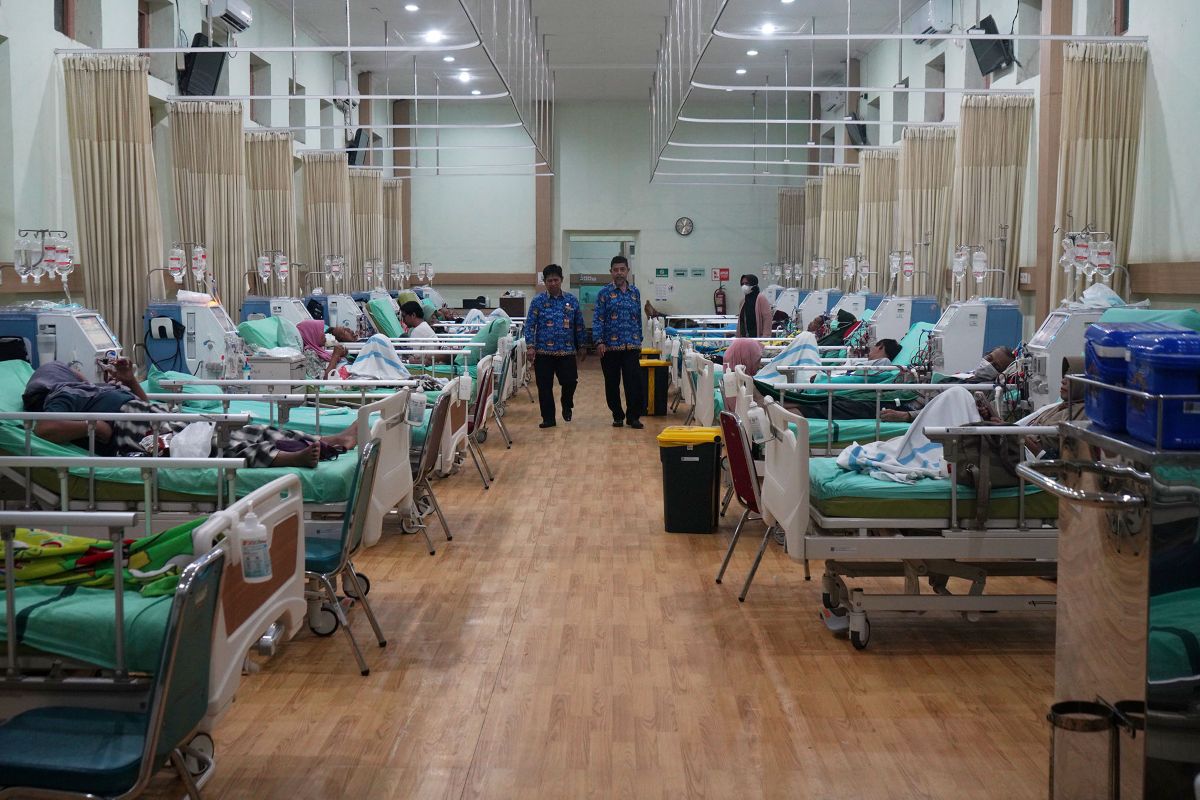
In the dialysis unit of Banyumas Regional General Hospital (RSUD), a similar struggle plays out for hundreds of patients each week. Tri Wahyu Kusumaningsih, 49, a resident of Kedunguter Village, has undergone dialysis twice a week for eight years. Her illness has not stopped her activities.
She continues to teach at her own tutoring centre for pre-school and primary school children. “Everything is covered by BPJS. I can still carry on with my activities and teach,” she said.
Indeed, that health protection opened the way to another dream that once seemed impossible. Freed from the burden of medical costs, Tri Wahyu was able to save up and eventually depart for the umrah pilgrimage. During her ten days in the Holy Land, she continued her twice-weekly haemodialysis after consulting with doctors beforehand.
“Alhamdulillah, everything went smoothly. Because my treatment costs were covered, I could set aside money for the umrah. Even the HD in the Holy Land cost nothing,” she said.
A different story comes from Eka Rivai, 31. He has been undergoing HD for around two and a half years. Yet his condition has not stopped him from working as a courier for an expedition company.
In fact, he feels his physical condition has improved by remaining active at work, coupled with a controlled diet and adequate rest. “I cannot imagine having to pay for dialysis myself. With BPJS, I can focus on working to earn a living,” he said.
At RSUD Banyumas, haemodialysis is one of the services where nearly all patients are covered by BPJS Health.
Dr Widyana Grehastuti, Director of RSUD Banyumas, said the type B hospital receives referrals from various healthcare facilities. Banyumas’s strength lies in the application of UHC Non-Cut-Off, which allows newly registered members to immediately obtain service coverage.
The hospital currently operates 35 haemodialysis machines every day, Monday to Saturday, from 06:00 to 23:00 WIB.
Dr Sugiyanto, Head of the Dialysis Unit at RSUD Banyumas, noted that a single haemodialysis session costs around Rp1 million if paid independently. At a frequency of twice weekly, patients would need to prepare roughly Rp8 million each month. “Before BPJS existed, many families had to sell their houses or land to pay for treatment,” he said.
Today, 265 patients routinely undergo haemodialysis at RSUD Banyumas. They have formed the Sayang Ginjal Edelweiss Association as a forum for mutual support and to organise social activities together with the hospital.
The Banyumas Regency Government ensures that under the non-cut-off UHC policy, residents with only their ID card can immediately receive free treatment. Banyumas Regent Sadewo Tri Lastiono stressed that no healthcare facility may refuse a patient solely because of administrative issues or limited economic means.
Residents needing healthcare simply show their electronic ID card in accordance with prevailing procedures. “No more residents should be turned away because they cannot pay. Treatment must still be provided.”
To support this policy, the Banyumas Regency Government has allocated around Rp105 billion in the 2026 regional budget to guarantee the sustainability of the UHC programme.
Data from the BPJS Health Purwokerto Branch shows that as of June 2026, some 1,856,471 residents, or 98.96 per cent of Banyumas’s population, have become JKN participants. The active membership rate stands at 81.88 per cent.
Niken Sawitri, Head of the BPJS Health Purwokerto Branch, said UHC is not merely about pursuing high membership numbers. What matters more is ensuring people remain active participants so they can access care whenever needed.
“That is why BPJS, together with the Banyumas Regency Government, continues to expand the PESIAR Programme (Map, Sweep, Advocacy, and Registration), fulfil the Premium Assistance Recipients (PBI) quota, and strengthen coordination with village governments and healthcare facilities,” she said.
In Banyumas, health protection is not just about free hospital services. An ecosystem has formed, encompassing ambulances that collect patients from remote villages, hospitals that provide care, volunteers who support families, and regional policies that ensure residents need only bring their ID card to receive treatment.
When all stakeholders work within a single ecosystem, healthcare services can also prevent sick families from losing their homes, selling their rice fields, or falling into the abyss of poverty.
Source: jawawa.id (https://jawawa.id/newsitem/the-formation-of-a-healthcare-ecosystem-where-citizens-no-longer-sell-their-assets-1784533855)
Originally published by Media Indonesia (https://mediaindonesia.com/nusantara/912599/terbentuknya-ekosistem-layanan-kesehatan-warga-yang-tak-lagi-jual-harta-benda), translated from Indonesian