
The First Rail, The Last Crossing Barrier
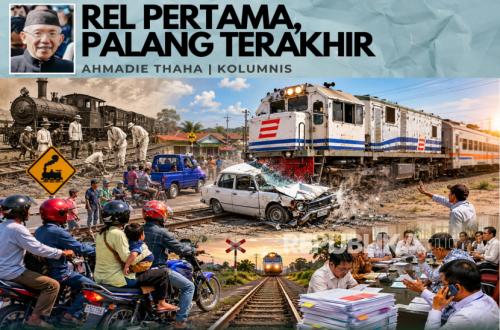
It was high noon. The Semarang sun was at its fiercest, like a project foreman who had missed his morning coffee. On Jalan Cilosari Dalam, Kemijen ward, East Semarang, a white Datsun car stopped right on a railway track without a crossing gate. There was no dramatic siren sound. No barrier lowering slowly like in a Korean film scene. No officer blowing a whistle while running in panic. There was only the bare track, a wide smooth road, and fate playing a game of dice. Then from the east, the Argo Bromo Anggrek train serving the Surabaya-Jakarta route hurtled down the line. Crash! The locomotive struck the car. Luckily it was only a glancing blow, though it was still dragged along like a tin can kicked by a village child after Eid. The car was wrecked. Five passengers survived. Three suffered bruises. The hospital went to work. The media arrived. Cameras switched on. Residents clutched their chests. Then everything returned to normal, as if this nation has an extraordinary talent for forgetting a tragedy before the afternoon coffee is brewed.
Yet this is not a new story. Nor is it even an old story. It is an ancient tale nurtured by modernity. The greatest irony springs from a historical fact: Kemijen is the very cradle of Indonesia’s railways. It was in this village, on 17 June 1864, that the Governor-General of the Dutch East Indies, Baron Sloet van de Beele, broke ground on the first railway line in the archipelago. From this soil, the modern train began to travel on 10 August 1867. Just imagine that. From an era when horse-drawn carts were still premium technology, from when the Dutch still wore top hats while carting sugar and produce, until today when humanity speaks of artificial intelligence, satellites, electric cars, and space tourism, the crossing in Kemijen remains bare, without a barrier gate.
The trains have changed. The locomotives have changed. Ministers have changed. Presidents have changed. Uniforms have changed. Institutional logos have changed. Even the stations now have WiFi and lattes. But the barrier-less track remains loyal, like a monument to bureaucratic indolence. In this country, sometimes what lasts longest is not development, but excuses. Residents have repeatedly requested a crossing gate. Studies have been conducted for years. Analyses pile up like undergraduate theses only read by examiners before being stored away. Moreover, the budget is said to be available. Discussions take place. Meetings are held. PowerPoint presentations are delivered. Safety seminars are held in star-rated hotels while enjoying coffee breaks and chocolate pudding. But on the ground? The track remains open like the mouth of a hungry crocodile.
Then comes the sacred ritual known as “it’s not our authority.” PT KAI says that guarding and barrier gates are the responsibility of the regional government. The regional government perhaps feels it is a central government matter. The central government feels the operator must also take action. Everyone speaks of coordination. Everyone speaks of regulation. Everyone speaks of studies. No one speaks to say: “Install it tomorrow!” Just imagine, since 1867, the work of officials seems to have truly been limited to reporting. Perhaps thousands of pages of studies have been born, printed, bound, initialled, stamped, and then put to peaceful slumber in filing cabinets. If all those reports were lined up, they could probably form a paper flyover from Semarang to Surabaya.
The irony grows more bitter as accident after accident continues to occur. East Bekasi in April 2026 became the next alarm bell. A collision involved a commuter line train, an online taxi, and the Argo Bromo Anggrek. One hundred and six victims fell. Sixteen died. Once again, the public was shocked. Once again, officials spoke of acceleration. Once again, this nation seemed to only just realise that a train cannot stop suddenly like an automatic scooter whose brakes are squeezed by a motorbike taxi driver.